
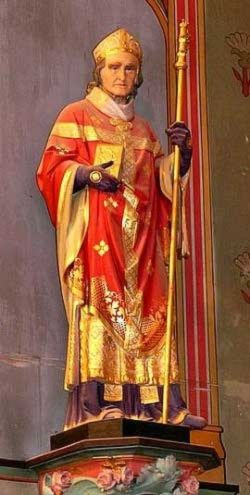
Image Credit: Wikipedia
Saint Germain of Paris: The Father of the Poor Who Held the Keys to a City
Saint Germain of Paris was born around 496 near Autun, France. He became the Father of the Poor, transformed a worldly king into a saintly patron, built the church that would bury French royalty for centuries, excommunicated a wicked king but failed to stop a civil war. Yet for nine centuries, Paris carried his relics through plague-stricken streets. He died on May 28, 576. The Church celebrates him on May 28. He remains one of France’s most revered saints.
Early Piety and the Dream That Changed Everything
Germain was born to noble Gallo-Roman parents near Augustodunum, in what is now Autun, France. This was twenty years after the Western Roman Empire collapsed. Burgundians controlled the region. His parents, Eleutherius and Eusebia, raised him in piety. He studied at Avallon in Burgundy. He also studied at Luzy under his cousin Scapilion, a priest.
No weather could stop his devotion. He walked over a mile to attend Matins at midnight. Rain, snow, and cold meant nothing. This discipline shaped his entire life.
At age thirty-four, around 530, St. Agrippinus of Autun ordained him. He became abbot of the Abbey of St. Symphorian near Autun, worked hard and lived in austerity. His almsgiving was extraordinary. Monks feared he would give away everything. They rebelled against him. He had scarcely been imprisoned when the doors opened by themselves. The bishop recognized his sanctity. He treated Germain with great respect.
One night, a dream changed everything. A venerable old man presented him with the keys of Paris. The man told him that God committed the city’s inhabitants to his care. He must save them from perishing. Four years later, in 554, this prophecy came true.
Bishop of Paris and Reformer of a King
Bishop Eusebius of Paris died in 554. Germain happened to be in the city. King Childebert I, with unanimous clergy and popular support, nominated him. Germain tried to refuse. He wept many tears. The honor overwhelmed him. Nevertheless, he accepted consecration.
His promotion changed nothing in his lifestyle. The same simplicity marked his dress, table, and furniture. His house overflowed with the poor and afflicted. Beggars always sat at his table. He had edifying books read during meals. Souls needed nourishment alongside bodies.
God granted his sermons extraordinary power. All ranks of people felt their influence. The city’s face transformed quickly. Frivolous dances vanished. Profane amusements disappeared. Enmities extinguished. Sinners reconciled with the Church.
King Childebert experienced the deepest change. Until then, he was ambitious and worldly. Germain’s sweetness and powerful discourses converted him entirely. The king reformed his court. He founded religious institutions. He sent incredible sums to the bishop for the poor. When his coffers emptied, he melted his silver plate. He gave away his neck chains, begged Germain never to cease giving and promised never to tire of supplying relief for the distressed.
Miracles, Councils, and the Church in the Meadows
In 542, Childebert besieged Saragossa in Spain. The inhabitants carried St. Vincent’s relics in procession. Their devotion moved the king. He spoke with the city’s bishop. He promised to withdraw if he received some relic. The bishop gave him Vincent’s blood-stained stole. Childebert raised the siege.
Upon returning to Paris, the king built a church to receive this relic. He chose the Celles suburb. He called it St. Vincent’s. In 558, Germain dedicated it on December 23. Childebert died that very day. A monastery rose nearby. This church would become St. Germain-des-Prés. For generations, it served as the burial place of French royalty.
Childebert fell dangerously ill before this, at his Celles palace. Physicians failed completely. Germain spent the entire night in prayer. In the morning, he laid his hands on the king. Childebert found himself perfectly healed instantly. The king’s own letters-patent record this miracle. In gratitude, he gave the lands of Celles to the church of Paris.
Germain attended major councils. The Third Council of Paris in 557 drew him. So did the Fourth Council of Paris in 573. The Second Council of Tours in 566 also counted him among its fathers. He persuaded Childebert to stamp out pagan practices in Gaul. He forbade excess at Christian festivals. By his zeal, the remains of idolatry were extirpated in France.
Excommunication and Fratricidal War
Childebert’s brief successor, Clotaire, reunited the four kingdoms. His death in 561 divided them again among four sons. Charibert became King of Paris. He was vicious, worthless, and immoral, divorced Ingoberga – his wife, married Marcovesa – her maid, who had worn a religious habit. After Marcovesa died, he married her sister Merofleda while Ingoberga still lived.
Germain remonstrated repeatedly. All was lost on him. In 568, the bishop excommunicated Charibert and his accomplice. He wanted to stop the scandalous example. Charibert died in 570. His brothers quarreled violently over his possessions. Germain labored for peace. Success eluded him.
Sigebert and Chilperic went to war. Their wives, Brunehaut and the infamous murderess Fredegund, instigated this conflict. Chilperic was defeated. Paris fell to Sigebert. Germain wrote to Brunehaut. He begged her to prevent further war. His letter survives. Sigebert remained obdurate. Despite Germain’s warning, he set out to attack Chilperic at Tournai. Fredegund had him assassinated at Vitry in 575.
Germain died the following year, on May 28, 576. He was eighty years old. Peace had not yet returned.
Veneration and Enduring Legacy
Germain’s remains were interred in St. Symphorien’s chapel. This was in the vestibule of St. Vincent’s church. In 754, his relics were solemnly moved into the main church. King Pepin the Short assisted. His son Charles, later Charlemagne, was seven years old. The boy attended. Miracles at this translation deeply affected him. As king, he loved relating them.
From that moment, the church became known as St. Germain-des-Prés. For nine centuries, in times of plague and crisis, Paris carried his relics in procession through the streets. The church was plundered and burned by Normans in the ninth century. It was rebuilt in 1014. Pope Alexander III dedicated it in 1163.
A treatise on the ancient Gallican liturgy has been attributed to Germain. Venantius Fortunatus, whom Germain commissioned to write a Vita Sancti Marcelli, also composed a eulogy of his life. Fortunatus described Germain’s shrine as “nothing but a string of miracles.” According to Venantius, Germain performed his first miracle in the womb, preventing his mother from performing an abortion.
He is known as the Father of the Poor. He is a patron of Paris alongside St. Genevieve. The Archdiocese of Rimouski, Quebec, also claims him. The commune Saint-Germain-en-Laye, a Paris suburb, bears his name. So do the former Abbey of Saint-Germain-des-Prés and Saint-Germain de Charonne in Paris proper.
On May 28, the Church remembers this bishop who held the keys to Paris in more than a dream. Catholics seeking to serve the poor find his model. Those who believe one person’s holiness can transform a city discover his proof. And every believer who has ever felt overwhelmed by the needs around them understands why the old man in the dream entrusted Germain with an entire city—because he knew this abbot would never count the cost of giving everything away.



Leave a Reply