
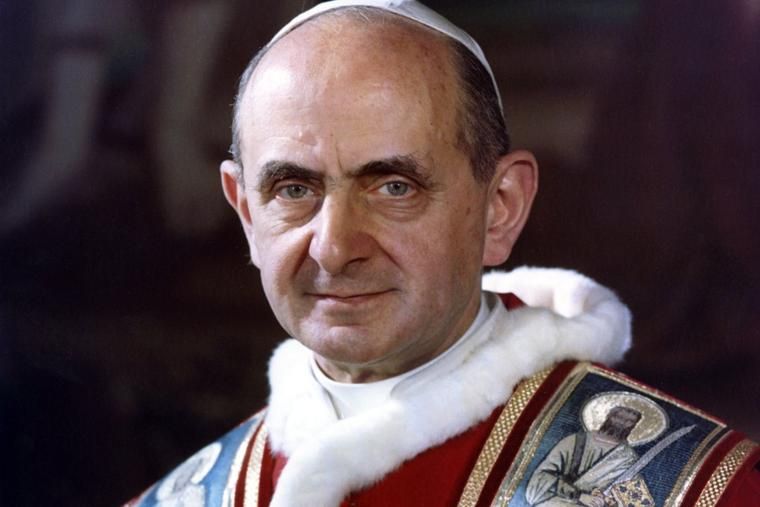
Image Credit – Fotografia Felici / Wikimedia Commons / Public Domain
Pope Saint Paul VI: The Pilgrim Pope Who Defended Life and Guided Vatican II
Pope Saint Paul VI was born Giovanni Battista Montini on September 26, 1897, in Concesio, Italy. He became the pope who closed the Second Vatican Council and traveled to five continents. He became the pope who defended human life against the sexual revolution. His encyclical Humanae Vitae provoked the most violent attacks on papal authority in modern times. Yet both miracles that led to his sainthood involved healing unborn children. Pope Francis canonized him on October 14, 2018. The Church celebrates his feast on May 29.
Early Life and Formation
Giovanni Montini was the second of three boys. His father, Giorgio, was a lawyer, journalist, and director of Catholic Action. He also served in the Italian Parliament. His mother, Giudetta Alghisi, came from rural nobility. The family called him “Battista” as a child. Jesuits educated him. He enjoyed sports and playing cards.
At twelve, doctors diagnosed him with chronic heart flutter. Intestinal difficulties also plagued him. He often missed long periods of school. Private tutoring at the family villa filled the gaps. These health struggles would shadow his entire life.
In 1916, Montini entered the seminary. He was ordained on May 29, 1920, in Brescia and celebrated his first Mass at Santa Maria delle Grazie. He completed a laurea in canon law in 1922. Then he studied at the Gregorian University, the University of Rome La Sapienza, and the Pontifical Academy of Ecclesiastical Nobles.
Career in the Vatican Secretariat
In 1922, at age twenty-five, Montini entered the Secretariat of State. He worked under Giuseppe Pizzardo. His colleagues included Francesco Borgongini-Duca, Alfredo Ottaviani, Carlo Grano, Domenico Tardini, and Francis Spellman. He never served as a parish priest. This was unusual. It shaped his entire approach to church governance.
In 1925, he helped found the publishing house Morcelliana in Brescia. It promoted Christian-inspired culture. During World War II, he organized Vatican efforts to shelter and feed refugees. He kept them hidden. He addressed their mental and spiritual needs.
Archbishop of Milan and Cardinal
In 1954, Pope Pius XII named Montini Archbishop of Milan. This was the largest Italian diocese. In Milan, he built many churches. He organized diocesan-wide catechesis. He sought innovative ways to share the Word of God. To confront Marxist ideology, he supported unions and immigrants. He reached out to other Christians, Jews, Muslims, and those without any faith.
Pope John XXIII elevated him to the College of Cardinals in 1958. He continued as a papal advisor, visited countries worldwide and served on a commission that prepared for Vatican II.
The Papacy and Vatican II
Pope John XXIII died on June 3, 1963. Cardinal Montini was elected his successor on June 21, 1963. He took the name Paul VI, first pope to travel by Aeroplane and the first pope to leave Italy since 1809. People call him the “pilgrim pope.”
Pope Saint Paul VI reconvened the Second Vatican Council, which had been suspended during the interregnum. He closed it in 1965. He then took charge of interpreting and implementing its mandates. This was delicate work. Various Catholic groups had conflicting expectations. The resulting reforms were among the widest and deepest in Church history.
The council issued sixteen documents and four constitutions. It addressed divine revelation, Church and media, ecumenism, priestly formation, the role of the laity, and the permanent diaconate. Paul VI fostered improved ecumenical relations with Eastern Orthodox and Protestant churches. These resulted in many historic meetings and agreements.
In January 1964, he flew to Jordan. This was the first time a reigning pontiff had left Italy in more than a century. He visited Jerusalem, the first pope to do so since St. Peter. He also traveled to Iran, Bangladesh, Uganda, and Colombia. During his 1965 trip to the United States, he celebrated Mass at Yankee Stadium.
Mary, Mother of the Church
Pope Saint Paul VI spoke repeatedly to Marian conventions. He visited Marian shrines. He issued three Marian encyclicals. Following Ambrose of Milan, he named Mary as the Mother of the Church during the Second Vatican Council. This title became official in 1964.
Humanae Vitae and the Storm
In July 1968, Paul VI issued his encyclical Humanae Vitae (“Of Human Life”). It reaffirmed the Church’s opposition to artificial birth control. The reaction was explosive. Many sectors responded with the most violent attacks on papal teaching authority in modern times.
Paul VI did not shy away from the suffering that followed. He acknowledged that difficulty and hardship often accompany the joy of new life. He expressed compassion for married couples. Yet he reminded them that they cannot act as God. To deny this truth is to signal that we are willing to let the responsibility of procreating life fall to arbitrary human decisions.
His firm stand on priestly celibacy, Sacerdotalis caelibatus in June 1967, also evoked harsh criticism. He later likened the large numbers of priests leaving the ministry to a “crown of thorns.” He was disturbed by religious men and women abandoning their vows.
Social Justice and the New Evangelization
From the outset of his papacy, Paul VI gave clear evidence of the importance he attached to social problems. His first encyclical, Ecclesiam suam (“His Church”), appeared in August 1964. His celebrated Populorum progressio (“Progress of the Peoples”) followed in March 1967. This encyclical was such a pointed plea for social justice that some conservative circles accused the pope of Marxism.
In 1975, he coined the term “New Evangelization” in his encyclical Evangelii nuntiandi. He wrote: “Modern man listens more willingly to witnesses than to teachers, and if he does listen to teachers, it is because they are witnesses.” This insight shaped Catholic evangelization for decades.
The Miracles That Made Him a Saint
Pope Benedict XVI proclaimed Paul VI venerable on December 20, 2012. Pope Francis beatified him on October 19, 2014. The first miracle involved an unborn child in California in the 1990s. The baby had suffered ruptured organs. Miscarriage or serious deformity was expected. Abortion was suggested. The mother refused. She prayed for Paul VI’s intercession. The baby was born in good condition at eight months and remains healthy.
The second miracle occurred in 2014. Vanna Pironato was hospitalized during her thirteenth week of pregnancy. The amniochorial membranes had broken prematurely. Amniotic fluid leaked continuously. Doctors suggested abortion. She and her husband refused. On October 29, 2014, ten days after Paul VI’s beatification, they prayed at Santa Maria delle Grazie in Brescia. Amanda Paola Tagliaferri was born on December 25, 2014, at twenty-six weeks. She survived despite having practically no amniotic fluid for three months. She remains in good health.
Both miracles involved unborn children. The postulator noted that Paul VI might be invoked as the protector of rising life. Pope Francis canonized him on October 14, 2018, alongside Oscar Romero.
Final Years and Death
Paul VI’s liturgical feast was originally celebrated on September 26, his birth date. In 2019, it was moved to May 29, the date of his priestly ordination. His death date, August 6, falls on the Feast of the Transfiguration, a major liturgical feast.
He died on August 6, 1978, at Castel Gandolfo. He was eighty years old. His last testament spoke of the Church, the Council, ecumenism, and the world. He blessed everyone, especially Rome, Milan, and Bresciaoffered a special greeting for the Holy Land, where he had gone as a pilgrim of faith and peace.
He is buried among the papal tombs under St. Peter’s Basilica.
Legacy for Today’s Church
Pope Saint Paul VI’s legacy is complex and contested. Liberals criticize his caution. Conservatives criticize his reforms. Yet his courage in issuing Humanae Vitae grows clearer with each passing year. The sexual revolution he resisted has produced broken families, declining birth rates, and widespread loneliness. The unborn children healed through his intercession stand as living witnesses to his prophetic defense of life.
On May 29, the Church remembers this pilgrim pope. Catholics seeking courage to defend unpopular truths find his model. Those who believe the Church must engage the modern world without surrendering to it discover his path. And every believer who has ever felt the world turning against them understands why Paul VI, in his final hours, blessed the very city that had rejected his most important teaching.
Leave a Reply