
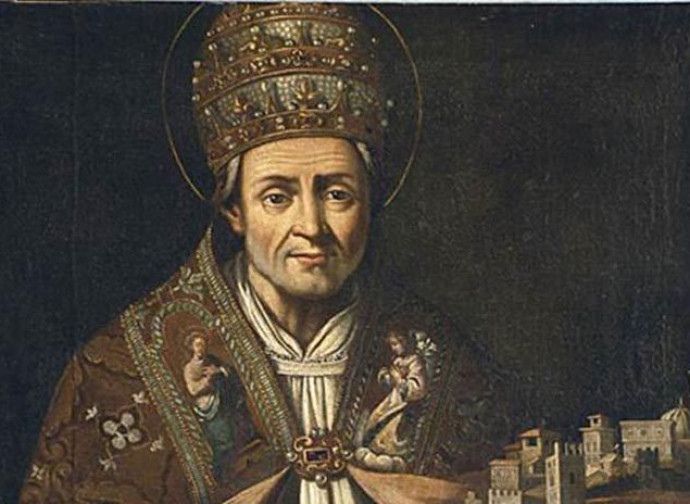
Image Credit: New Daily Compass
Pope St. Celestine V: The Hermit Who Became Pope—and Chose to Walk Away
Pope St. Celestine V stands alone in papal history. He was the first pope to formalize resignation – an octogenarian hermit who never wanted the Throne. He held the office for just five months. Then he gave it up. His successor threw him in prison. He died there. Dante may have placed him in Hell’s antechamber. Yet the Church canonized him. His feast day is May 19. His story raises eternal questions about power, humility, and the cost of holiness in a political world.
A Mother’s Prophecy in Rural Molise
Pietro Angelerio entered the world around 1215 in the rural region of Molise. His birthplace was likely Sant’Angelo Limosano, now part of the province of Campobasso. His father, Angelo Angelerio, died when Pietro was only five or six. This left Maria Leone to raise twelve children alone. Seven sons survived infancy. Pietro was the second-youngest.
Maria had a dream. She sold family property to hire a tutor for Pietro. His brothers resented this. They wanted the land. But Maria imagined a different future for her boy. She did not want him to become merely a farmer or shepherd. Pietro took to his studies quickly. He learned to read the psalter. His mother’s investment would shape Church history.
One day Maria asked her children which one would become a saint. Little Pietro answered with all his heart: “Me, mama! I’ll become a saint!” He kept that promise. It would cost him everything.
The Hermit of Morrone
At seventeen, Pietro entered the Benedictine Abbey of Santa Maria di Faifoli in the Diocese of Benevento. His disposition toward asceticism was extraordinary. In the early 1230s, he retreated to a solitary cavern on the Montagne del Morrone. This gave him his lifelong sobriquet: “da Morrone.” He lived as a strict ascetic. He modeled himself on John the Baptist.
Other hermits came to him. They begged for guidance. Pietro could not refuse them. In 1244, he founded a new religious order. He issued a formal rule in 1254. It was fundamentally Benedictine. Yet it added severities and privations beyond the norm. The order had ties to radical Franciscans. These friars were dismayed by the Church’s worldliness and political entanglements.
Pope Urban IV approved the new institution in June 1263. Gregory X took it under papal protection at Lyon in 1274. Pietro became superior-general to thirty-six monasteries and more than six hundred monks. In 1293, the order moved its headquarters to the Abbey of the Holy Spirit near Sulmona. Pietro took up residence in a cliffside hermitage overlooking the monastery. He thought he would remain undisturbed. He was wrong.
The Conclave That Could Not Decide
Pope Nicholas IV died in April 1292. The cardinals assembled at Perugia. They could not agree on a successor. Months dragged into years. The papal throne sat empty for over two years. This was the last non-conclave papal election in Catholic history.
Pietro sent the cardinals a letter. He warned them that divine vengeance would fall upon them if they did not elect a pope quickly. Latino Malabranca, the aged and ill Dean of the College of Cardinals, heard this message. He cried out in desperation: “In the name of the Father, the Son, and the Holy Spirit, I elect brother Pietro di Morrone!”
The cardinals ratified the choice immediately. They sent for Pietro. He obstinately refused. According to Petrarch, he even tried to flee. A deputation of cardinals, accompanied by the King of Naples and a Hungarian pretender, finally persuaded him. He was elected on July 5, 1294, crowned at Santa Maria di Collemaggio in Aquila on August 29, took the name Celestine V and he was about eighty-four years old.
Five Months of Chaos
Celestine V had no political experience. He proved weak and ineffectual. He held his office in the Kingdom of Naples. This kept him far from the Roman Curia. It placed him under the complete power of King Charles II. He appointed the king’s favorites to Church offices. Sometimes he gave several men the same office. He ordered Louis of Toulouse to receive clerical tonsure and minor orders. This was never carried out.
He did accomplish one significant act. He renewed Pope Gregory X’s stringent rules for papal conclaves. This decree responded to the prolonged election that had brought him to power. He also issued a rare plenary indulgence. All pilgrims visiting Santa Maria di Collemaggio through its holy door on his coronation anniversary would receive it. The Celestinian forgiveness festival continues in L’Aquila every August 28-29 to this day.
Yet matters soon fell into great confusion. Everyone took advantage of the humble old man. He could not say no. He appointed three cardinals to govern the Church during Advent while he fasted. They refused. He realized his personal incompatibility with papal duties. He consulted with Cardinal Benedetto Caetani about resignation. This conversation would change both men’s lives.
The Great Refusal
Celestine issued one final decree. It declared the right of the pope to abdicate. He promptly exercised this right. On December 13, 1294, after five months and eight days, he resigned. His formal instrument cited multiple reasons. He desired humility, wanted a purer life, sought a stainless conscience, admitted his physical weakness, his ignorance, and the perverseness of the people and longed for the tranquility of his former life.
He divested himself of every symbol of papal dignity, slipped away from Naples, returned to solitude but did not succeed.
Pope Saint Celestine V Imprisonment and Death
The new Pope Boniface VIII had reason to worry. Various parties had opposed Celestine’s resignation. Boniface feared someone might install the former pope as antipope. He ordered Pietro to accompany him to Rome. Pietro escaped. He hid in the woods. He tried to return to Sulmona. This proved impossible. He attempted to flee to Dalmatia by ship. A tempest forced the vessel back to port.
Boniface captured him. He imprisoned Pietro in the castle of Fumone near Ferentino in Lazio. Two monks of his order attended him. Pietro died there after ten months. The date was May 19, 1296. He was about eighty-one years old.
His supporters spread allegations. They claimed Boniface had treated him harshly. Some said Boniface executed him. There is no clear historical evidence for this. Dan Brown’s novel Angels & Demons controversially referenced Celestine as a murdered pope. It claimed an X-ray revealed a ten-inch nail in his skull. This X-ray is fictitious. A 2013 examination of a half-inch hole in his skull found it occurred post-mortem, likely during reburial.
Pietro was initially buried at Ferentino. His body was later moved to the Basilica of Santa Maria di Collemaggio in L’Aquila.
Canonization and Controversial Legacy
Philip IV of France had supported Celestine. He bitterly opposed Boniface. After Pope Clement V’s election, Philip nominated Celestine for sainthood. Clement signed a dispensation on May 13, 1306, to investigate the nomination. Celestine was canonized on May 5, 1313. In a notable consistory, Boniface’s Caetani family was outvoted by members of the rival Colonna family.
No subsequent pope has taken the name Celestine. This is rare for a canonized pontiff.
Dante Alighieri may have placed him in the antechamber of Hell. In Inferno III, 59-60, Dante sees “the shade of him who due to cowardice made the great refusal.” Early commentators, including Dante’s son Jacopo, identified this figure as Celestine V. Petrarch vigorously defended him against the charge of cowardice. Modern scholars debate the identification. Some suggest Dante meant Esau, Diocletian, or Pontius Pilate instead.
Pope Paul VI visited Ferentino in 1966. He paid homage at Celestine’s place of death. His speech prompted speculation that he was considering retirement. This proved prescient. Pope Benedict XVI later cited Celestine as an example when he resigned in 2013—719 years after Celestine’s own departure.
Celestine’s remains survived the 2009 L’Aquila earthquake. An Italian spokesman called it “another great miracle by the pope.” Pope Benedict XVI visited the damaged basilica on April 28, 2009. He left the woolen pallium from his 2005 papal inauguration on Celestine’s glass casket as a gift. To mark the 800th anniversary of Celestine’s birth, Benedict proclaimed the Celestine year from August 28, 2009, through August 29, 2010.
What Pope Saint Celestine V Teaches Us
Pope St. Celestine V embodies the tension between spiritual aspiration and institutional power. He wanted only to pray in a cave. The Church made him pope. He tried to serve, failed by worldly standards, left before he could do more harm and he paid with his freedom and his life.
His story asks hard questions. Is holiness compatible with political power? Can a saint govern? When does humility become abdication of responsibility? Dante may have judged him harshly. The Church canonized him. History remembers him as the pope who quit—and in doing so, opened a door that Benedict XVI would walk through seven centuries later.
On May 19, the Church remembers this reluctant pontiff. Catholics seeking to escape the world’s noise find in him a patron. Those wrestling with power and integrity discover a warning. And every believer who has ever wanted to return to simplicity understands exactly why he said: “You wanted a cell, Peter, and a cell you have.”
Leave a Reply