
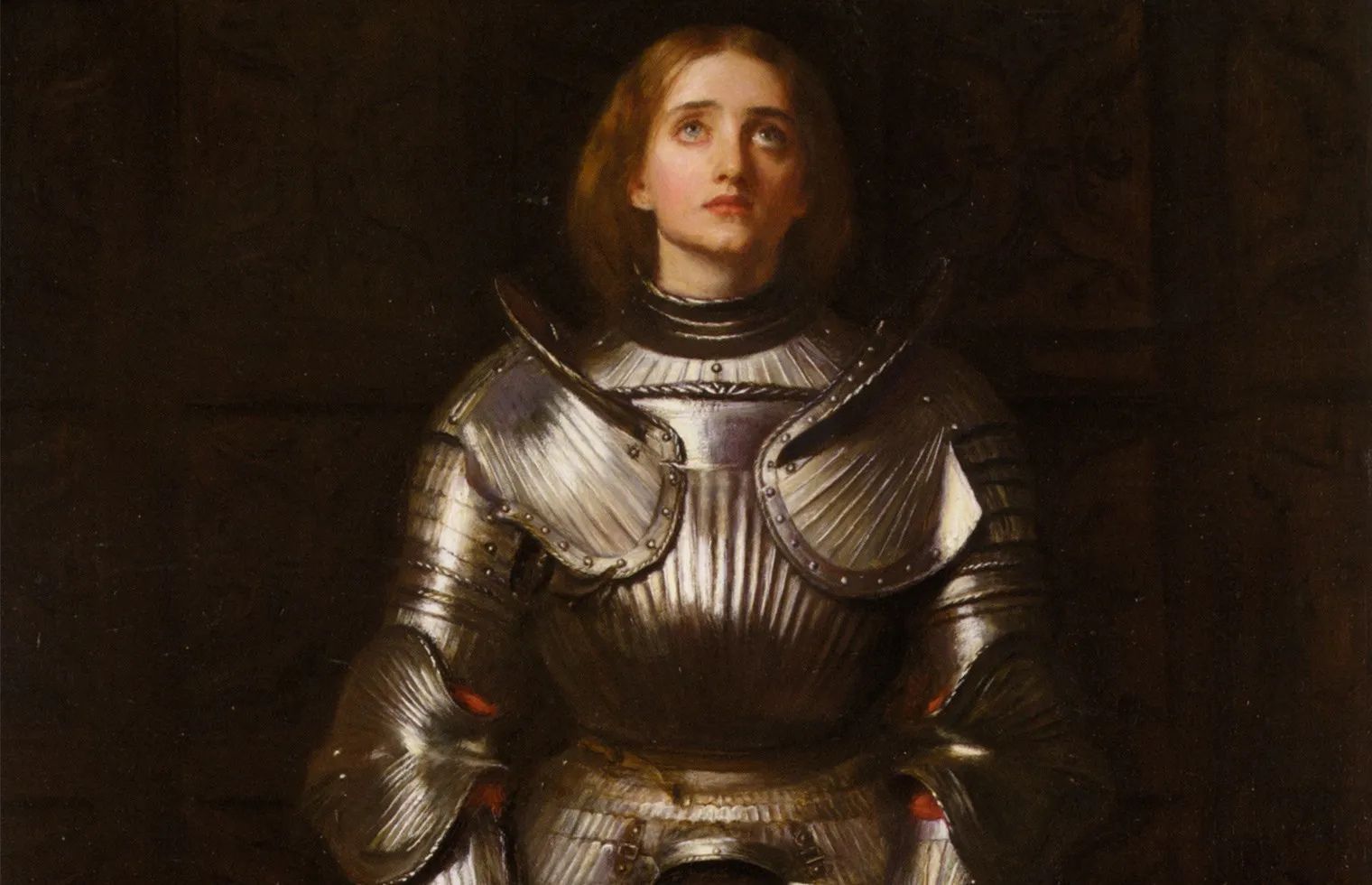
Image Credit: Aleteia
St. Joan of Arc: The Maid of Orléans and Patron Saint of France
Joan of Arc stands among the most remarkable figures in medieval history. Born around 1412 in Domrémy, a modest village in northeastern France, she emerged from peasant origins to reshape the destiny of an entire nation. Her parents, Jacques d’Arc and Isabelle Romée, raised her in a devout Catholic household where she learned prayer and service from her earliest years.
The young girl spent her childhood performing domestic duties, spinning wool, and assisting with farm labor. Yet beneath this ordinary existence, something extraordinary was unfolding. Around 1425, when Joan was merely thirteen years old, she experienced her first divine vision in her father’s garden. The archangel Michael appeared before her, surrounded by celestial beings, delivering a message that would alter French history forever.
Divine Calling and the Voices of Heaven
Joan’s spiritual experiences intensified rapidly. Soon, she began hearing the voices of three distinct saints: Michael, Margaret of Antioch, and Catherine of Alexandria. These heavenly messengers delivered increasingly specific instructions. Initially, their guidance remained personal and general. However, as Joan matured, the messages grew urgent and political.
The saints commanded her to accomplish two monumental tasks. First, she must drive English forces from French territory. Second, she needed to escort the Dauphin Charles to Reims for his coronation as rightful king. These instructions arrived during France’s darkest hour. The Hundred Years’ War had ravaged the countryside for generations, and English dominance seemed inevitable.
At sixteen, Joan approached her relative Durand Lassois with an audacious request. She needed transportation to Vaucouleurs, where she would petition Robert de Baudricourt, the local garrison commander, for an armed escort to the royal court. Baudricourt initially dismissed her with sarcasm. Nevertheless, Joan persisted. She returned the following January, accompanied by two of Baudricourt’s own soldiers who had become convinced of her sincerity.
Jean de Metz, one of these supporters, later recalled Joan’s determination. She confided that she preferred spinning wool beside her mother, yet divine will demanded her presence at the king’s side. Without her intervention, she insisted, France would find no salvation.
The Journey to Victory
Joan’s credibility received unexpected validation when she accurately predicted a military reversal at the Battle of Rouvray near Orléans. Given the distance involved, Baudricourt recognized this knowledge could only come through divine revelation. Consequently, he arranged her escort to Chinon.
For protection through hostile Burgundian territory, Joan traveled disguised as a male soldier. This practical precaution, suggested by her escorts themselves, would later become controversial. However, at the time, everyone recognized its necessity for a young woman crossing enemy lands.
Upon reaching the royal court, Joan met privately with Charles VII. Their conversation convinced the uncertain Dauphin of her authenticity. His mother-in-law, Yolande of Aragon, subsequently organized a relief expedition to besieged Orléans. Joan requested permission to accompany this army in armor, and the government agreed, providing equipment while she relied on donations for supplies.
Arriving at Orléans on April 29, 1429, Joan transformed the Anglo-French conflict into a spiritual crusade. She carried her banner rather than weapons, stating she preferred it “forty times” better than any sword. Although command officially remained with noblemen, several acknowledged that her divinely inspired advice shaped their tactical decisions.
The siege lifted dramatically. On May 4, French forces captured the fortress of Saint Loup. The following day, they advanced to Saint-Jean-le-Blanc, finding it deserted. When English troops attempted to block their progress, a cavalry charge sent them fleeing without serious combat. The assault on Les Tourelles on May 7 proved more brutal. Joan took an arrow between her neck and shoulder while holding her banner, yet returned to encourage the final push. By May 8, the English retreated, ending the siege.
From Coronation to Capture
Following Orléans, Joan persuaded Charles to advance toward Reims for his coronation. The Loire Campaign secured crucial bridge towns, culminating in the decisive victory at Patay. Reims opened its gates on July 16, 1429, and Charles received consecration the next morning with Joan standing proudly nearby.
However, fortune turned. The failed siege of Paris in September 1429, where Joan suffered a leg wound, diminished court confidence in her. A subsequent unsuccessful siege at La-Charité-sur-Loire further eroded her standing. When a truce with Burgundy collapsed, Joan traveled to Compiègne’s defense without explicit royal permission.
On May 23, 1430, Burgundian forces captured her during a sortie. Despite multiple escape attempts, including a desperate leap from a seventy-foot tower into a dry moat, she remained imprisoned. The English eventually purchased her for ten thousand gold coins, transferring her to Rouen for trial.
The Unjust Trial and Martyrdom
Bishop Pierre Cauchon presided over a proceeding riddled with procedural violations. Pro-English clergy dominated the tribunal rather than impartial churchmen. Joan of Arc was denied legal counsel and held in a secular prison with male guards, contrary to Inquisitorial guidelines.
Throughout interrogation, she demonstrated remarkable theological acumen. When asked whether she knew she stood in God’s grace—a trap question since certainty was considered impossible—she responded masterfully: “If I am not, may God put me there; and if I am, may God so keep me.” Court notaries reported the interrogators were stunned.
Cross-dressing charges featured prominently in her condemnation. Joan explained that male clothing protected her from rape attempts in prison. Indeed, witnesses confirmed guards had stolen her dress, leaving her no alternative. Despite this context, she was condemned as a relapsed heretic.
On May 30, 1431, authorities executed Joan by burning at Rouen’s Vieux-Marché. She requested crucifixes from attending priests and an English soldier. After death, her executioners burned her remains twice more, then scattered ashes in the Seine to prevent relic collection.
Rehabilitation and Canonization
Twenty-five years later, Pope Callixtus III authorized a posthumous retrial. The appellate court declared Joan innocent on July 7, 1456, finding her original trial tainted by deceit and procedural errors. Formal rehabilitation followed, though her visions weren’t officially authenticated until 1894 when Pope Leo XIII pronounced her mission divinely inspired.
Bishop Félix Dupanloup of Orléans championed her cause throughout the nineteenth century. Pope Pius X beatified her in 1909, and Pope Benedict XV canonized her on May 16, 1920. Her feast day, May 30, commemorates her martyrdom. Pope Pius XI subsequently declared her one of France’s patron saints in 1922.
Enduring Legacy of the Maid of Orléans
Joan of Arc transcends her historical moment. She represents divine possibility manifesting through ordinary individuals. Her story inspired Shakespeare, Voltaire, Mark Twain, and countless artists across centuries. During World War II, competing French factions simultaneously claimed her legacy—Vichy authorities, Free French under Charles de Gaulle, and Communist resistance all found meaning in her example.
Today, Joan of Arc embodies multiple identities: obedient Catholic daughter, military strategist, national symbol, feminist icon, and virgin saint. Her short hair and armor challenged gender expectations while her voices challenged political ones. Whether viewed through religious, historical, or cultural lenses, Joan remains perpetually relevant.
The annual Orléans festival celebrating her victory continues after six centuries. Her image adorns churches, monuments, and national memory. For believers, she demonstrates that divine grace operates beyond social boundaries. For historians, she illustrates how individual conviction can reshape geopolitical realities. For everyone, she proves that courage, faith, and determination can emerge from the most unexpected places.

Leave a Reply