
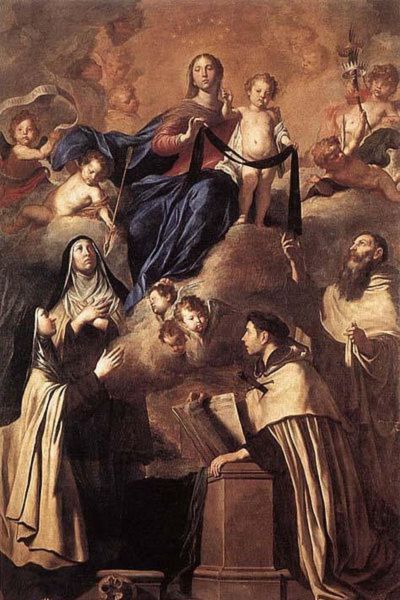
Image Credit: Christian Iconography
St. Simon Stock: The English Hermit Who Received the Brown Scapular from Our Lady of Mount Carmel
St. Simon Stock stands as one of Catholicism’s most captivating saints. This 13th-century English priest left a legacy forever linked to the Brown Scapular of Our Lady of Mount Carmel. The Church cherishes this devotional tradition above many others. Historical records reveal little about his early years. Yet the traditions surrounding his life inspire millions of Catholics worldwide. The famous apparition attributed to him continues to shape Catholic devotion centuries later.
From Hermit to Carmelite Leader
Born in England during the early 1200s, Simon Stock entered religious life as a young man. According to longstanding tradition, he earned the surname “Stock”—meaning “tree trunk.” He lived as a hermit beginning at age twelve. He dwelt inside the hollow trunk of an oak tree. Modern scholars have questioned this particular detail. Yet the image of the young Simon seeking solitude and communion with God has endured across centuries.
More historical certainty surrounds Simon’s pilgrimage to the Holy Land. There he encountered the Brothers of the Blessed Virgin Mary of Mount Carmel. Muslim forces reclaimed Palestine in the early 13th century. They toppled the Crusader Kingdoms. These events forced the Carmelites to flee to Europe. The order had begun as a hermit community on Mount Carmel, but this upheaval uprooted them from their Palestinian homeland.. Simon joined their ranks and eventually returned to his native continent, where he would play a pivotal role in transforming the order.
Under Simon’s leadership, the Carmelites evolved from a hermit community into an order of mendicant friars—walking preachers who lived on alms and served the spiritual needs of growing university towns. He founded numerous Carmelite communities across Europe’s intellectual centers, including Cambridge, Oxford, Paris, and Bologna. In 1254, he was elected Superior-General of the Carmelite Order at a chapter meeting in London, a testament to his administrative skill and spiritual authority.
The Vision of the Brown Scapular
St. Simon Stock’s most enduring claim to fame stems from a reported apparition in Cambridge, England, on July 16, 1251. According to tradition, the Virgin Mary appeared to him at a critical moment. The Carmelite Order faced significant opposition and oppression at that time. She held the brown scapular in her hand. She spoke words that Catholics have cherished for nearly eight centuries:
“Receive, my beloved son, this scapular of thy Order; it is the special sign of my favor, which I have obtained for thee and for thy children of Mount Carmel. He who dies clothed with this habit shall be preserved from eternal fire. It is the badge of salvation, a shield in time of danger, and a pledge of special peace and protection.”
The scapular itself derives from the Latin scapula, meaning “shoulder blade.” It traditionally consists of two pieces of cloth joined by straps over the shoulders. Religious orders wear larger scapulars as outer garments. Lay Catholics typically wear smaller versions beneath their clothing. These consist of two small squares of woolen cloth connected by cords.
Historical Questions and Enduring Faith
Modern scholarly investigation has raised important questions about the historicity of the scapular vision. The earliest surviving accounts of Simon’s life make no mention of such an apparition. The first known reference to the vision dates from the late 14th century—more than a hundred years after the traditional date of July 16, 1251. Furthermore, the great Carmelite authors of the 14th century do not mention the scapular at all in their writings.
Challenges to the vision’s historicity are not new. In 1653, Jean de Launoy, a scholar at the University of Paris, published a notable critique. In response, a Carmelite named John Cheron produced what he claimed was a letter from Simon Stock’s secretary, Peter Swanington, detailing the scapular vision. Historians have since determined this document to be a fabrication.
Despite these scholarly reservations, devotion to the Brown Scapular has flourished. The Catholic Church has approved eighteen different kinds of scapulars. The woolen brown scapular of Mount Carmel remains the most widely recognized. Beginning in the 16th century, the Carmelites began distributing the Brown Scapular to laypeople. These faithful sought deeper affiliation with the order. It quickly became one of the most popular religious articles in Catholic devotional life.
Legacy and Veneration
The earliest extant liturgical office in Simon Stock’s honor was composed in Bordeaux, France, in 1435. Liturgical celebrations in Ireland and England followed in 1458, and the entire Carmelite Order adopted his feast by 1564. Today, Catholics commemorate St. Simon Stock with an optional memorial on May 16. He serves as the patron saint of the English province of Discalced Carmelites.
Simon is believed to have spent his later years at Aylesford in Kent, where the Carmelite Order held its first general chapter outside the Holy Land in 1247. The priory there still preserves his cranium as a revered relic.
Pope John Paul II addressed the Carmelite family in 2001. He marked the 750th anniversary of the scapular’s traditional bestowal, called the devotion “a treasure for the whole Church.” He noted that the People of God had embraced the practice deeply. Their devotion spread so widely that the Church expressed it in the July 16 memorial. This feast honors Our Lady of Mount Carmel. The pope himself wore the scapular throughout his life. He even refused to let anyone remove it after the 1981 assassination attempt against him.
For contemporary Catholics, St. Simon Stock represents the bridge between the Carmelite hermit tradition and the order’s mendicant mission. You can approach the scapular devotion as historical fact or cherished spiritual tradition. Either way, its power to deepen your relationship with Mary remains undiminished. The Carmelites themselves continue to find profound meaning in the story. They use it to nurture devotion and trust in the Mother of God.









Leave a Reply