
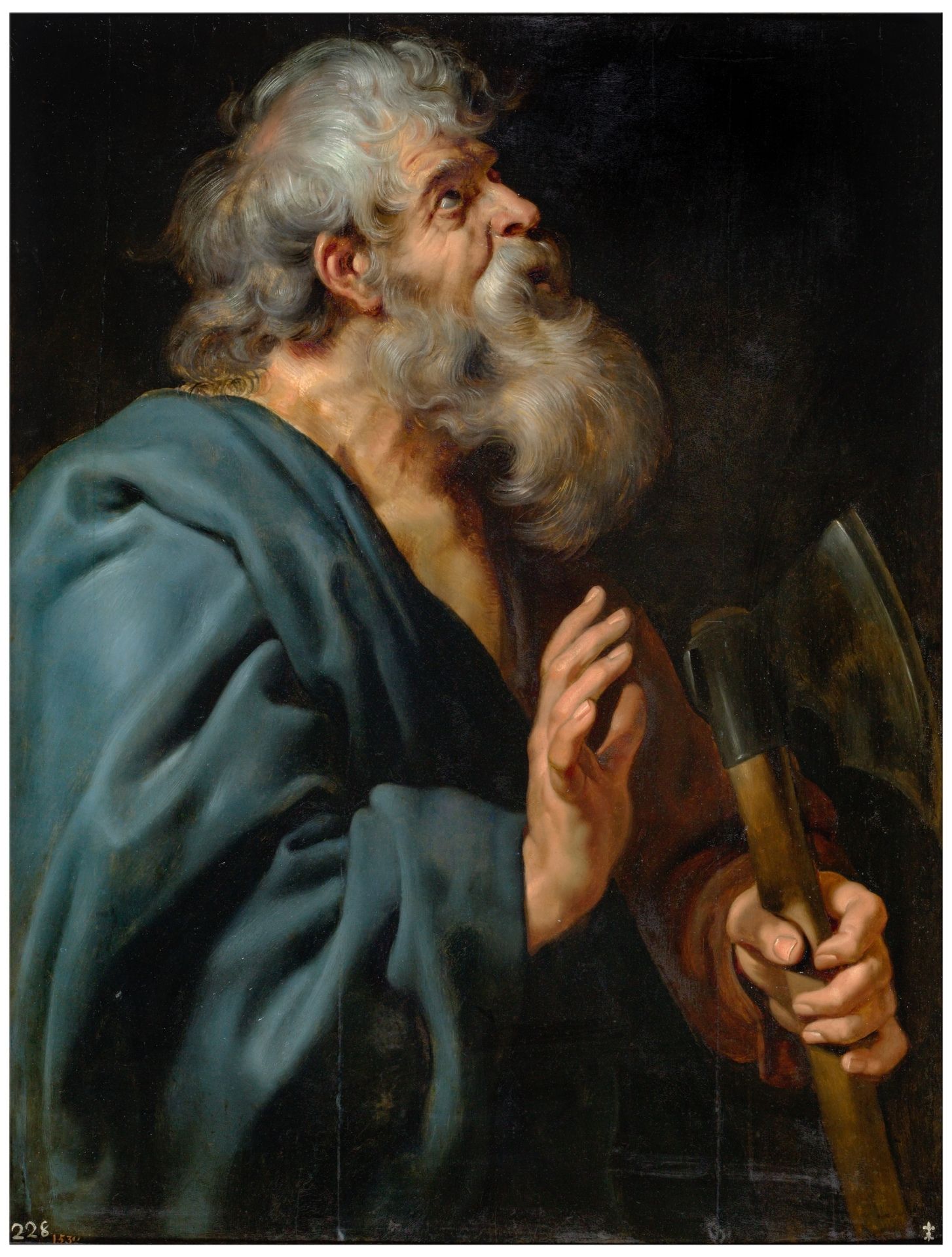
Image Credit – Wikipedia
Saint Matthias the Apostle: Chosen to Replace Judas Iscariot to Complete the Twelve Apostles
Feast Day – May 14
Patron Saint of Alcoholics, Tailors, Carpenters, hope against despair, perseverance in faith
The Problem of the Empty Throne
The first crisis facing the Church was not persecution, poverty, or doctrinal dispute. It was a number. Eleven apostles gathered in the upper room after the Ascension, and eleven was not enough.
Twelve mattered. For the people of Israel, twelve was the number of the tribes, the fullness of the covenant, the completeness of God’s chosen family. If the disciples were to become the new Israel, they could not remain eleven. The vacancy left by Judas Iscariot was not merely a personnel gap. It was a theological wound. The college of apostles had to be restored before the Church could move forward.
But here was the difficulty. Jesus himself had chosen the original twelve. He had walked the shores of Galilee, called each by name, shaped them through three years of intimate companionship. Now he was gone. How could mere men know whom the Lord would have chosen?
The Criterion: Witness to the Whole Mystery
One hundred and twenty disciples gathered in the upper room for prayer. Peter stood and proposed a criterion both simple and demanding. The new apostle must be someone who had followed Jesus from the very beginning, from his baptism by John in the Jordan until the day he ascended into heaven.
This was not nostalgia for the early days. It was the necessary qualification for a specific mission. The new apostle would have to bear witness to the Resurrection. To do this credibly, he must have known Jesus when no one knew him, stayed when others left, believed when the teachings grew hard. He must have heard the Sermon on the Mount, seen the feeding of the five thousand, wept at the foot of the Cross, been there when Jesus spoke of eating his flesh and drinking his blood, teachings that thinned the crowds and sent many disciples walking away. He must have remained.
Two men met this standard. Matthias. And Joseph called Barsabbas, also known as Justus. Both had walked the entire journey. Both had been faithful when faith cost something. The community knew their faces, their voices, their perseverance. But which one possessed the interior disposition to become a witness to the Resurrection? Only the Lord could read that secret.
The Choice by Lot
The apostles did not vote. They did not campaign or debate merits. They prayed and cast lots, surrendering the decision to divine providence. This was not superstition. It was acknowledgment that the Church belongs to Christ, not to human preference. The lot fell to Matthias. He became the twelfth apostle, and the apostolic college was whole again as they waited for the Holy Spirit.
Scripture records nothing more of Saint Matthias the Apostle. His name appears once in the Acts of the Apostles, at the beginning of the Church’s story, and then disappears from the biblical narrative. This silence is itself instructive. Most of the apostles vanish from the pages of the New Testament after Pentecost. Their work was not performed for the record. It was performed for the kingdom.
The Apostolic Vocation: What Matthias Embraced
Later traditions and apocryphal texts, including the Acts of Andrew and Matthias, testify to what his apostleship entailed. Matthias carried the Gospel to regions beyond Judea, likely to Ethiopia or Colchis near the Black Sea, according to varying ancient accounts. Matthias faced the resistance, ridicule, and violence that accompanied apostolic preaching in the pagan world. He persevered through imprisonment and torture. He died by martyrdom, traditionally by beheading or, in some accounts, stoning.
Clement of Alexandria, writing in the second century, offers a profound reflection on Matthias’s election. The apostle was not chosen for what he already was, but for what Jesus foresaw he would become. His worthiness was not the ground of his selection. His selection was the seed of his transformation. This is the pattern of every Christian calling. God does not wait for readiness. He commands obedience, and readiness follows.
The Halberd and the Crown
In traditional iconography, Matthias appears holding a halberd, the weapon of his execution. This image shocks modern sensibilities. We prefer our saints gentle, approachable, untroubled by blood. But the halberd is honest. It declares that Matthias understood what apostleship meant from the beginning. He did not accept the office hoping for ease. He accepted it knowing the cost, embracing the whole vocation: evangelization, persecution, and death in the service of the Lord.
The crown of martyrdom that surmounts his image in Eastern and Western iconography is not a decoration. It is a verdict. It says that Matthias finished what he began, that the lot which fell to him in the upper room was honored through faithful endurance to the end.
Matthias and the Modern Christian
The story of Matthias speaks directly to contemporary experience. Many believers feel like latecomers, afterthoughts, additions to a community already formed and flourishing. Matthias was precisely this. He was not among the first chosen, not in the inner circle of Peter, James, and John. He watched from the edges of the Galilean ministry, faithful but unremarked, until the moment his hidden perseverance became visible and necessary.
His election also challenges communities that resist newcomers. The eleven could have remained eleven. They could have guarded their intimacy, preserved their history, excluded the one who had not shared every moment. Instead, they recognized that the community was incomplete without him. They made room, surrendered their preference to God’s providence and discovered that the newcomer was not an intruder but a completion.
The Question Jesus Poses
Clement of Alexandria’s question remains alive across the centuries. What does Jesus want you to become? This is the question Saint Matthias the Apostle lived. It is the question every disciple faces. The answer is not found in present capacity but in future possibility. Jesus does not choose the worthy. He makes worthy those he chooses.
Matthias began as an anonymous disciple and ended as an apostle whose name is proclaimed in the Church’s liturgy every May 14. His transformation was not his own achievement. It was the fruit of grace working through human availability. He remained when others left, accepted the lot that fell to him, carried the Gospel to the ends of his strength and his geography and died faithful.
A Witness to the Resurrection
The essential qualification for apostleship was witness to the Resurrection. Saint Matthias the Apostle possessed this not because he saw the empty tomb or encountered Jesus on the Emmaus road. He possessed it because he had been formed by the whole mystery of Christ: the hidden years, the public ministry, the scandal of the Cross, the silence of Holy Saturday, the triumph of Easter morning. He could speak of the Resurrection because he could speak of everything that preceded and surrounded it.
This is the vocation of every Christian. Not all are called to apostleship in the technical sense. But all are called to witness. All are chosen for what they will become rather than what they presently are. All are invited to remain faithful when faith costs something, to accept the lot that falls to them, and to discover that their perseverance, however hidden, is known to God and necessary for the community.
Prayer to Saint Matthias
Saint Matthias, apostle by divine election and faithful witness to the Resurrection, you who began as an unknown disciple and finished as a martyr crowned with glory, pray for us who feel like latecomers and afterthoughts. Teach us that our hidden fidelity is seen by God. Obtain for us the grace to accept our calling without demanding worthiness, to persevere without requiring recognition, and to become what Jesus foresees in us. Through Christ our Lord, who lives and reigns with the Father and the Holy Spirit, one God, forever and ever. Amen.
In His Footsteps
Have you felt like an afterthought, a latecomer, someone added to a community already complete? Consider that the Church is not whole without you. The lot that fell to Matthias fell by divine providence, not accident. The place you occupy, however unexpected, is chosen by God. Welcome the newcomers to your parish, your workplace, your family this week as necessary members of a body that remains incomplete without them.

Leave a Reply