
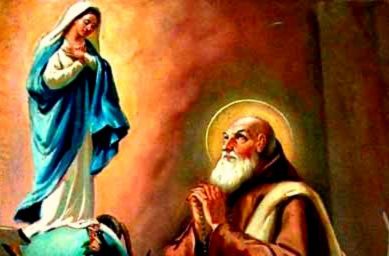
Image Credit: Catholic Fire
Saint Ignatius of Laconi: The Humble Franciscan Wonderworker
Saint Ignatius of Laconi is remembered as one of the most humble and beloved Franciscan saints in Italy. Known for his simplicity, obedience, compassion for the poor, and extraordinary miracles, he spent his life serving ordinary people through quiet acts of charity and deep faith. Though he never became a priest or held an important office in his religious order, his holiness touched thousands and earned him a reputation as a wonderworker during his lifetime.
Saint Ignatius of Laconi was born Vincenzo Peis on December 17, 1701, in the small village of Laconi on the island of Sardinia, Italy. He came from a poor farming family and was the second of seven children born to Mattia Peis and Anna Maria Sanna. His birth followed a difficult pregnancy during which his mother prayed for the intercession of Saint Francis of Assisi. In gratitude, the child received the names Francesco Ignazio Vincenzo at baptism.
From an early age, Vincenzo showed signs of strong religious devotion. He loved visiting the local church and often referred to it as his “home.” As a young boy, he admired the example of Saint Lawrence of Brindisi and dreamed of dedicating his life to God. However, because his family depended on farming for survival, he spent much of his youth working in the fields to help support his parents.
When Vincenzo was about seventeen years old, he became seriously ill. Believing he might die, he made a promise to God that if he recovered, he would join the Capuchin Franciscans and dedicate his life to religious service. Miraculously, he regained his health. Yet after recovering, his father persuaded him to delay fulfilling the vow because the family still needed his help on the farm.
A few years later, another frightening incident changed his life permanently. While riding a horse, the animal suddenly panicked and nearly threw him to his death. In that terrifying moment, Vincenzo called upon God and renewed the promise he had made during his illness. The horse unexpectedly calmed down, and he escaped unharmed. Convinced that God had spared his life for a purpose, he decided not to postpone his vocation any longer.
In 1721, Vincenzo applied to join the Capuchin Franciscans in Cagliari. His superiors initially hesitated because of his delicate health, but after the intervention of an influential friend, he was accepted into the novitiate. Upon entering religious life, he took the name Ignatius. One year later, he made his religious profession as a Capuchin friar.
Brother Ignatius never became a priest, but he embraced his role as a humble religious brother with extraordinary dedication. For the first fifteen years of his religious life, he worked in the convent’s weaving shed. He carried out even the simplest duties with discipline, humility, and obedience to his superiors.
Later, he was assigned the task that would define much of his ministry. For more than forty years, Brother Ignatius served as the friary’s quester, traveling from house to house collecting food and donations for the Capuchin community. Though this work involved long journeys, difficult weather, and occasional rejection, he accepted it joyfully as a form of service to God and neighbor.
The people of Cagliari soon realized that Brother Ignatius offered more than requests for alms. Wherever he went, he brought peace, encouragement, and spiritual comfort. He visited the sick, encouraged sinners to repent, reconciled enemies, advised troubled families, and comforted the lonely. His gentle presence and quiet words deeply affected those he encountered.
Although he spoke very little, when he did speak, people listened carefully because his words carried wisdom and compassion. Many residents began eagerly waiting for his visits because they believed they received spiritual blessings through him. His humble way of life itself became a silent sermon to the people.
Brother Ignatius also became known for extraordinary miracles and supernatural gifts. Reports of healings, prophecies, and miraculous events spread throughout Sardinia. According to accounts gathered during his canonization process, over one hundred miracles were attributed to him during his lifetime alone.
One of the most famous stories connected to Saint Ignatius involved a wealthy moneylender known for exploiting poor people through unfair debts and excessive interest. Brother Ignatius avoided visiting the man’s house because he believed accepting donations obtained through injustice would make him share in the man’s sins.
Feeling insulted, the moneylender complained to the superior of the friary. Unaware of the situation, the superior ordered Brother Ignatius to accept alms from the man. In perfect obedience, Ignatius obeyed without protest and returned carrying a sack filled with food. However, when the sack was opened at the convent, blood reportedly began dripping from it. Calmly, Brother Ignatius explained, “This is the blood of the poor.” The event deeply moved those present and became one of the most remembered miracles associated with him.
Despite poor health throughout his life, Brother Ignatius continued serving tirelessly. Even after becoming blind in 1779, he still worked to help the people around him. His dedication never weakened because he believed every act of charity was an offering to God.
Saint Ignatius of Laconi died peacefully on May 11, 1781, at the age of eighty in Cagliari. Soon after his death, devotion to him spread rapidly across Sardinia because many people believed they had received miracles through his intercession. His tomb became a place of pilgrimage, and reports of healings continued for years.
The Church later investigated his life and miracles carefully. Pope Pius XII beatified him on June 16, 1940, and canonized him a saint on October 21, 1951, in Saint Peter’s Basilica.
Today, Saint Ignatius of Laconi is honored as the patron saint of beggars and students. His incorrupt body remains preserved in Cagliari as a testimony to the holy life he lived. He continues to inspire Christians through his humility, obedience, charity, and unwavering dedication to the poor and suffering.




Leave a Reply