
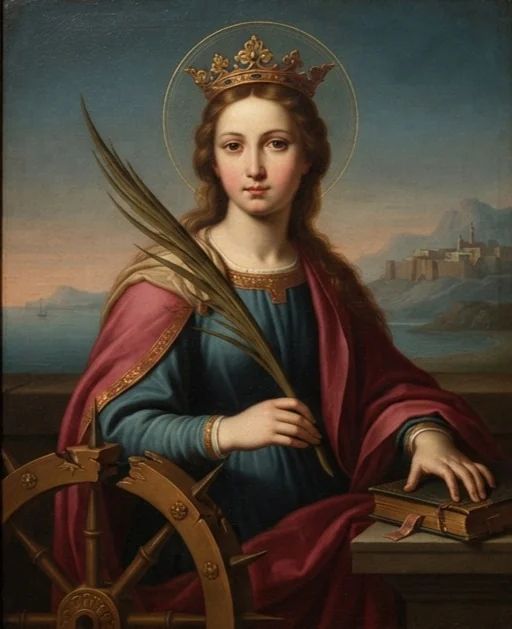
The Martyr and Patron Saint of Scholars Who Defended Her Christian Faith
The Church remembers Saint Catherine of Alexandria on November 25. The Roman calendar lists her as an optional memorial. Eastern Christians also honour her as a Great Martyr. Moreover, believers have loved her for centuries as a model of wisdom and bravery. Therefore, her feast offers a fine moment to reflect on faith and learning.
Before telling her story, we must make one point clear. Her account comes from tradition and legend. The earliest surviving life of Catherine appears centuries after her death. Consequently, historians cannot confirm many details. Nevertheless, the Church has treasured her story, because it teaches lasting truths about faith and reason.
According to tradition, Catherine was born into a noble family in Alexandria, Egypt, around the end of the third century. She was beautiful, wealthy and remarkably intelligent. Moreover, she studied the great philosophers and mastered every branch of learning. Later, she encountered Christianity, and a vision of the Virgin Mary and the Christ Child led her to be baptised.
Then the emperor, named Maxentius in many accounts, ordered all citizens to offer sacrifice to the Roman gods. Catherine, only 18 years old, went to the palace and challenged him. She argued calmly that the pagan gods were false. Furthermore, she defended Christ as the true Wisdom of God. Surprised, the emperor summoned fifty of the finest philosophers to refute her.
However, the plan failed. Catherine answered every objection with clarity and grace. As a result, the philosophers admitted defeat, and many embraced the Christian faith. Enraged, the emperor ordered their execution. He then tried to win Catherine with promises of wealth and a place at court. She refused, and he imprisoned her.
Next, the emperor devised a spiked wheel to torture her. According to the story, the wheel shattered at her touch. Finally, he ordered her beheading. Tradition adds that milk, rather than blood, flowed from her neck. In several versions, the empress and a general named Porphyrius also converted. Therefore, believers saw her death as a sign of purity and victory. Most accounts place it in the early fourth century.
After her death, angels carried her body to Mount Sinai, according to the legend. Around the year 800, monks reportedly discovered relics there. The monastery at the foot of the mountain, which Emperor Justinian had built in the sixth century, later took her name. Today, Saint Catherine’s Monastery remains a major place of pilgrimage.
Devotion to her spread widely in the Middle Ages, especially after the Crusades. Pilgrims returning from Sinai brought stories and relics to Europe. Consequently, churches, chapels and universities adopted her name. The Church also counted her among the Fourteen Holy Helpers, a group of saints invoked in times of need. Furthermore, Joan of Arc said that Catherine spoke to her. The Catherine wheel firework also takes its name from the saint’s wheel.
Catherine became the patron of students, philosophers, scholars, teachers and preachers. She earned these titles because she met the best minds of her time and won them through reason and truth. In addition, people who work with wheels, such as wheelwrights and millers, also honour her. Likewise, many young women chose her as their patron.
Meanwhile, the Church’s calendar reflected the historical doubts. In 1969, her feast left the General Roman Calendar. However, Rome restored it in 2002 as an optional memorial. Thus, the Church kept her devotion alive while acknowledging the limits of the evidence.
What can Catholics learn from Saint Catherine of Alexandria? First, she shows that faith and reason work together. Second, she proves that young people can speak boldly for Christ. Third, she teaches that truth deserves courage, even when power opposes it. Finally, she encourages students to study with humility and to use knowledge for good.
Prayer to Saint Catherine of Alexandria
Saint Catherine, wise and courageous virgin, you loved Christ above every earthly reward. Pray for all students and teachers. Open their minds to truth, and keep their hearts humble. Moreover, give us courage to defend our faith with charity. Help us to seek wisdom and to follow Christ faithfully. Amen.
Readers who wish to learn more can visit the Franciscan Media and the Catholic Encyclopedia. Furthermore, our Saints of the Day section offers more stories like this.

Leave a Reply