
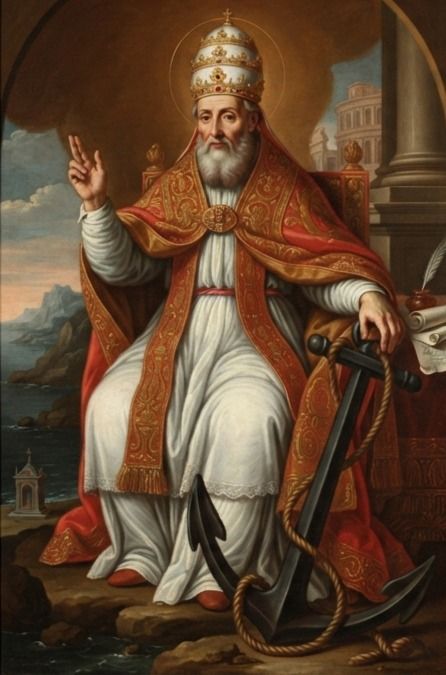
The Fourth Pope, Martyr and Early Church Writer
Saint Clement I and the Letter That Called the Church to Unity
The Church honours Saint Clement I every November 23. He was the fourth pope in the line of Saint Peter. Moreover, he wrote one of the earliest Christian texts outside the New Testament. Therefore, his feast invites us to remember the unity of the early Church.
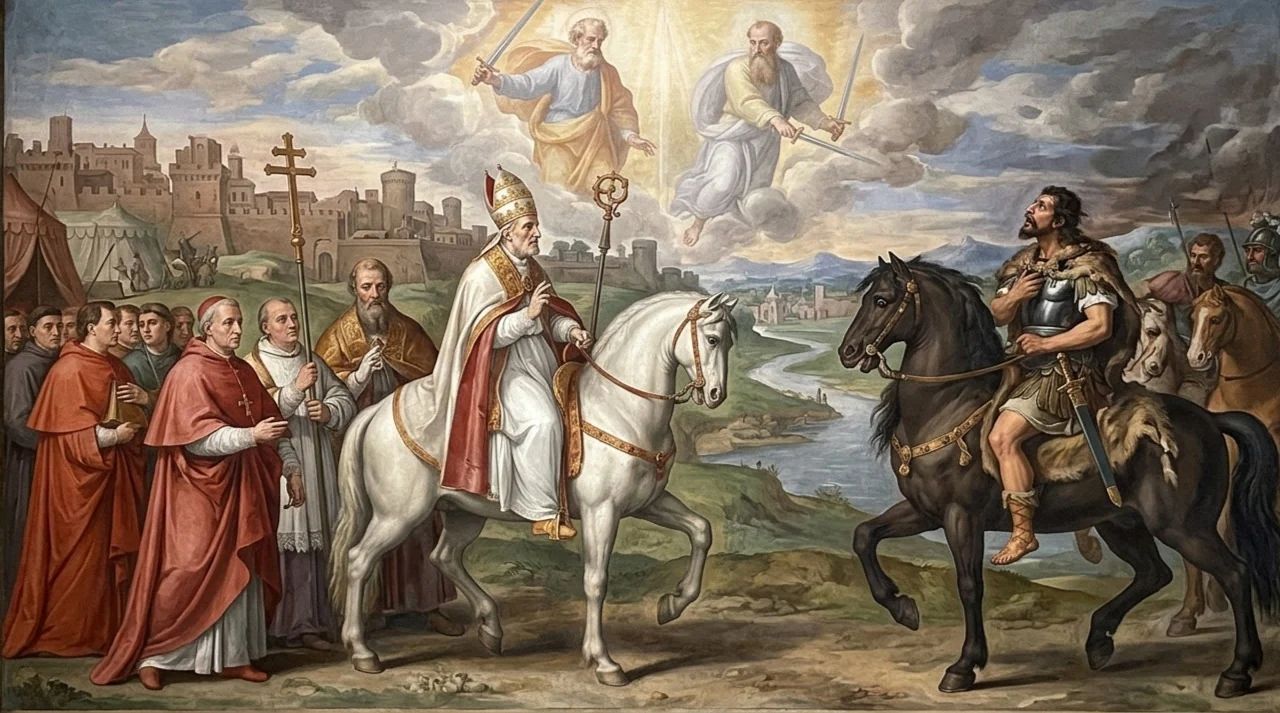
Little is known about Clement’s early life. According to tradition, he was a Roman who knew Saint Peter and possibly Saint Paul. Some early writers, such as Tertullian, said that Peter himself ordained him. Furthermore, Origen suggested that he was the Clement whom Paul praised in the Letter to the Philippians. Historians cannot confirm these links. Nevertheless, they show how highly the early Christians valued him.
Ancient lists name Linus, Anacletus and Clement as the first successors of Peter in Rome. Irenaeus and Tertullian describe Clement as the fourth bishop of Rome. His pontificate lasted roughly from 88 to 99, although some historians suggest slightly different years. In addition, the Roman Canon, the First Eucharistic Prayer, still mentions his name at Mass.
Clement is best known for his letter to the Christians of Corinth, written around the year 96. The Corinthians had removed several respected leaders from office. As a result, the community had split into quarrelling groups. Therefore, Clement wrote to restore peace. He urged humility, obedience and love. Moreover, he reminded them that the apostles had appointed leaders to continue their work.
This letter matters for several reasons. First, it is the oldest surviving record of the Church in Rome stepping in to help another local church. Second, it shows that early Christians valued order and apostolic succession. Third, the Corinthians treasured it so much that they read it aloud at worship for generations. Consequently, scholars rank Clement among the Apostolic Fathers.
Tradition adds a dramatic ending to his life. According to later accounts, the Emperor Trajan exiled Clement to a stone quarry near the Black Sea. There, he comforted fellow Christian prisoners. When they suffered from thirst, he prayed, and a spring of water appeared. Consequently, many local people embraced the faith. Finally, the authorities tied an anchor to his neck and threw him into the sea. Scholars treat these details with caution, since they appear only in later legends.
Legend says that the sea receded each year, revealing a shrine built by angels. Centuries later, Saint Cyril found bones and an anchor in Crimea. He believed they belonged to Clement. Then he carried them to Rome around the year 868, where Pope Adrian II placed them in the Basilica of San Clemente. Meanwhile, other places, including Kyiv, also claim some relics.
The Basilica of San Clemente stands near the Colosseum. Beneath the present church lie older layers, including an early Christian church from the fourth century and a Roman temple of Mithras. Visitors can walk down through these levels and see history in layers. Thus, the basilica itself tells the story of the faith in Rome.
Because of his anchor, believers honour him as a patron of mariners and sailors. He is also the patron of marble workers, since tradition places him in a quarry. In art, painters show him as a pope holding an anchor. Moreover, the Eastern Churches keep his feast on November 24 or 25.
What can Catholics learn from Saint Clement I? First, he teaches that unity matters more than pride. Second, he shows that leaders must serve with humility. Third, he proves that peacemaking requires courage and patience. Finally, he reminds us that faith can remain firm even in exile and suffering.
Prayer to Saint Clement I
Saint Clement, faithful shepherd and martyr, you worked for peace in the Church. Pray for all bishops and priests. Help families and parishes to resolve their quarrels with humility. Moreover, protect sailors and all who work at sea. Teach us to hold fast to Christ, even in hard times. Amen.
Readers who wish to learn more can visit the Catholic Encyclopedia entry at New Advent and the Catholic Culture. Furthermore, our Saints of the Day section offers more stories like this.
Leave a Reply