
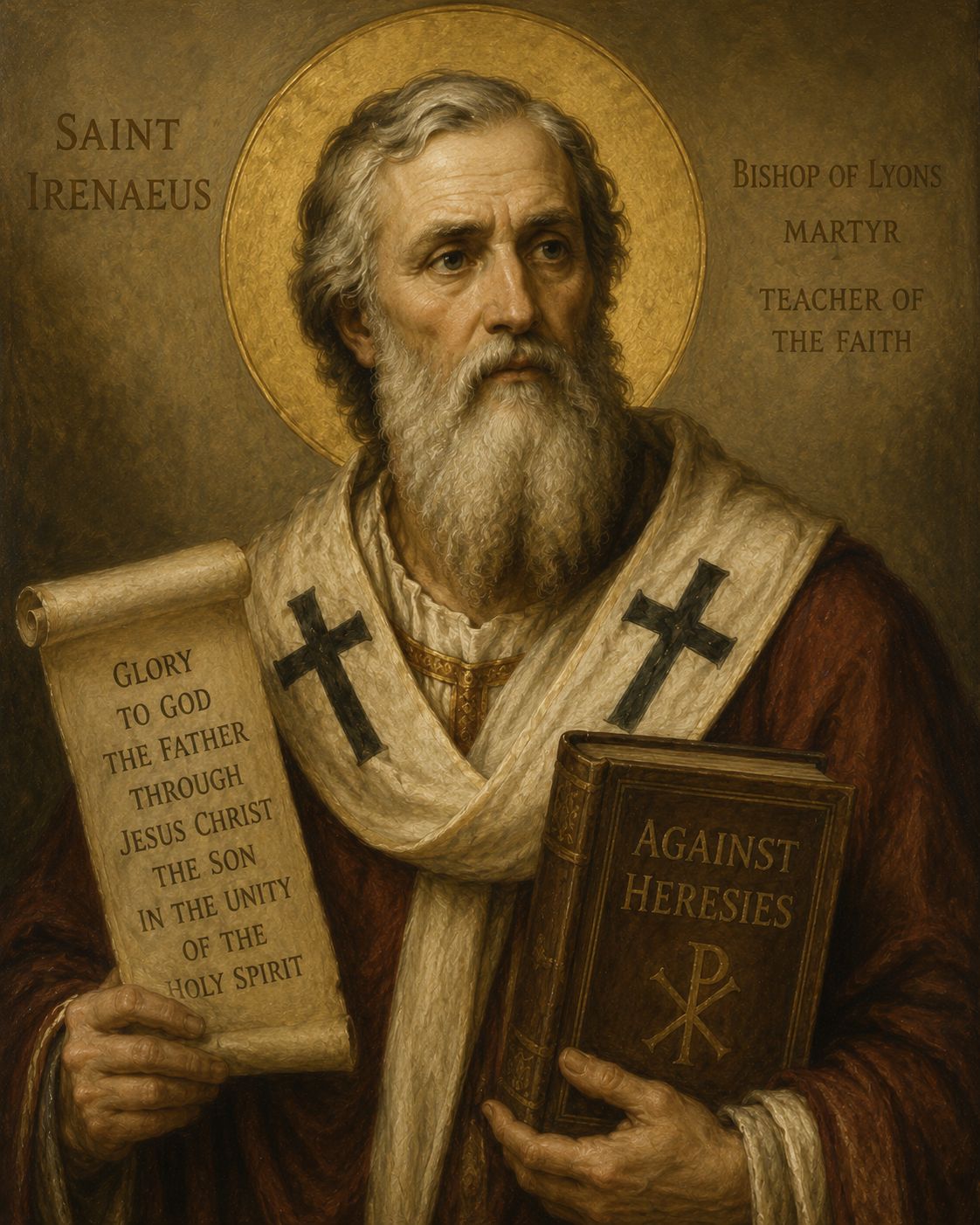
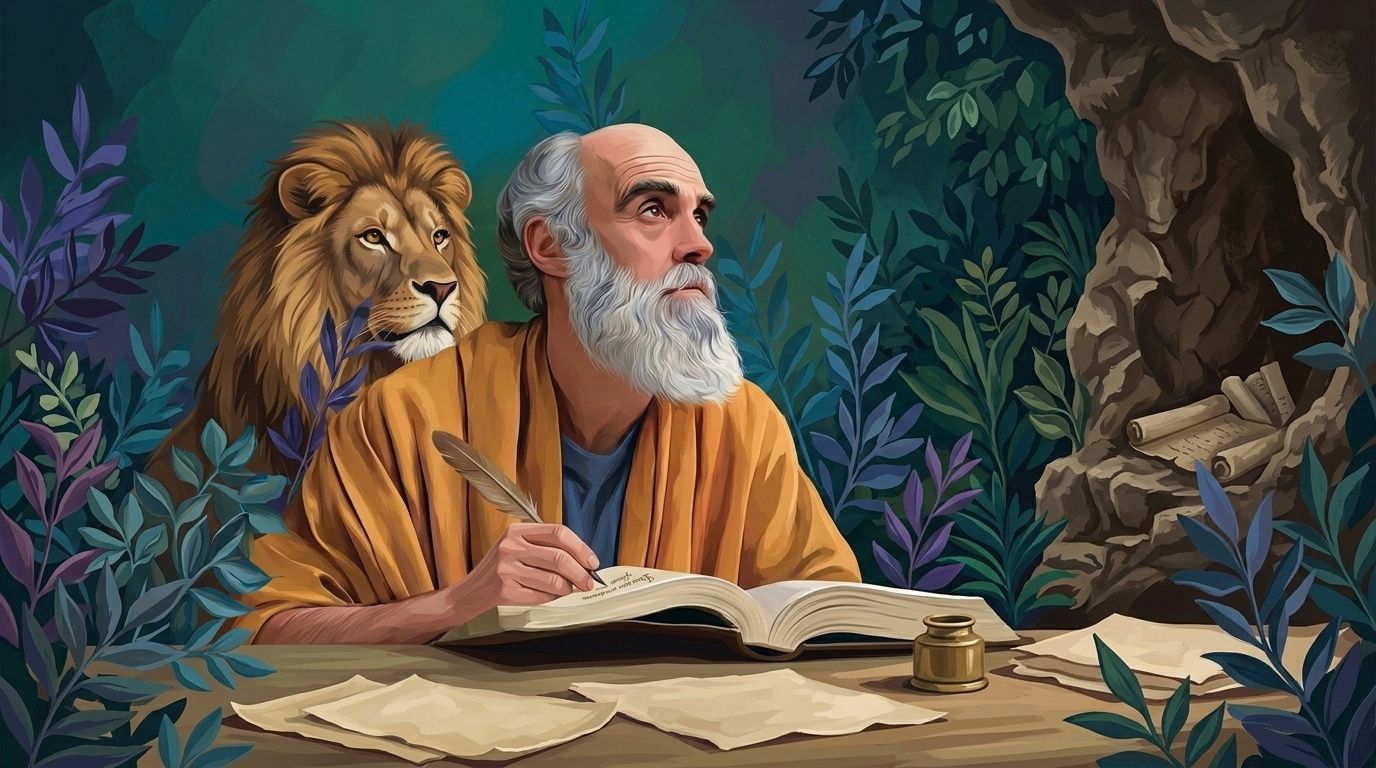
Image Credit: Generated by AI
Saint Irenaeus of Lyon: The Defender of Orthodoxy Who Saved the Gospels
Saint Irenaeus of Lyon stands as one of Christianity’s most influential early thinkers. As a second-century bishop, he rescued the Catholic faith from Gnostic heresies, established the four-Gospel canon, and connected believers directly to the apostles through an unbroken chain of tradition. Pope Francis declared him a Doctor of the Church in 2022, conferring upon him the special title Doctor unitatis—Doctor of Unity.
The Feast Day of Saint Irenaeus of Lyon
The Church celebrates Saint Irenaeus of Lyon on June 28, a date that commemorates his death around the year 202. The Latin Catholic Church, Lutheran Churches, the Church of England, and the Episcopal Church all observe this anniversary. Meanwhile, the Eastern Orthodox Church honours him on August 23. Pope Francis’s 2022 declaration elevated his status dramatically, recognizing how his ancient teachings continue addressing modern divisions.
Roots in Apostolic Soil
Irenaeus was born around 125 in one of Asia Minor’s maritime provinces, where memories of the apostles remained vivid and Christian communities thrived. Unlike many converts of his era, he grew up in a Christian family, absorbing the faith from infancy rather than discovering it as an adult.
His most formative relationship developed with Saint Polycarp, the venerable bishop of Smyrna. Polycarp had personally known the apostles or their immediate disciples, making him a living bridge to the first generation of Christians. Irenaeus later recalled Polycarp’s accounts of conversations with John the Evangelist, descriptions that shaped his entire understanding of authentic Christianity. This direct connection to apostolic witness became the foundation for everything Irenaeus would teach and defend.
Mission to Gaul and Escape from Martyrdom
Many Asian priests and missionaries carried the gospel across the Mediterranean to pagan Gaul, establishing a vibrant church in what is now southern France. Irenaeus joined this community and served as a priest under its first bishop, Saint Pothinus, who shared his eastern origins.
In 177, the church of Lyon dispatched Irenaeus to Rome on an urgent mission. He carried a letter to Pope Eleutherius regarding the Montanist heresy, and this journey testified to his emerging reputation. While he was absent, a terrible persecution erupted in Lyon. Saint Pothinus and numerous other Christians suffered martyrdom. Because Irenaeus was in Rome, he escaped this slaughter. When he returned to Gaul, he found the bishopric vacant and assumed leadership of the wounded community.
Battling the Gnostic Threat
The persecution had ended, yet a more insidious danger threatened Irenaeus’s flock. Gnosticism was spreading rapidly through Gaul, seducing Christians with promises of secret knowledge and spiritual elitism. Various sects claimed to possess hidden wisdom that ordinary believers could never access. They taught that the material world was created by an evil demiurge, that salvation came through esoteric understanding rather than faith, and that Jesus was merely a spiritual being who only seemed human.
Irenaeus recognized that Gnosticism struck at Christianity’s very heart. If the material world was evil, then creation was not good. If Jesus only appeared human, then God had not truly entered our condition. If salvation required secret knowledge, then the apostles’ public preaching was insufficient.
Consequently, he undertook his magnum opus: Against Heresies, a five-volume treatise written in Greek but quickly translated into Latin for wider circulation. In Book I, he meticulously exposed the inner doctrines of various Gnostic sects, tracing their origins back to Simon Magus. In Book II, he demonstrated the logical and theological bankruptcy of Valentinian Gnosticism. Book III provided counter-evidence from the Gospels themselves. Book IV explored Jesus’s sayings and stressed the unity between Old Testament and Gospel. Book V focused on additional sayings of Jesus and Paul’s letters, culminating in a vision of bodily resurrection and new creation.
This work succeeded in dealing what Irenaeus hoped would be a death-blow to Gnosticism. While Gnostic ideas persisted in various forms, they never again posed a serious threat to mainstream Christianity. Irenaeus’s thorough documentation preserved invaluable information about these movements, and until the 1945 discovery of the Nag Hammadi library, Against Heresies remained our best source for understanding Gnosticism.
Establishing the Four Gospels
Perhaps Irenaeus’s most enduring contribution involved the New Testament canon. Before his time, Christians disagreed about which Gospels held authority. Communities in Anatolia preferred John, while Matthew enjoyed the widest overall popularity. Some groups used only one Gospel, while others accepted more than four.
Irenaeus insisted that exactly four Gospels—Matthew, Mark, Luke, and John—constituted authoritative Scripture. He argued that just as there are four corners of the earth and four winds, so there must be four pillars of the Gospel. This was not merely aesthetic preference. Irenaeus understood that each Gospel presented a distinct yet complementary portrait of Christ, and together they provided the full picture that any single account might distort.
He became the earliest surviving witness to affirm all four canonical Gospels as essential, possibly responding to Marcion’s edited version of Luke, which Marcion claimed was the only true Gospel. Irenaeus also identified John the Apostle as the author of the fourth Gospel and Luke as Paul’s companion, establishing authorship traditions that would shape Christian reading for centuries.
The Three Pillars of Orthodoxy
To counter Gnostic claims of secret apostolic traditions, Irenaeus offered three accessible pillars that every believer could verify. First, the Scriptures themselves provided the written record of apostolic teaching. Second, the tradition handed down from the apostles offered living interpretation. Third, the teaching of the apostles’ successors—the bishops—ensured continuity across generations and geography.
He famously traced the succession of bishops in Rome from Peter and Paul through Linus, Anacletus, Clement, and others down to his own day. This demonstration served multiple purposes. It proved that authentic teaching survived in public, verifiable offices rather than hidden circles. It showed that multiple independent churches preserved identical doctrines. And it established that the unanimous agreement of these churches confirmed orthodox faith as true.
Theology of Recapitulation
Irenaeus’s theological vision centered on what he called recapitulation—the idea that Christ systematically undid what Adam had done. Where Adam disobeyed, Christ obeyed even unto death. Where Eve was faithless, Mary was faithful. Where humanity fell through a tree, redemption came through the wood of the cross.
He saw Christ as the New Adam who restored humanity to God’s image and likeness. This was not merely spiritual metaphor. Irenaeus believed that by taking genuine human flesh, Christ conveyed immortality and incorruptibility to human nature itself. Salvation spread like a benign infection, as he colorfully described it, transforming those united to Christ.
Unlike Gnostics who despised the body, Irenaeus celebrated Christ’s physical life from infancy through adulthood. He argued that Jesus lived into his forties, sanctifying every stage of human existence. The Incarnation was not an unfortunate necessity but the very heart of God’s plan, intended before humanity’s creation.
Peacemaker and Final Years
Irenaeus’s last recorded action occurred around 190 or 191, when he intervened with Pope Victor I regarding the Quartodeciman controversy. Victor had threatened to excommunicate Asian churches that celebrated Easter on the Jewish Passover date rather than the Sunday tradition. Irenaeus urged moderation, reminding the pope that previous bishops had tolerated this diversity without breaking communion. His intervention preserved unity while respecting legitimate differences.
The date of his death remains uncertain, though tradition places it around 202. He was buried beneath the altar of the church of Saint John in Lyon, which was later renamed in his honor. Calvinists destroyed this shrine in 1562, and his relics seemingly perished. However, a piece of heelbone preserved in Lyon Cathedral has been carbon-dated to the correct period, offering a tangible connection to this ancient defender of the faith.
Legacy as Doctor of Unity
Saint Irenaeus of Lyon speaks with remarkable relevance to contemporary Christianity. In an age of competing spiritualities and fragmented truth claims, his insistence on public, verifiable tradition offers an anchor. His vision of recapitulation—that Christ transforms rather than escapes human existence—challenges both materialist despair and spiritual escapism. An

Leave a Reply