
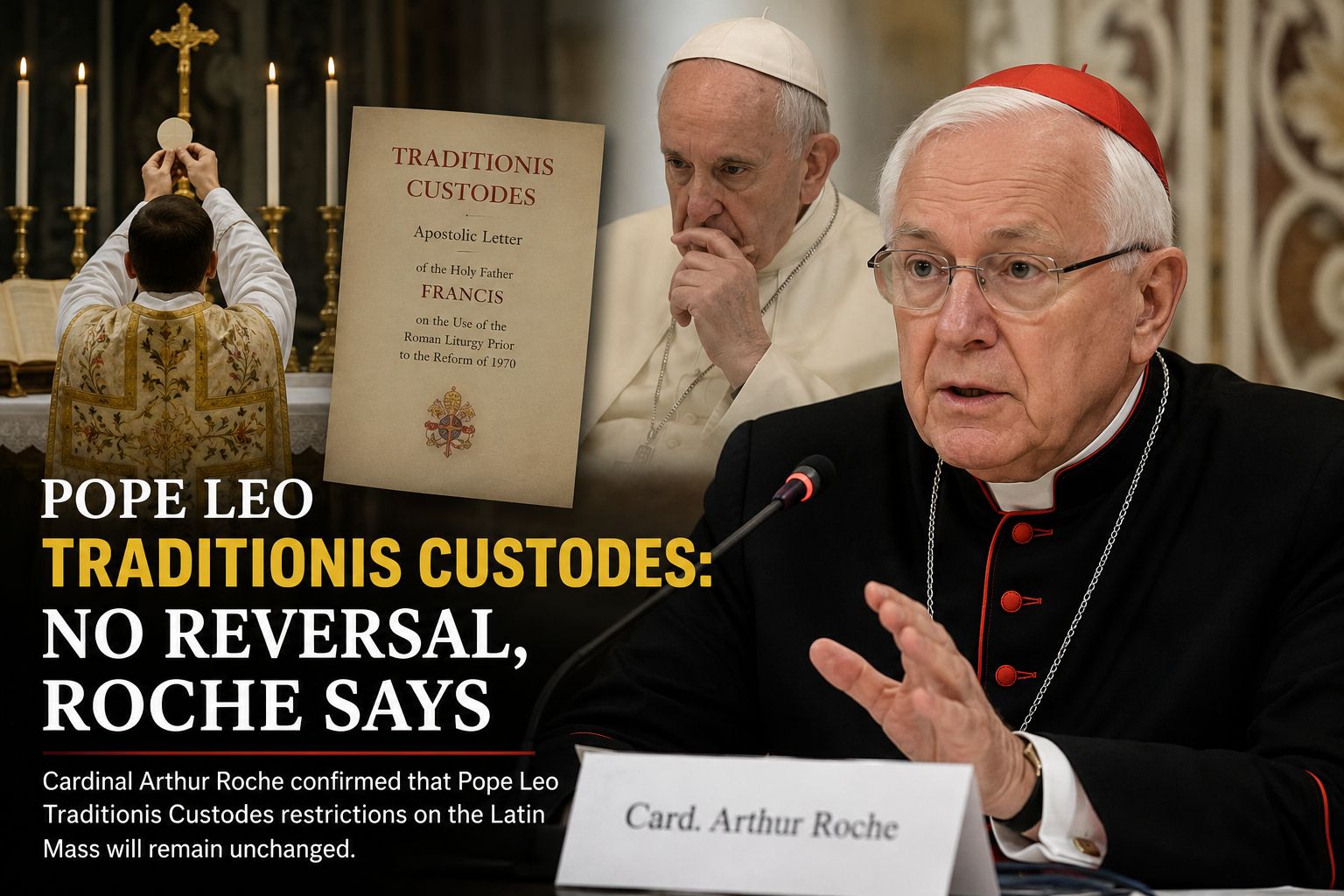
Pope Leo Traditionis Custodes questions have circulated for months among Catholics hoping for a return to wider Latin Mass access. Those hopes dimmed considerably this week. Cardinal Arthur Roche, the Vatican’s top liturgy official, confirmed that Pope Leo XIV has no plans to lift the restrictions his predecessor placed on the traditional Latin Mass. His comments arrived in an interview published July 29 by the British Catholic weekly The Tablet, offering the clearest signal yet of where the new pontificate stands on this contested issue.
Pope Leo Traditionis Custodes Policy Confirmed by Roche
Cardinal Roche serves as prefect of the Dicastery for Divine Worship and the Discipline of the Sacraments, making him the Vatican’s leading voice on liturgical matters. Asked directly whether restricting the older Mass would remain as important under Pope Leo XIV as it had been under Pope Francis, Cardinal Roche answered without hesitation. He stated plainly that Pope Leo is not going to change Traditionis Custodes and that he is not going back to Summorum Pontificum either. Because Cardinal Roche has overseen this policy since 2021, his words carry significant institutional weight.
What Traditionis Custodes Actually Changed
Pope Francis issued Traditionis Custodes in July 2021, reversing the broader permissions that Pope Benedict XVI had granted through his own 2007 document, Summorum Pontificum. Pope Benedict had declared that the 1962 Missal had never been legally withdrawn and remained, in principle, always permitted, meaning priests needed no special approval to celebrate it privately. Traditionis Custodes moved firmly in the opposite direction. It named the liturgical books introduced after Vatican II as the sole official expression of the Roman Rite’s law of prayer, while giving individual bishops authority to limit or restrict celebrations of the older Mass within their own dioceses.
Roche Defends the Restrictions as Necessary for Unity
During the interview, Roche framed the entire issue around Church unity rather than liturgical preference. He described the Eucharist as the sacrament that should unite Catholics rather than divide them, adding that something is seriously wrong whenever liturgy becomes a source of division instead. He also recounted conversations with groups devoted to the older Mass, saying he often asks them what their complaint actually is, since Francis had already permitted celebrations under existing norms. According to Roche, these groups struggle to answer that question directly, yet continue describing themselves as persecuted.
Reaction From Traditional Catholic Communities
Cardinal Roche’s comments landed hard among traditionalist Catholics who had hoped Pope Leo’s papacy might soften the restrictions first imposed under Pope Francis. Cardinal Gerhard Ludwig Müller has previously argued that Traditionis Custodes failed to achieve its stated goals and that it instead strengthened support for groups like the Society of Saint Pius X. Archbishop Georg Gänswein has likewise said Pope Francis made a mistake with the decree, describing the pain it caused Pope Benedict XVI personally. Some bishops have also pushed back on the survey data used to justify the original restrictions, with Archbishop Alexander Sample stating publicly that further limits would only deepen division rather than resolve it.
Where Pope Leo XIV Personally Stands
Since becoming pope, Leo has acknowledged limited personal familiarity with the traditional Latin Mass debate at the outset of his pontificate. He has since met with several prominent advocates for the older rite and some observers describe him as somewhat more open to the topic than his predecessor. Even so, Cardinal Roche’s remarks suggest that any softening in tone has not translated into a change in formal policy. For now, the restrictions established under Pope Francis remain fully in place, with no indication that Pope Leo XIV intends to revisit them.
Why This Debate Continues to Matter
This story touches a deeper divide within the Church over how the Second Vatican Council’s liturgical reforms should be received. Traditionis Custodes remains one of the most contested decisions of the past decade, and Roche’s comments confirm that debate will likely continue well into Leo’s pontificate. For additional coverage of the interview itself, see National Catholic Reporter’s full report.

Leave a Reply