
Eucharistic Miracles Documented by Carlo Acutis: A Guide to Faith and Evidence
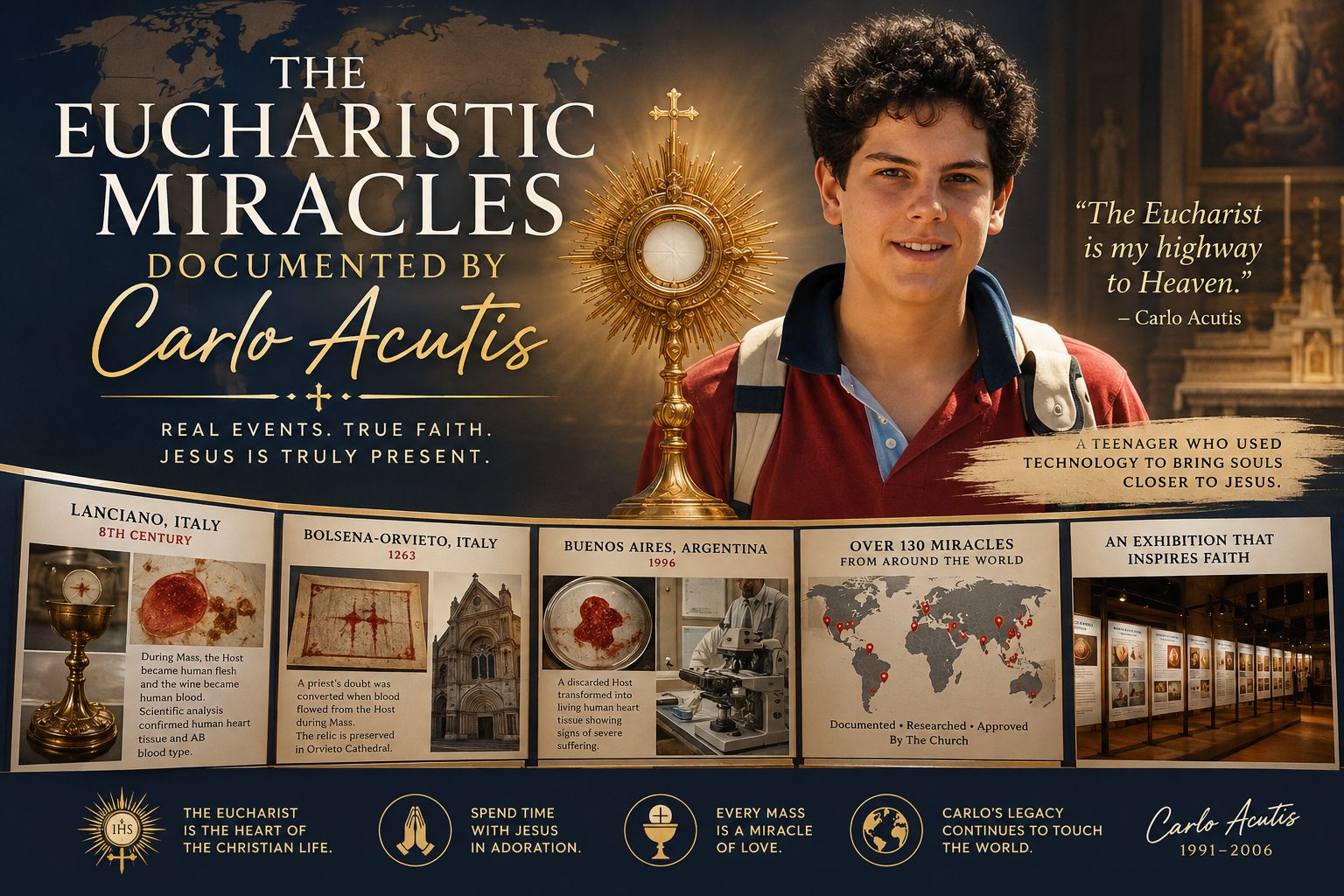
The Eucharistic miracles documented by Carlo Acutis have inspired millions of Catholics around the world. Long before artificial intelligence, social media influencers and digital evangelization became common, Carlo Acutis recognized the internet as a powerful tool for spreading the Gospel. As a teenager, he researched and catalogued Eucharistic miracles from different countries, creating an online exhibition that remains one of the Church’s most popular educational resources. His work continues to strengthen belief in the Real Presence of Jesus Christ in the Holy Eucharist.
Feast Day of Blessed Carlo Acutis: October 12
The Church celebrates the feast of Blessed Carlo Acutis every year on October 12. Born in London on May 3, 1991, and raised in Milan, Italy, Carlo combined a deep love for Jesus with remarkable computer skills. He died from leukemia on October 12, 2006, at only fifteen years old. His witness of holiness led to his beatification in 2020, while his canonization has inspired Catholics worldwide.
The Eucharistic Miracles Documented by Carlo Acutis Explained
The Eucharistic miracles documented by Carlo Acutis refer to a collection of over 130 reported miracles from different centuries and countries. Carlo personally researched each case using Church-approved sources. He then organized the information into an online exhibition and later into printed displays that have travelled across the world.
Rather than inventing new claims, Carlo carefully presented historical events already investigated by bishops and Church authorities. His goal was simple: help people rediscover the importance of the Eucharist.
He often repeated the phrase:
“The Eucharist is my highway to Heaven.”
That sentence perfectly summarizes his spirituality.
What Is a Eucharistic Miracle?
A Eucharistic miracle occurs when God permits an extraordinary event connected to the Blessed Sacrament. Most commonly, the consecrated Host visibly changes into human flesh or blood. In other cases, the Host remains perfectly preserved for many years without natural explanation.
The Catholic Church approaches every reported miracle with caution. Experts examine scientific, historical, and theological evidence before Church authorities recognize any event as worthy of belief. Importantly, Catholics are not required to believe in private miracles. However, approved miracles can strengthen faith and encourage devotion.
Famous Eucharistic Miracles Included in Carlo’s Exhibition
Several well-known miracles appear among the Eucharistic miracles documented by Carlo Acutis.
The Miracle of Lanciano, Italy
Perhaps the most famous example occurred in the eighth century in Lanciano. During Mass, a priest struggled with doubts about Christ’s Real Presence. After the consecration, the Host reportedly became human flesh, while the wine became blood.
Modern scientific studies concluded that the flesh consisted of human heart tissue and the blood belonged to the AB blood group. Although science cannot explain how the transformation occurred, the Church presents the event as a sign pointing toward the mystery of the Eucharist rather than replacing faith.
The Miracle of Bolsena-Orvieto
In 1263, a German priest celebrated Mass in Bolsena while struggling with doubts. During the consecration, blood reportedly flowed from the Host onto the corporal.
The event deeply influenced Pope Urban IV, who later established the universal feast of Corpus Christi. The blood-stained corporal remains preserved in the Cathedral of Orvieto.
The Miracle of Buenos Aires
In 1996, a discarded consecrated Host was placed in water according to Church practice. Days later, it reportedly transformed into what appeared to be bloody tissue.
Scientific examinations identified living human heart muscle showing signs of severe suffering. The investigation attracted worldwide attention because of its documented laboratory analysis.
Why Carlo Acutis Collected These Miracles
Unlike many teenagers, Carlo understood technology as a means of evangelization. Therefore, he used his programming skills to design a website featuring maps, photographs, timelines, and historical accounts.
His exhibition eventually reached thousands of parishes, schools, universities, and dioceses. Today, it has appeared on every inhabited continent.
More importantly, Carlo wanted people to spend more time before the Blessed Sacrament.
He believed many Catholics searched for extraordinary experiences while overlooking the greatest miracle already present at every Mass.
The Church’s Teaching on Eucharistic Miracles
The Catholic Church teaches that every validly celebrated Mass becomes the Body and Blood of Christ through transubstantiation. Consequently, Eucharistic miracles do not add to this doctrine.
Instead, they serve as signs that may encourage deeper faith.
The Catechism of the Catholic Church (CCC 1374–1377) explains that Christ is truly, really, and substantially present in the Eucharist. Therefore, miracles simply remind believers of a truth already revealed by Christ.
The Lasting Legacy of Carlo Acutis
Although Carlo died young, his digital evangelization continues to bear fruit. His exhibition remains available online and has encouraged Eucharistic Adoration across the globe.
Young Catholics especially relate to Carlo because he enjoyed ordinary hobbies. He played football, liked video games in moderation and loved computers. Yet he also attended daily Mass whenever possible, prayed the Rosary, and spent time in Eucharistic Adoration.
His life demonstrates that holiness belongs in every generation.
Why the Eucharistic Miracles Documented by Carlo Acutis Still Matter Today
The Eucharistic miracles documented by Carlo Acutis continue to inspire believers because they direct attention to Jesus in the Blessed Sacrament rather than to extraordinary events themselves.
Furthermore, they remind Catholics that faith and reason work together. Historical records, scientific studies and careful Church investigations all contribute to understanding these remarkable cases. Nevertheless, the greatest invitation remains the same: encounter Christ in the Eucharist.
Carlo’s exhibition ultimately points beyond miracles. It points to the Altar, where Catholics believe Christ truly becomes present at every Mass.
Whether someone is a lifelong Catholic or simply curious about Christian faith, Carlo’s work offers an opportunity to explore one of the Church’s deepest mysteries with both reverence and thoughtful inquiry.

Leave a Reply