
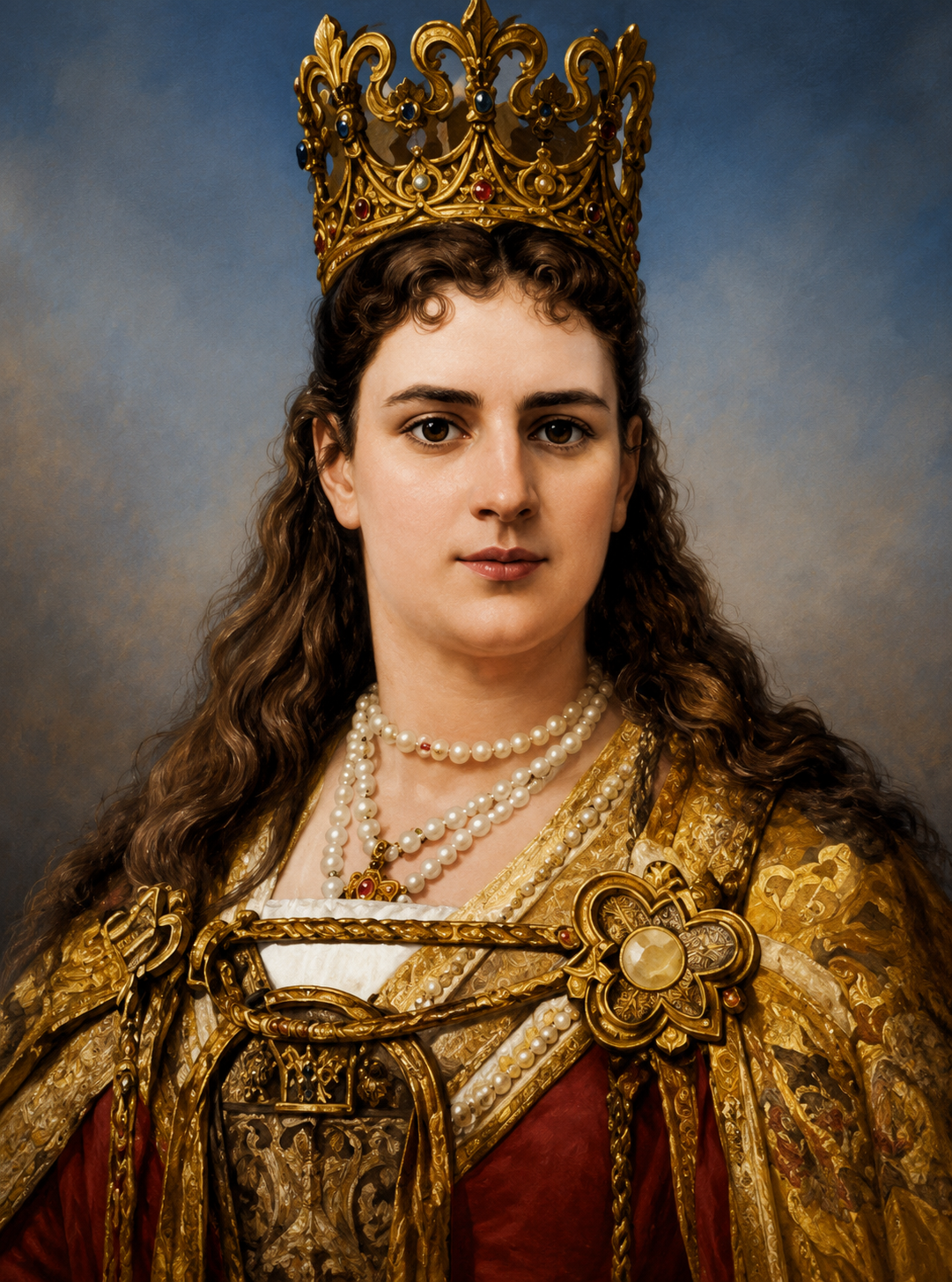
Image Credit: Catholic Online/modified by Chat GPT
Saint Hedwig of Poland: A Queen Who Became a Saint
Saint Hedwig of Poland, also known as Jadwiga, holds a rare place in history. She ruled a kingdom before she was even a teenager, and centuries later, the Catholic Church declared her a saint. Her feast day falls on July 17, the same date she died in 1399. Today, the faithful honour her as the patroness of queens and of a united Europe, and her story still offers a powerful example of faith, sacrifice, and quiet strength.
Saint Hedwig of Poland’s Feast Day and Royal Beginnings
The Church celebrates the feast day of Saint Hedwig of Poland every July 17, marking the anniversary of her death. She was born around 1373 in Buda, the capital of Hungary, as the youngest daughter of King Louis I of Hungary and his wife, Elizabeth of Bosnia. Because her father had no sons, he worked hard to secure the right of his daughters to inherit his kingdoms. As a result, young Hedwig became a highly sought-after bride among the royal houses of Europe from an early age.
Initially, her father arranged for her to marry William of Habsburg, and the two were formally betrothed as children. However, political turmoil in Poland soon changed the course of her life entirely.
Saint Hedwig of Poland Ascends the Polish Throne
Following her father’s death in 1382, Poland fell into a period of uncertainty. Polish nobles refused to accept foreign rulers they did not trust, and instead insisted on crowning one of Louis’s daughters, provided she settled permanently in Poland. Eventually, after lengthy negotiations and delays, Hedwig’s mother sent her to Kraków. On October 16, 1384, at just ten or eleven years old, she was crowned as “King” of Poland, a title chosen deliberately to emphasize that she ruled in her own right, not merely as a consort.
Though many of her advisors initially guided her decisions, Hedwig matured quickly. Historians note that her intelligence, warmth, and diplomatic skill soon allowed her to wield genuine authority rather than simply serve as a figurehead.
Saint Hedwig of Poland’s Marriage to Grand Duke Jogaila
Rather than proceeding with her earlier engagement to William, Polish nobles pushed for a far more strategic union. They proposed a marriage between Hedwig and Władysław II Jagiełło, the pagan Grand Duke of Lithuania. In exchange for her hand, Jagiełło agreed to convert to Christianity and to lead his Lithuanian subjects toward the Catholic faith as well.
Legend holds that Hedwig only agreed to the marriage after long, prayerful reflection before a crucifix, seeking divine guidance for her difficult decision. She ultimately renounced her union with William, and on February 18, 1386, she married Jagiełło, who took the baptismal name Władysław. He was crowned king shortly afterward, and the couple ruled Poland together as co-monarchs, even though they did not share a common language at first.
Saint Hedwig of Poland as Queen, Peacemaker, and Advocate
Throughout her reign, Saint Hedwig of Poland proved herself a capable diplomat and a compassionate ruler. After rebellious nobles murdered her mother in 1387, she personally led troops into the region of Galicia-Volhynia and persuaded most of its people to accept Polish rule peacefully, largely avoiding bloodshed.. She also worked tirelessly to mediate disputes, both between her husband’s relatives and between Poland and the powerful Teutonic Knights.
Beyond politics, she became known for her generosity toward the poor. According to tradition, when royal travels caused damage to peasants’ land, she insisted on compensating them, famously asking, “who can repair their tears?” She founded hospitals, churches, and schools, and she encouraged the translation of Scripture and church hymns into the Polish language so ordinary people could understand them.
The Death of Saint Hedwig of Poland
For more than a decade, the royal couple remained without an heir. Finally, in 1399, Hedwig became pregnant. She gave birth to a daughter, Elizabeth Bonifacia, on June 22, 1399, but the infant died only three weeks later. Weakened by childbirth complications, Hedwig herself died four days after her daughter, on July 17, 1399. Because her only child did not survive her, she became the last hereditary monarch of Poland; afterward, the Polish crown passed to elective monarchs instead.
She and her infant daughter were buried together in Wawel Cathedral in Kraków, fulfilling the wishes stated in her will.
Saint Hedwig of Poland’s Legacy and Path to Sainthood
Long after her death, admiration for Saint Hedwig of Poland only grew. She helped fund the restoration of the University of Kraków, later renamed Jagiellonian University, using proceeds from the sale of her own jewelry. Consequently, this institution became one of the most important centers of learning in Central Europe.
Veneration of her holiness began almost immediately after her death, supported by numerous legends of miracles attributed to her intercession. Centuries later, Pope John Paul II, himself a native of Kraków, formally beatified her in 1986 and canonized her on June 8, 1997. Today, the Catholic Church honors Saint Hedwig of Poland as a model of humility, sacrifice, and devoted service to both faith and country.



Leave a Reply