
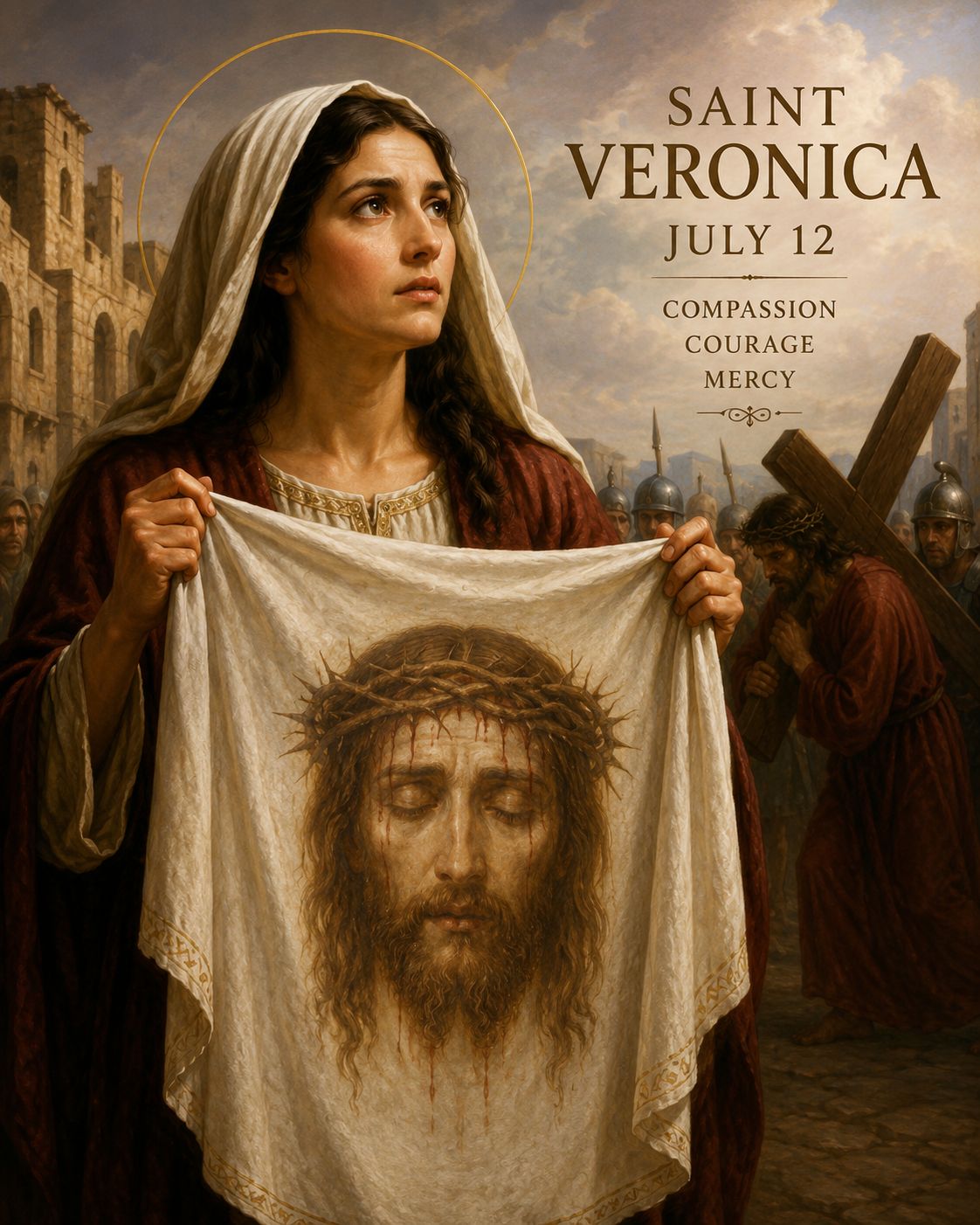
Saint Veronica: The Woman Who Offered Her Veil to Jesus on the Way to Calvary
The Feast Day of Saint Veronica
Every July 12, the Catholic Church honours Saint Veronica, whose single compassionate act on Calvary has echoed across two millennia. Though her name never appears in the gospels, she holds a cherished place in Catholic tradition at the Sixth Station. She also serves as patron saint of laundry workers and photographers, her legacy woven into both sacred art and craft.
The Legend of Compassion on the Via Dolorosa
According to tradition, as Jesus carried his cross toward Calvary, his face dripped with sweat and blood from the scourging. Along the crowded path stood Veronica, a bystander moved by profound pity. She stepped forward and offered him her veil, which he accepted to wipe his face. When he returned the cloth, the image of his sacred countenance had been miraculously imprinted upon it.
This simple kind gesture, recorded in the Sixth Station as “Veronica Wipes the Face of Jesus,” is one of the most beautiful episodes of Christ’s Passion. Furthermore, the cloth itself—the Veil of Veronica—ranks among the most treasured relics in the history of the Church.
The Mystery of Her Identity
No legends from the early centuries speak of Veronica either before or after her act of mercy. We do not know when she was born or when she died. She is, in many ways, lost to recorded history. Nevertheless, several traditions attempt to fill this silence. The apocryphal Acts of Pilate says she is the Woman with the issue of blood and was healed by touching the hem of Jesus’s garment. The apocryphal Gospel of Nicodemus gives her name as Berenikē or Beronike, recounting her attempt to testify for Jesus’ trial.
Some scholars propose a fascinating linguistic origin for her name. The Latin phrase vera icon, meaning “true image,” was used to describe the cloth bearing Christ’s face. Over time, popular imagination transformed this designation into a personal name, attaching various legends to the figure of “Veronica.” The Catholic Encyclopedia of 1913 notes that medieval texts gradually shifted from referring to the relic itself to inventing a saintly bearer of that name.
The Veil Through the Centuries
The history of the Veil of Veronica stretches across centuries of devotion, violence, and mystery. The relic was first mentioned as being in the possession of Pope John VII in the early eighth century. Thereafter, it gained tremendous popularity during the thirteenth through fifteenth centuries, when public exhibitions drew enormous crowds. The Church granted indulgences to those who performed devotions before it, and pilgrims flocked to Rome for the privilege.
Pedro Tafur, a Spanish knight who visited Rome in 1436, described the dramatic exhibition of the relic. An opening was made in the roof of Saint Peter’s Basilica, and a wooden chest containing two clerics was lowered down. These attendants, with the greatest reverence, removed the veil and displayed it to the gathered faithful. Tafur noted that the press of worshipers often became so great that lives were endangered.
However, the fate of the veil grew uncertain after the Sack of Rome in 1527. This period of chaos produced many reproductions, so no one knows whether the Vatican’s cloth is the original or a later copy. In 1616, Pope Paul V banned the production of all copies, and in 1629, Pope Urban VIII went further, ordering the destruction of existing copies or their delivery to the Vatican. Disobedience meant excommunication.
Since that time, the Vatican’s relic has been kept largely from public view. It is displayed only briefly on the Fifth Sunday of Lent each year. Those who have seen it up close report minimal visible detail. The cloth is preserved in a frame cut to match the outline of the original image. Six known copies exist in the world today, including one kept in Saint Peter’s Basilica that may date from the medieval period. None of these relics have been photographed in detail or subjected to forensic testing.
Devotion to the Holy Face
The story of Veronica inspired one of the most significant devotions in modern Catholic spirituality. In the nineteenth century, Sister Marie of Saint Peter, a Carmelite nun in Tours, France, reported visions of Jesus in which she saw Veronica wiping away the spit and mud from Christ’s face. Jesus told her that sacrilegious and blasphemous acts today were adding to that spit and mud, and he desired devotion to his Holy Face in reparation.
Pope Leo XIII approved this Devotion to the Holy Face of Jesus in 1885. Consequently, people now compare acts of reparation to Christ to Veronica’s compassionate gesture on the road to Calvary. The Bollandists listed her feast under July 12 in their seventeenth-century Acta Sanctorum, though some sources also mention January 13.
Artistic and Spiritual Legacy
In sacred art, Veronica is always depicted as a woman holding a cloth upon which the face of Christ is imprinted. Her symbol combines the veil with the Crown of Thorns, linking her act of mercy directly to Christ’s suffering. A statue by Francesco Mochi stands in a niche of the pier supporting the main dome of Saint Peter’s Basilica, honoring her place in the heart of the Church.
The Roman Martyrology does not include Saint Veronica, yet Catholics and some other Christian denominations continue celebrating her feast day and commemorating her memory in the Stations of the Cross.. She reminds us that even the smallest act of compassion—offering a cloth to a suffering stranger—can become a vessel of divine grace for generations to come.





Leave a Reply