
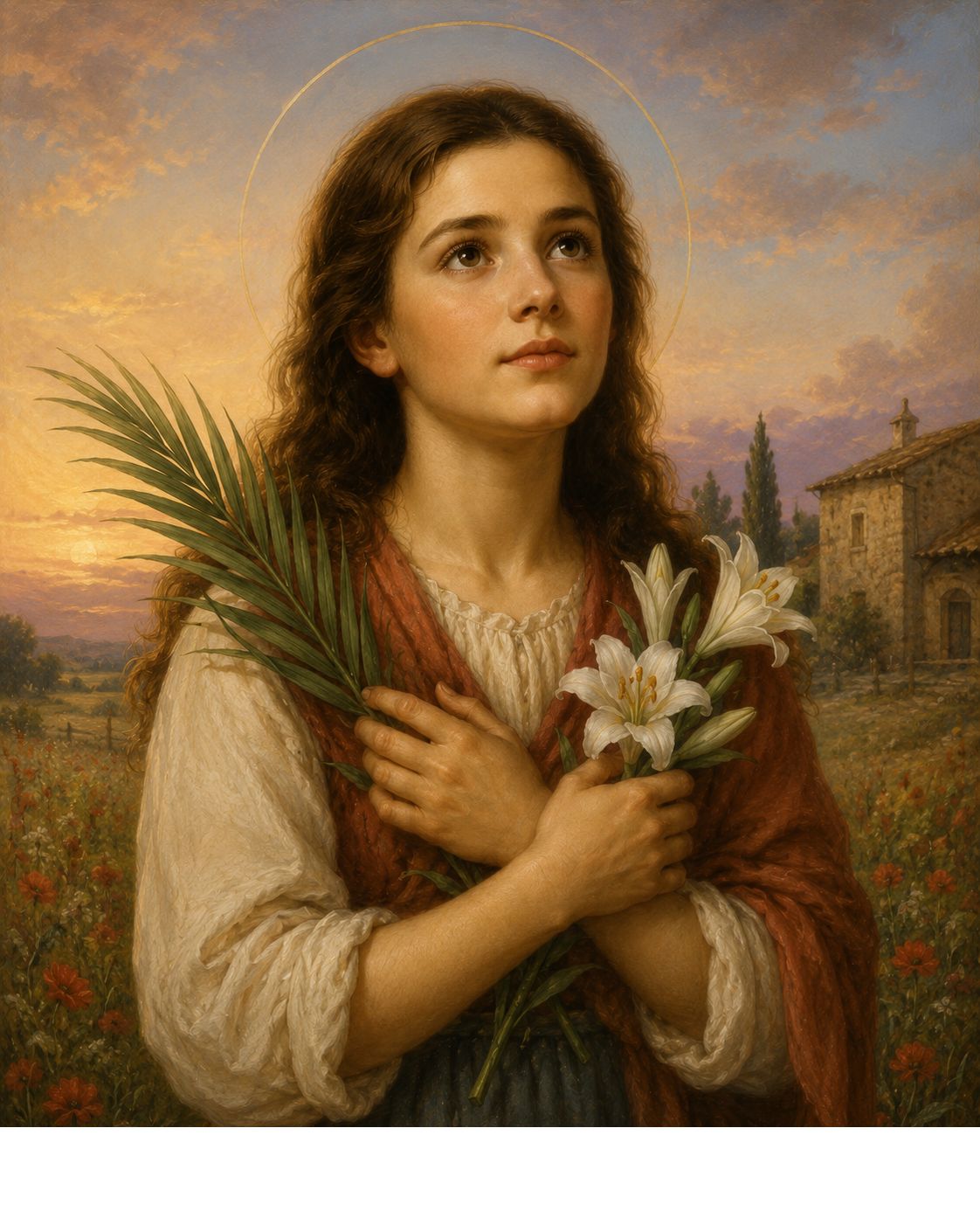
Saint Maria Goretti: The Young Martyr of Purity and Forgiveness
The Feast Day of Saint Maria Goretti
Every year on July 6, the Catholic Church celebrates the feast day of Saint Maria Goretti, a remarkable young girl whose brief life continues to inspire millions around the world. Born on October 16, 1890, in Corinaldo, Italy, Maria became one of the youngest saints ever canonized by the Church. Her story transcends time, offering powerful lessons about purity, courage, and the redemptive power of forgiveness.
Early Life in Deep Poverty
Maria Goretti was born during a period of tremendous hardship for her family. Her parents, Luigi Goretti and Assunta Carlini, struggled to provide for their growing household in the rural Province of Ancona. Consequently, when Maria turned five, extreme poverty forced the family to abandon their farm and seek work as labourers for other landowners. They relocated first to Colle Gianturco, then in 1899 to Le Ferriere near Nettuno in Lazio.
At their new home, a building called “La Cascina Antica,” the Goretti family shared living quarters with another household that included Giovanni Serenelli and his son, Alessandro. This arrangement, born of economic necessity, would ultimately lead to tragic circumstances. Meanwhile, Maria’s father fell gravely ill with malaria and passed away when she was merely nine years old. This loss thrust enormous responsibility upon the young girl.
While her mother and older siblings toiled in the fields, Maria assumed household duties far beyond her years. She cooked meals, mended clothing, maintained their humble dwelling, and lovingly cared for her youngest sister, Teresa. Despite their crushing poverty, the Goretti household remained united through profound faith and deep devotion to God.
The Attack and Maria’s Unwavering Resistance
On the afternoon of July 5, 1902, eleven-year-old Maria sat on the outdoor steps of her home, quietly sewing one of Alessandro Serenelli’s shirts while watching over little Teresa. Alessandro, then twenty years old, had been threshing beans nearby in the barnyard. Sensing Maria was alone, he returned to the house with terrible intentions.
Armed with a ten-inch awl, Alessandro threatened to kill Maria unless she submitted to his sexual advances. However, the young girl refused with extraordinary conviction. She protested that his demands constituted a mortal sin and warned him that such actions would condemn his soul to Hell. Furthermore, she declared she would rather die than offend God. Enraged by her steadfast resistance, Alessandro choked Maria and stabbed her fourteen times. When she attempted to crawl toward the door, he stabbed her three additional times before fleeing.
Teresa’s cries awakened the household. Assunta and Giovanni discovered Maria bleeding profusely on the floor and rushed her to the hospital in Nettuno. There, surgeons operated without anesthesia, yet her injuries proved beyond medical help. During the procedure, Maria briefly regained consciousness. The attending pharmacist asked her to remember him in Paradise. With serene faith, she replied, “Well, who knows which of us is going to be there first?” When he assured her she would arrive first, she graciously promised to think of him. Additionally, she expressed concern for her mother’s wellbeing.
A Death Defined by Forgiveness
The following day, July 6, 1902, Maria Goretti passed away from her wounds. Before dying, she forgave Alessandro completely, stating her desire to see him with her in Heaven. She departed this world gazing at an image of the Blessed Virgin Mary, clutching a crucifix close to her heart. Thus, at barely twelve years old, Maria became a powerful witness to faith and mercy.
Alessandro’s Remarkable Conversion
Authorities captured Alessandro shortly after the attack—indeed, the police transporting him to prison actually overtook the ambulance carrying Maria to the hospital. Because he was legally a minor, his originally contemplated life sentence was commuted to thirty years imprisonment. For three years, he remained hardened and unrepentant, isolated from the world.
Everything changed when Monsignor Giovanni Blandini, a local bishop, visited him in jail. Following this encounter, Alessandro wrote to the bishop describing a vivid dream: Maria appeared to him in a garden, offering beautiful lilies that burned away immediately in his hands. This vision sparked a profound conversion that transformed his entire existence.
After serving twenty-seven years, Alessandro gained release and sought out Maria’s mother, Assunta. He begged her forgiveness, and she responded with grace: “If my daughter can forgive him, who am I to withhold forgiveness?” The following day, they attended Mass together and received Holy Communion side by side. Alessandro subsequently became a lay brother with the Capuchin Franciscans, working as a receptionist and gardener until his death in 1970 at age eighty-seven. He reportedly prayed to Maria daily, affectionately calling her “my little saint.”
Beatification and Canonization of Saint Maria Goretti
The Church formally recognized Maria’s holiness when Pope Pius XII beatified her on April 27, 1947. Assunta attended this historic ceremony at Saint Peter’s Basilica. During the event, the Pope approached her, placed his hand upon her head, and said, “Blessed mother, happy mother, mother of a Blessed!” Both were visibly moved to tears.
Three years later, on June 24, 1950, Pope Pius XII canonized Maria Goretti as a saint, proclaiming her the “Saint Agnes of the twentieth century.” The canonization ceremony drew approximately 500,000 people, predominantly youth, to Piazza San Pietro. Speaking in Italian rather than Latin, the Pope asked the assembled young people: “Are you determined to resist any attack on your chastity with the help of the grace of God?” Their resounding “yes” echoed through the square.
Contrary to popular reports, Alessandro Serenelli did not attend either ceremony, as he and the friars agreed his presence might distract from the sacred occasions.
Legacy and Devotion
Today, Saint Maria Goretti serves as patroness of youth, young women, purity, victims of sexual assault, and forgiveness. Her remains rest in the crypt of the Passionist Basilica of Nostra Signora delle Grazie e Santa Maria Goretti in Nettuno. Though sometimes mistakenly described as incorrupt, her skeletal remains are actually housed within a wax statue, which has occasionally caused confusion.
In artistic depictions, Maria typically appears as a wavy-haired young girl wearing either simple farmer’s clothing or a white dress, holding lilies that symbolize purity. She holds special significance within the Passionist order, whose members guided her spiritual formation and promoted her cause for sainthood.
Her story has inspired numerous cultural works, including the acclaimed 1949 Italian film Heaven over the Marshes (Cielo sulla palude), which won recognition at the Venice Film Festival for contributing to humanity’s spiritual and moral betterment. Additionally, schools and churches worldwide bear her name, including Neumann-Goretti High School in Philadelphia and a large Catholic elementary school in Toronto, Canada.

Leave a Reply