
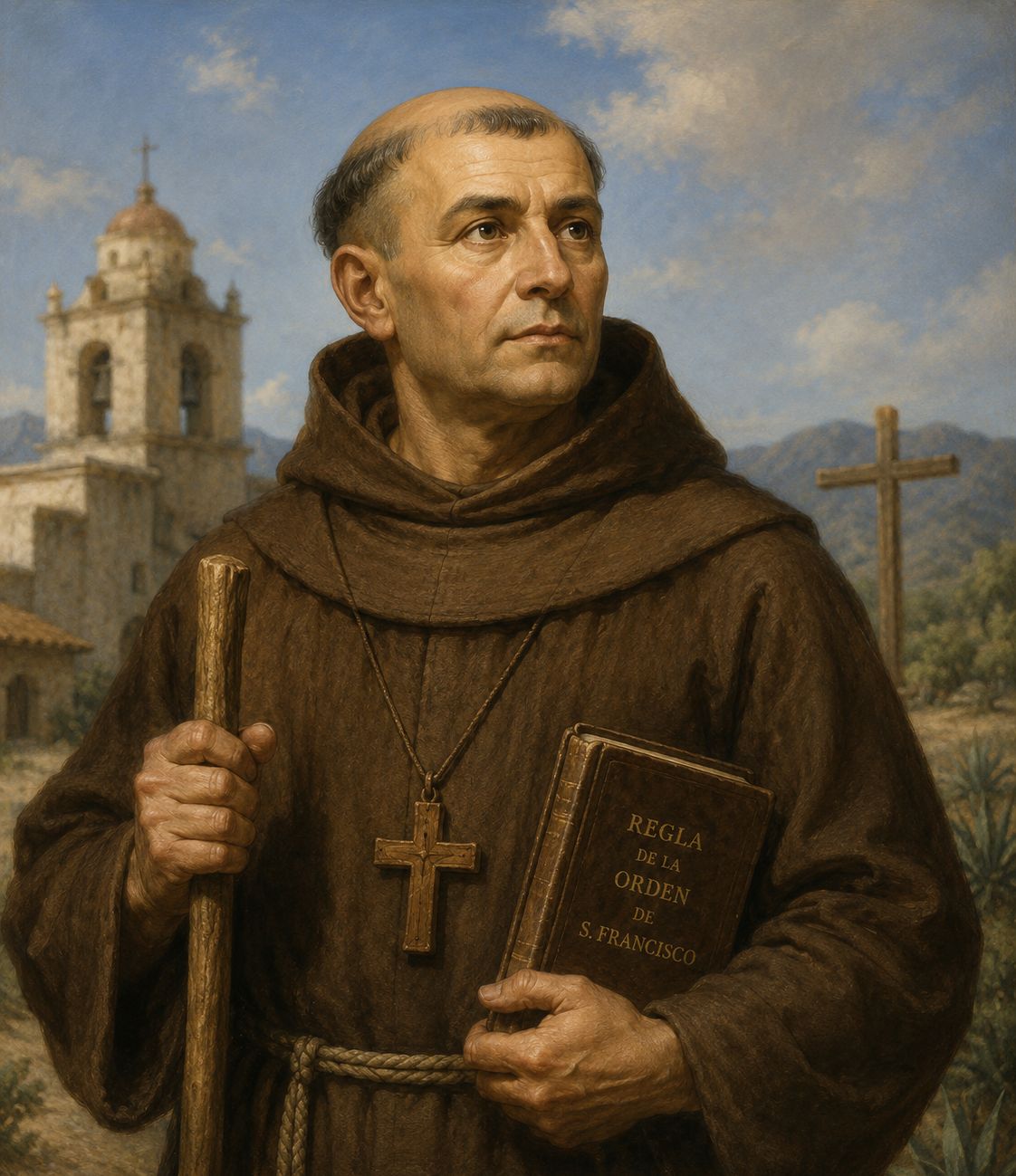
Saint Junipero Serra: The Apostle of California and Patron of Vocations
Saint Junipero Serra stands as one of the most influential missionaries in North American history. Born Miguel José Serra on the Spanish Island of Majorca, this Franciscan friar would eventually earn the title “Apostle of California” through his tireless work among indigenous peoples. Furthermore, the feast day of Saint Junipero Serra on July 1 continues to inspire those discerning religious vocations, since the Church honours him as patron of vocations. In fact, his legacy extends far beyond the 21 missions that transformed the landscape of early California.
Feast Day of Saint Junipero Serra: July 1
The Catholic Church commemorates Saint Junipero Serra on July 1 each year. This date marks the celebration of a man who devoted his entire adult life to spreading the Gospel across two continents. Moreover, his designation as patron of vocations reflects his own dramatic calling. After all, he abandoned a prestigious academic career in Spain at age 36 to become a missionary in the New World. Consequently, his feast day holds special significance for anyone considering priesthood, religious life, or missionary work.
Early Life and Formation of Saint Junipero Serra
Saint Junipero Serra was born in November 24, 1713, in Petra, Majorca, Spain. His parents, Antonio Nadal Serra and Margarita Rosa Ferrer, worked the land as humble farmers. In fact, they had him baptized at St. Peter’s Church in Petra on the very same day of his birth. As a child, he attended the primary school run by Franciscans in his hometown. However, his life took a decisive turn at age 15 when his parents entrusted him to a cathedral canon in Palma.
There, he began attending philosophy classes at the Franciscan monastery of San Francisco. On September 14, 1730, he became a novice at the Convento de Jesús near Palma. A year later, on September 15, 1731, he made his religious profession and chose the name Junípero in honor of St. Francis of Assisi’s beloved companion. Subsequently, he pursued advanced studies in philosophy and theology at the Convento de San Francisco. Although the exact date of his priestly ordination remains unknown, scholars believe it occurred during December 1738. In 1742, he earned his doctorate in theology from Lullian University in Palma. By January 1749, he had become the primary professor of theology at that same university.
Saint Junipero Serra’s Journey to the New World
Despite his academic success, Saint Junipero Serra yearned for missionary work. Therefore, when the call came for volunteers to evangelize in America, he responded with enthusiasm. On April 13, 1749, accompanied by his former student Francisco Palóu, he set sail for the New World. After a long voyage, they arrived in Vera Cruz, Mexico, on December 7, 1749.
Remarkably, although Horses were provided for the journey, Saint Junipero Serra chose to walk the 250 miles from Vera Cruz to Mexico City. This decision would have lasting consequences. During that arduous trek, an insect bite infected his left leg, causing varicose ulcers that would plague him for the rest of his life. On January 1, 1750, he reached San Fernando College, having spent the previous night in prayer at the Shrine of Our Lady of Guadalupe.
Saint Junipero Serra in Sierra Gorda and Mexico
Within six months of arriving, Saint Junipero Serra volunteered for the Sierra Gorda missions. Between 1750 and 1758, he worked among the Pame Indians with extraordinary dedication. Not only did he oversee construction of a church that still stands today, but he also promoted both religious and economic development in the region. Additionally, he learned the Otomí language so he could teach the indigenous people more effectively. Under his leadership, missionaries built churches in four other towns as well.
Afterward, he returned to the college of San Fernando, where he served in multiple roles. Specifically, he worked as choir director, master of novices, college counselor, and confessor. Furthermore, he preached missions as a home missionary across various Mexican cities. In 1767, he was appointed president of the ex-Jesuit missions of Baja California.
California Missions: The Work of Saint Junipero Serra
Saint Junipero Serra’s enthusiasm for spreading the faith led him to volunteer for expeditions to Upper California in 1768. He reached Loreto on April 1, where he oversaw 15 missions stretching from San José del Cabo to Santa María. However, his most enduring work lay ahead in what is now the U.S. state of California.
On July 16, 1769, he founded Mission San Diego de Alcalá, the first of nine missions he would establish in Upper California. Over the following years, Saint Junipero Serra founded Mission San Carlos (1770), Mission San Antonio (1771), Mission San Gabriel (1771), Mission San Luis Obispo (1772), Mission San Francisco (1776), Mission San Juan Capistrano (1776), Mission Santa Clara (1777), and Mission San Buenaventura (1782). He also participated in the founding of Presidio Santa Barbara in 1782.
Throughout this work, he faced severe health challenges. His leg and foot problems worsened, often requiring him to travel on a stretcher. Despite these physical afflictions, he dedicated the next 15 years of his life to evangelizing in Upper California. Moreover, he fought tirelessly for the rights of indigenous converts against military abuses and royal interference.
Death and Legacy of Saint Junipero Serra
Saint Junipero Serra passed away on August 28, 1784, at Mission San Carlos, the headquarters he had established. He was buried in the church he himself had constructed. By the end of that same year, the first nine missions had baptized 6,736 Indians, while 4,646 Christianized Indians resided within their walls.
The cause for his beatification began in 1934 and concluded in 1949. Pope John Paul II beatified him on September 25, 1988. Finally, Pope Francis canonized Saint Junipero Serra on September 23, 2015, during a Mass at the Basilica of the National Shrine of the Immaculate Conception in Washington, D.C. This ceremony marked the first canonization ever performed on American soil.
Today, Saint Junipero Serra is widely recognized as the Apostle of California. Numerous monuments and memorials commemorate his legacy along the El Camino Real. Nevertheless, his legacy remains complex, as modern scholars continue to examine both his devotion to indigenous peoples and the difficult realities of the colonial mission.



Leave a Reply