
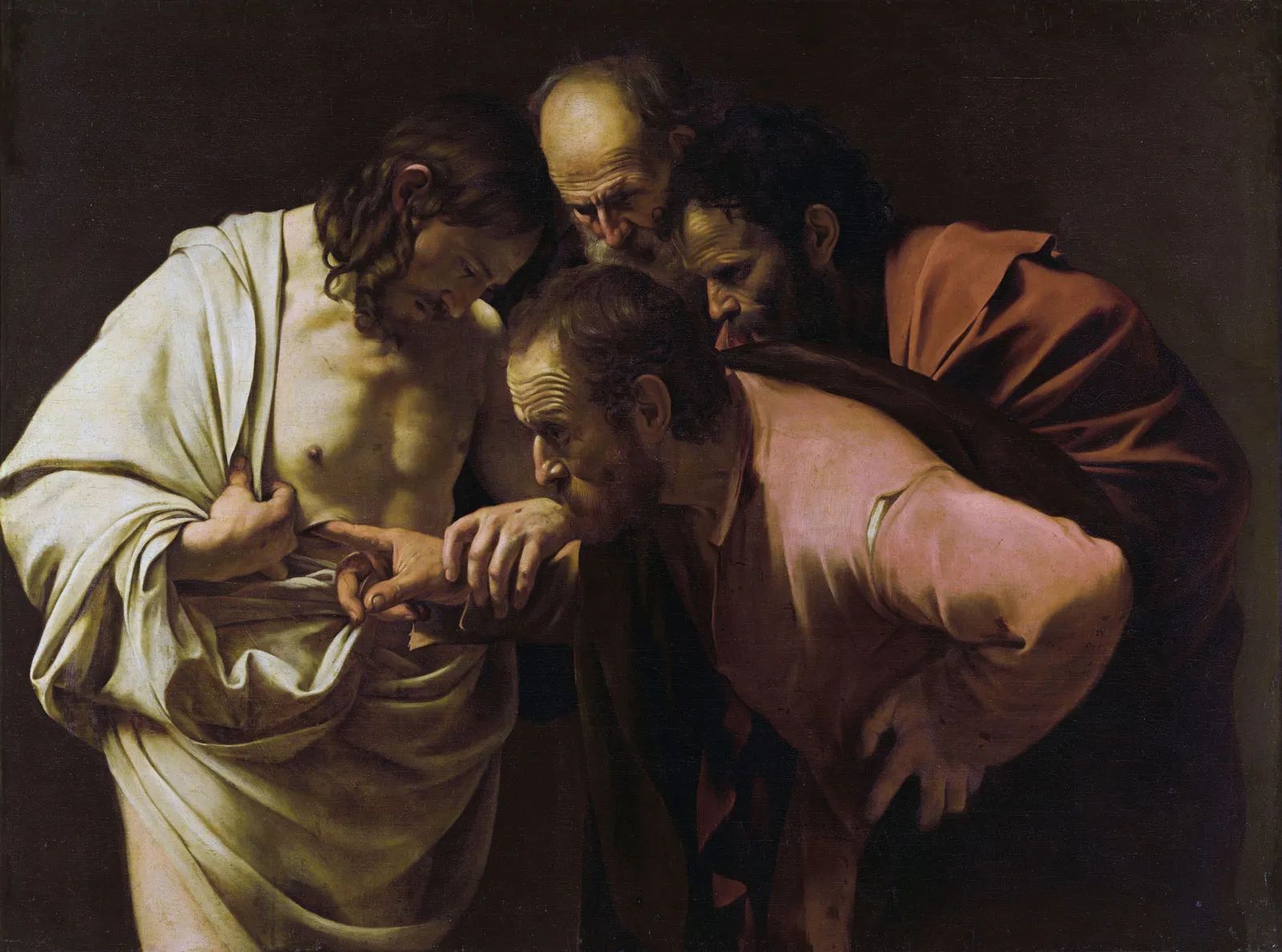
Image Credit: “The Incredulity of Saint Thomas” by Caravaggio, c. 1601–1602. Source: Wikimedia Commons / Public Domain.
Saint Thomas the Apostle: From Doubter to Evangelist of India
Saint Thomas the Apostle stands among the most compelling figures in Christian history. Known widely as “Doubting Thomas,” this Jewish-born disciple transformed from a skeptical follower into one of the most far-reaching missionaries of the early Church. Furthermore, his feast day on July 3 honors a man who carried the Gospel from the shores of Galilee all the way to the Indian subcontinent. In fact, millions of believers today still trace their spiritual heritage directly to his evangelistic work.
Feast Day of Saint Thomas the Apostle: July 3
The Catholic Church celebrates Saint Thomas the Apostle on July 3, a date transferred from the traditional December 21 in 1969 to avoid conflict with Advent. However, traditionalist Roman Catholics, Lutherans, and Anglicans following the 1662 Book of Common Prayer still observe his feast on December 21. Meanwhile, the Eastern Orthodox Church commemorates him on October 6 as his primary feast day, along with June 20 and June 30. Consequently, St. Thomas the Apostle enjoys one of the most widely distributed feast day calendars among the Twelve Apostles.
Early Life and Calling of St. Thomas the Apostle
Born into a Jewish family, the future apostle entered history with the Aramaic name Tʾōmā, meaning “the Twin.” The Greek equivalent, Didymus, appears alongside his name in the New Testament. Although his exact birthplace remains unknown, Scripture first introduces him as one of the Twelve Apostles chosen by Christ. Moreover, his impetuous nature quickly revealed itself through his unwavering loyalty to Jesus.
When Jesus announced plans to return to Judea to visit the ailing Lazarus, the other disciples hesitated because of the mounting hostility from Jewish authorities. Nevertheless, St. Thomas the Apostle immediately urged his fellow apostles to accompany their Master, declaring, “Let us also go, that we may die with him.” This bold statement reveals a man willing to face death rather than abandon Christ.
Saint Thomas the Apostle at the Last Supper
During the Last Supper, Jesus told His disciples that He would prepare a place for them and that they already knew both the way and the destination. At this point, St. Thomas the Apostle spoke up with a question that resonated through the ages: “Lord, we know not whither thou goest; and how can we know the way?” In response, Jesus delivered one of the most profound declarations in Scripture: “I am the way, the truth, and the life.” Thus, his honest confusion opened the door to theological clarity that continues to comfort believers worldwide.
Saint Thomas the Apostle: From Skeptic to Believer
The episode that forever branded him as “Doubting Thomas” occurred after the Resurrection. When the other apostles reported seeing the risen Christ, Saint Thomas the Apostle refused to believe without direct physical evidence. He demanded, “Except I shall see on his hands the print of the nails, and put my finger into the print of the nails, and thrust my hand into his side, I will not believe.”
Eight days later, Jesus appeared again and specifically invited him to examine His wounds. Upon touching the nail marks and placing his hand into Christ’s side, St. Thomas the Apostle made the supreme profession of faith: “My Lord and my God!” Jesus gently rebuked his skepticism yet blessed those who would believe without seeing. Today, the phrase “doubting Thomas” has entered everyday language as a term for any skeptic who demands proof before believing.
Saint Thomas the Apostle at Lake Tiberias
Scripture also places St. Thomas the Apostle among the disciples fishing at Lake Tiberias when the resurrected Jesus appeared for another miraculous catch. This appearance reinforced his restored faith and prepared him for the extraordinary missionary journey ahead. Additionally, ancient tradition holds that he alone witnessed the Assumption of Mary into heaven, receiving her girdle as proof when the other apostles doubted his account.
Mission to India: Saint Thomas the Apostle as Apostle of the East
After Pentecost, tradition says the apostles dispersed to evangelize distant lands. St. Thomas the Apostle reportedly traveled to Parthia, Media, and Persia before embarking on his most famous mission. Around 52 AD, he arrived on the Malabar Coast of India at Muziris (modern Cranganore in Kerala). There, he established seven churches at Kodungallur, Palayoor, Kottakkavu, Kokkamangalam, Niranam, Nilackal, Kollam, and Thiruvithamcode.
His approach differed from other missionary efforts. Rather than imposing foreign customs, he adapted to local culture while preaching the Gospel. As a result, the Saint Thomas Christians of Kerala emerged as one of the oldest Christian communities in the world. Furthermore, he baptized numerous families, many of whom trace their lineage back to these first converts.
Martyrdom and Death of Saint Thomas the Apostle
According to Syrian Christian tradition, St. Thomas the Apostle met his death on July 3, 72 AD, at St. Thomas Mount near present-day Chennai (Madras). A fowler aiming at a peacock allegedly struck him with a spear instead, though other accounts describe direct martyrdom by soldiers. Regardless of the exact circumstances, he gave his life for the faith he once doubted. Meanwhile, Latin tradition places his death on December 21.
Relics and Sacred Sites of Saint Thomas the Apostle
The body of St. Thomas the Apostle was interred at Mylapore, where the San Thome Basilica now stands. Portuguese missionaries first built a church there in the 16th century, and the British rebuilt it in the 19th century. Moreover, some relics traveled to Edessa in 232 AD, then moved to Ortona, Italy, in 1258, where they remain in the Cathedral of St. Thomas the Apostle. His skull reportedly rests at the Monastery of Saint John the Theologian on Patmos, Greece. In 1964, workers discovered his finger bones in Mosul, Iraq, later transferring them to the Monastery of Saint Matthew for safekeeping.
Patronage and Legacy of Saint Thomas the Apostle
The Church recognizes Saint Thomas the Apostle as patron saint of Architects, Builders, and Carpenters, stemming from a tradition that he assisted in constructing a church despite pagan opposition. Additionally, he serves as patron of India and the Saint Thomas Christians. His feast on July 3 is celebrated as Indian Christians’ Day, honouring his foundational role in the subcontinent’s Christian history.
In art, artists typically depict him as a young man holding a scroll or touching Christ’s wounds. The Saint Thomas Cross, also called the Nasrani Menorah, remains a powerful symbol among Kerala Christians. Furthermore, the Gospel of Thomas discovered at Nag Hammadi in 1945 sparked renewed scholarly interest, though the Church considers it apocryphal.
Prayer to Saint Thomas the Apostle
Believers continue to pray: “Dear Saint Thomas, you were once slow in believing that Christ had gloriously risen; but later, because you had seen him, you exclaimed: ‘My Lord and my God!’ Please bless architects, builders, and carpenters that through them the Lord may be honored. Amen.”

Leave a Reply