
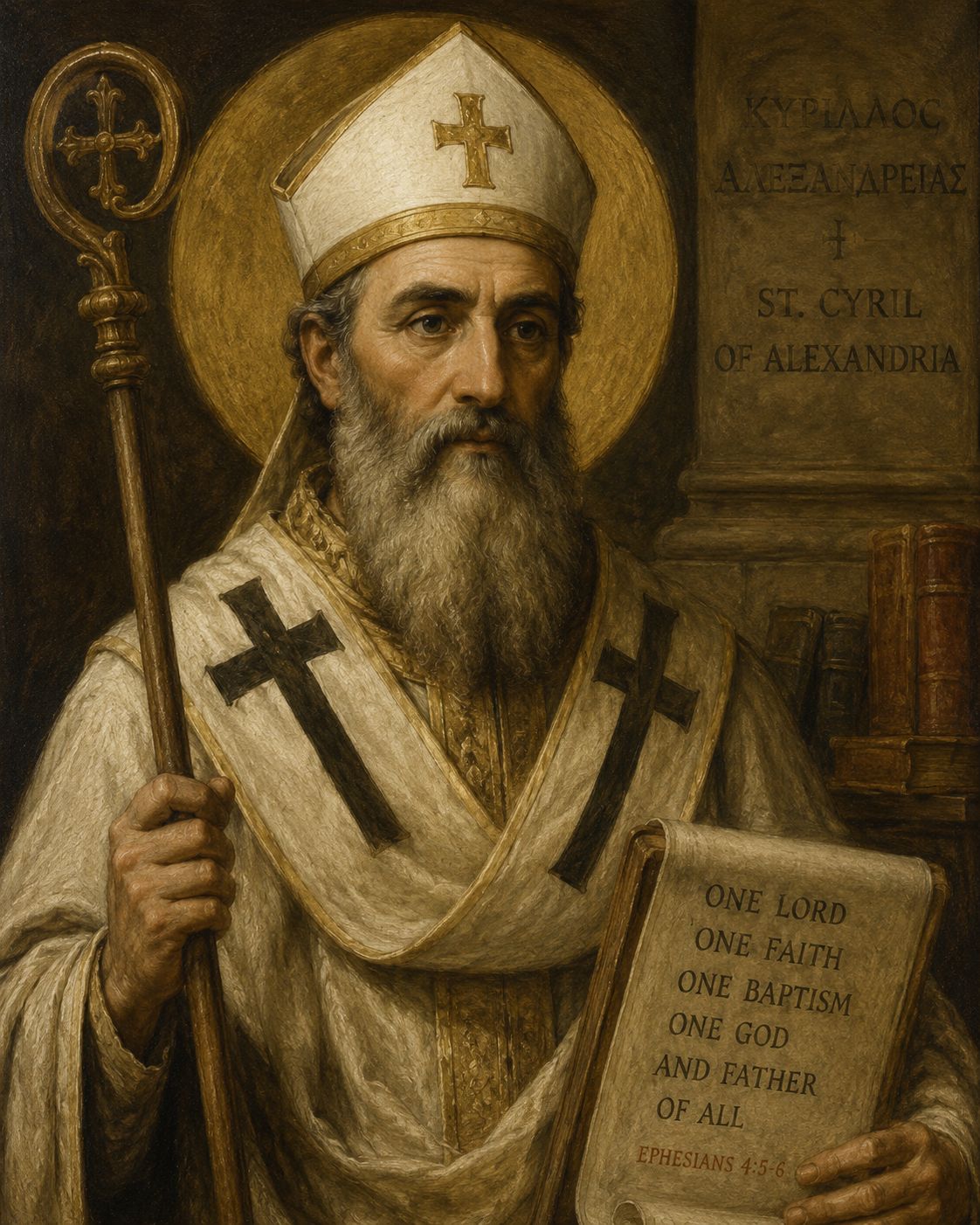
Saint Cyril of Alexandria: The Pillar of Faith Who Defined Mary as Mother of God
Saint Cyril of Alexandria stands among the most formidable theologians in Christian history. As Patriarch of Alexandria from 412 to 444, he battled heresies that threatened to fracture the Church, championed the divine motherhood of Mary, and shaped Christological doctrine for millennia. His unwavering defense of orthodox teaching at the Council of Ephesus earned him the titles “Pillar of Faith” and “Seal of all the Fathers.”
The Feast Day of Saint Cyril of Alexandria
The Church commemorates Saint Cyril of Alexandria on June 27, the date traditionally recognized as his death in the Year 444. The Coptic Orthodox Church had long celebrated this anniversary, and the Catholic Church adopted it during the 1969 calendar reform, moving his feast from its previous February 9 date. Eastern Orthodox and Byzantine Catholic communities honour him on June 9, while the Church of England remembers him on June 27 alongside the Catholic observance.
Formation in the Shadow of Power
Cyril was born around 376 in Didouseya, Egypt, near modern-day El-Mahalla El-Kubra. His family connections positioned him for extraordinary influence. His maternal uncle, Theophilus, ascended to the Patriarchate of Alexandria, one of Christianity’s most powerful sees. Under this uncle’s guidance, Cyril received an elite education that prepared him for leadership.
His studies followed the standard pattern for promising young Christians of his era. Between ages twelve and fourteen, he mastered grammar. From fifteen to twenty, he studied rhetoric and humanities. Finally, from twenty-two to twenty-six, he immersed himself in theology and biblical studies. His later writings reveal deep familiarity with Christian intellectuals including Eusebius, Origen, and Didymus the Blind.
In 403, Cyril accompanied Theophilus to Constantinople for the infamous “Synod of the Oak,” which deposed the beloved John Chrysostom as Archbishop. This episode exposed young Cyril to the brutal political realities of ecclesiastical power. Theophilus had marched against Egyptian monks with armed servants, burning their dwellings and persecuting them as Origenists. He then drafted largely unfounded accusations against Chrysostom. Cyril witnessed how ruthlessly his uncle wielded authority, lessons that would shape his own patriarchate.
Assuming the Patriarchate
Theophilus died on October 15, 412, and Cyril succeeded him as Patriarch of Alexandria just three days later. His enthronement was not peaceful. A violent riot erupted between Cyril’s supporters and those of his rival, Archdeacon Timotheus. Socrates Scholasticus later observed that Alexandrians were perpetually rioting, suggesting this turmoil was characteristic rather than exceptional.
Cyril inherited a see of immense prestige. Alexandria rivaled Constantinople and Rome in theological influence. Yet the city teemed with tension among its pagan, Jewish, and Christian populations. The prefect wielded secular authority that frequently clashed with ecclesiastical claims. Cyril moved swiftly to consolidate his position, closing Novatianist churches and seizing their sacred vessels.
Conflict with Orestes and the Hypatia Tragedy
The Praefectus augustalis Orestes resisted Cyril’s encroachment upon civil authority. Their feud intensified dramatically in 415 when Orestes issued regulations regarding public entertainments. Cyril sent a grammaticus named Hierax to investigate, and Hierax’s presence at a public reading provoked a disturbance. Orestes responded by torturing Hierax publicly, asserting his dominance over the patriarch.
Cyril threatened Alexandria’s Jewish community with “the utmost severities” unless harassment of Christians ceased. The Jews retaliated with a horrific ruse. They ran through streets at night shouting that the Church of Alexander was burning. When Christians rushed out to save their church, the Jews attacked them in the darkness, using rings to identify one another while killing everyone else. Morning light revealed a massacre.
Cyril then rounded up Jews, stripped them of possessions, and banished them from the city. Orestes was “excessively grieved” that Alexandria lost so many residents, and their conflict deepened. Both men wrote to Emperor Theodosius II. Cyril attempted reconciliation through mediators and by showing Orestes the Gospels, interpreting them to demand submission to religious authority. Orestes remained unmoved.
The situation grew more volatile when Nitrian monks arrived and instigated riots. They assaulted Orestes, accused him of paganism, and one monk named Ammonius struck him with a stone. Orestes had Ammonius tortured to death, yet Cyril allegedly honoured him as a martyr. The Christian community showed little enthusiasm for this designation.
The most notorious episode of Cyril’s patriarchate followed. Hypatia, a renowned philosopher, astronomer, and mathematician, enjoyed immense moral authority and close ties to Orestes. Many believed her influence prevented reconciliation between prefect and patriarch. In March 415, during Lent, a Christian mob led by a lector named Peter intercepted Hypatia’s carriage. They dragged her to the Kaisarion, a former pagan temple converted into a church. There, they stripped her naked and murdered her with roof tiles or oyster shells. Some accounts say they gouged out her eyes, tore her body apart, and burned the remains outside the city.
Historians continue debating Cyril’s direct responsibility for this atrocity. Socrates Scholasticus, our primary source, never explicitly names Cyril as ordering the murder. However, he condemns the violence unequivocally, declaring that “nothing can be farther from the spirit of Christianity than the allowance of massacres.” The murder brought “no small disgrace” to Cyril and the entire Alexandrian Church. Damascius, writing later, directly blames Cyril. Modern scholars remain divided, with some emphasizing the political context and others noting Cyril’s inflammatory rhetoric against pagans and his rival Orestes.
The Nestorian Controversy and the Council of Ephesus
Cyril’s defining achievement emerged from his conflict with Nestorius, who became Archbishop of Constantinople in 428. A priest under Nestorius began preaching against calling Mary “Mother of God” (Theotokos), arguing instead for “Mother of Christ” (Christotokos). Nestorius defended this position, claiming that Mary bore the human Jesus but not the divine Logos.
Cyril recognized this as a fundamental threat to Christ’s unity. If Mary was not God’s mother, then Christ was not truly God incarnate. Beginning in 429, Cyril wrote letters to ecclesiastical authorities defending Theotokos. He cited earlier theologians including Athanasius and the Cappadocian Fathers who had used the term. The controversy escalated through increasingly strident exchanges between Cyril and Nestorius.
In 430, Cyril issued his famous Twelve Anathemas, condemning anyone who refused to call Mary Theotokos. Emperor Theodosius II convoked the Council of Ephesus in 431 to resolve the dispute. Cyril chose Ephesus deliberately because the city venerated Mary intensely. He convened the council before Nestorius’s supporters from Antioch arrived. When summoned, Nestorius refused to attend. The council deposed and exiled him for heresy.
However, John of Antioch and pro-Nestorius bishops soon reached Ephesus and held their own council. They condemned Cyril for heresy, deposed him, and labeled him “a monster, born and educated for the destruction of the church.” Theodosius annulled the original council’s verdict and arrested Cyril. Yet Cyril escaped to Egypt, bribed imperial courtiers, and sent a mob led by the hermit Dalmatius to besiege the emperor’s palace. Theodosius eventually capitulated, sending Nestorius into exile in Upper Egypt.
Theological Vision and Mariology
Cyril’s theology centered on the profound mystery of God becoming human. He taught that the divine Word truly suffered “in the flesh,” maintaining that the Logos Incarnate experienced death on the cross. This was not merely the human nature suffering while the divine nature remained aloof. Rather, the single subject—God the Word—underwent passion and resurrection.
His famous formula, “one physis of the Word of God made flesh,” became the rallying cry of miaphysite Christianity. Cyril stressed that God himself walked Nazareth’s streets, making Mary truly Theotokos. This was not primarily about elevating Mary, though his Mariology became extraordinarily rich. It was about protecting Christ’s identity. If Mary bore only a man, then God had not truly entered creation.
Cyril’s Marian teachings overflowed with reverence. He called Mary “container of the uncontained,” “the place for the infinite,” “treasure of the world,” “crown of virginity,” and “scepter of orthodoxy.” His Homily IV at Ephesus stands among the earliest attestations of invoking Mary with the salutation “Hail” (Chaire). The council met in the newly constructed Church of Mary, whose devotional atmosphere shaped the theological debates.
Legacy as Doctor of the Church
Cyril died around 444, yet controversies surrounding his theology continued for decades. The “Robber Synod” of Ephesus in 449 and the Council of Chalcedon in 451 both wrestled with questions he had raised. The Second Council of Constantinople in 553 formally recognized his orthodoxy, declaring him one “who announced the right faith of Christians.”
The Catholic Church eventually named him a Doctor of the Church, acknowledging his immense contribution to Christian thought. His extensive writings include biblical commentaries, Thesaurus, Discourse Against Arians, commentary on John’s Gospel, and dialogues on the Trinity. His output was so prolific that opponents could not match it.
Saint Cyril of Alexandria remains controversial yet indispensable. His methods were sometimes brutal, his political maneuvering ruthless. Yet his theological insight—that in Jesus, God truly became one of us, and that Mary therefore deserves the title Mother of God—stands as a cornerstone of Christian faith. In an age that often separates the human from the divine, his insistence on their union in Christ speaks with fresh urgency.

Leave a Reply