
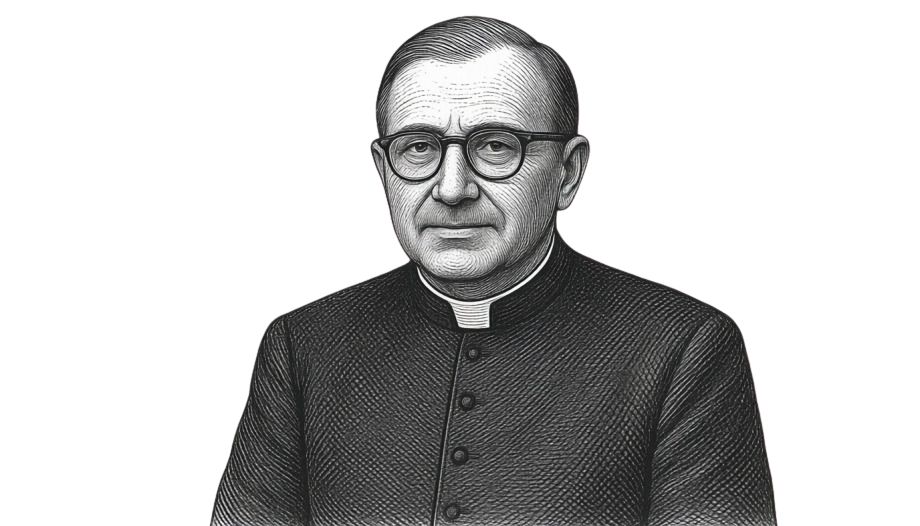
Saint Josemaría Escrivá de Balaguer: Sanctity in the Ordinary
Saint Josemaría Escrivá de Balaguer revolutionized Catholic spirituality by insisting that holiness belongs not only to monasteries but also to offices, kitchens, and construction sites. As founder of Opus Dei, he taught that everyday work, when offered to God, becomes a powerful path to divine union. His message of “sanctifying the ordinary” has transformed millions of lives across six continents.
The Feast Day of Saint Josemaría Escrivá de Balaguer
The Church celebrates Saint Josemaría Escrivá de Balaguer on June 26, commemorating the day he died in 1975. Pope Saint John Paul II both beatified and canonized this modern saint, declaring him Blessed on May 17, 1992, and raising him to sainthood on October 6, 2002. These ceremonies recognized a man who had lived within living memory yet whose spiritual impact already spanned the globe.
Childhood Trials in Barbastro
Josemaría was born on January 9, 1902, in Barbastro, a city in northern Spain. He was the second of six children born to José and Dolores Escrivá. His family practiced their Catholic faith with evident devotion, and young Josemaría absorbed essential truths through regular confession, Holy Communion, rosary prayer, and charitable giving.
Nevertheless, hardship arrived early. Three of his younger sisters died during his childhood, teaching him profound lessons about mortality and faith. Then his father’s business collapsed after financial reversals, plunging the family into poverty. These sufferings could have embittered him. Instead, they matured his naturally cheerful temperament, forging a resilience that would sustain his future mission.
In 1915, the family relocated to Logroño, where José Escrivá had secured new employment. This move proved providential, for it was here that Josemaría’s vocation began crystallizing.
Discerning a Priesthood of Availability
Beginning in 1918, Josemaría sensed that God was asking something specific from him. He could not yet identify what this calling entailed. Consequently, he chose priesthood as the path of maximum availability, ensuring he would be ready whenever divine intentions became clear.
He commenced seminary studies first in Logroño and later in Zaragoza. At his father’s suggestion, and with seminary approval, he also pursued civil law. This dual formation—sacred and secular—would later prove essential for his work among ordinary professionals. He received priestly ordination in 1925 and launched his pastoral ministry immediately.
Madrid: Poverty, Pastoral Zeal, and Foundational Grace
In 1927, Josemaría moved to Madrid to earn a graduate law degree. His mother, sister, and brother accompanied him, since his father had died in 1924 and Josemaría now headed the family. Their financial situation remained precarious. To support them, he tutored law students while simultaneously undertaking demanding pastoral work.
His ministry in Madrid focused particularly on the poor and sick. He visited hospitals, comforted the suffering, and catechized young children. Additionally, he developed an apostolate among manual labourers, professionals, and university students. These contacts with the needy taught his followers the practical meaning of charity and their Christian duty to improve society.
On October 2, 1928, everything changed. During a retreat in Madrid, God revealed his precise mission: he would establish Opus Dei, an institution within the Catholic Church helping people from every walk of life to follow Christ, seek holiness in daily living, and grow in love for God and neighbor. From that moment, Josemaría dedicated every ounce of energy to this mission, convinced that God had raised up Opus Dei to serve the universal Church.
Expanding Opus Dei’s Reach
In 1930, another divine illumination prompted Josemaría to extend Opus Dei’s apostolic work to women. He made clear that women carried the same responsibility as men to serve society and the Church. This expansion doubled the organization’s potential impact and affirmed its universal character.
The first edition of The Way, his most widely read work, appeared in 1934 under the title Spiritual Considerations. Expanded and revised through subsequent editions, it has sold over four million copies across dozens of languages. His other writings include Holy Rosary, The Way of the Cross, homily collections Christ Is Passing By and Friends of God, and the reflection books Furrow and The Forge. Each volume consists of brief points for prayer and meditation, perfectly suited for busy modern lives.
Surviving Persecution and Building Peace
Opus Dei’s development began among young people Josemaría knew before 1928. However, the Spanish Civil War (1936–1939) inflicted severe religious persecution upon the Catholic Church, gravely impeding this growth. The founder himself endured extreme hardships during these years. Unlike many fellow priests, he survived the conflict.
After the war, he traveled throughout Spain giving retreats to hundreds of priests at their bishops’ request. Meanwhile, Opus Dei expanded from Madrid into other Spanish cities. As soon as World War II concluded in 1945, the organization began establishing itself internationally. This growth brought pain as well as progress. Although local bishops consistently approved the Work, its then-unfamiliar message of worldly sanctity encountered misunderstandings and suspicions. Josemaría bore these difficulties with remarkable patience and charity.
Priestly Society and Pontifical Approvals
In 1943, while celebrating Mass, Josemaría received another foundational grace: he would establish the Priestly Society of the Holy Cross. This made it possible for some Opus Dei lay members to receive priestly ordination. The full integration of lay faithful and priests within Opus Dei, enabling seamless cooperation in apostolic work, constitutes an essential feature of the organization’s foundational charism. The Church later affirmed this structure by granting Opus Dei canonical status as a personal prelature.
Recognizing that God intended Opus Dei for the universal Church, Josemaría moved to Rome in 1946 to remain near the Holy See. By 1950, pontifical approvals had confirmed the Work’s main features: spreading holiness in daily life, service to the Pope and local churches, secularity and naturalness, and fostering personal freedom within Catholic moral and social teaching.
Beginning in 1948, married people could become full members. Two years later, the Holy See approved accepting non-Catholics and even non-Christians as cooperators—individuals who assist Opus Dei’s projects without formal membership. The following decade witnessed an explosion of initiatives: professional schools, agricultural training centers, universities, primary and secondary schools, hospitals and clinics. These institutions welcomed people of every race, religion, and social background, though they operated with manifestly Christian inspiration.
Vatican II and Global Catechesis
During the Second Vatican Council (1962–1965), Monsignor Escrivá collaborated closely with numerous council fathers. He discussed crucial themes including the universal call to holiness and the layperson’s vital role in the Church’s mission. Profoundly grateful for the Council’s teachings, he worked tirelessly to implement them through Opus Dei’s formative activities worldwide.
Between 1970 and 1975, the founder undertook extensive catechetical journeys across Europe and Latin America. He addressed enormous gatherings about love for God, the sacraments, Christian commitment, and the need to sanctify work and family life. By the time of his death, Opus Dei had reached thirty nations on six continents.
A Sudden Homecoming
Monsignor Escrivá’s death came unexpectedly on June 26, 1975, in Rome. He was seventy-three years old. The news prompted an outpouring of petitions from bishops and faithful alike, urging the Vatican to initiate his cause for beatification and canonization.
Pope John Paul II responded to this universal acclaim. On May 17, 1992, he declared Josemaría Blessed before an immense crowd in Saint Peter’s Square. Ten years later, on October 6, 2002, the same pope formally canonized him, confirming what millions already believed: this man who taught holiness through typing letters, cooking meals, and studying contracts had himself achieved extraordinary union with God.
The Enduring Message of Saint Josemaría Escrivá de Balaguer
Saint Josemaría Escrivá de Balaguer left a legacy that continues expanding. Today, Opus Dei numbers more than ninety thousand members across ninety countries. His writings remain bestsellers in spiritual literature. Most importantly, his central insight—that God calls everyone to holiness precisely through their ordinary circumstances—has become mainstream Catholic teaching.
Contemporary believers facing desk jobs, diaper changes, or difficult commutes can find in Josemaría a companion who understood their struggles. He never asked people to abandon their responsibilities for monastic peace. Instead, he showed them how to transform their existing duties into offerings of love. In a world that often separates the sacred from the secular, his message feels more necessary than ever.
Leave a Reply