
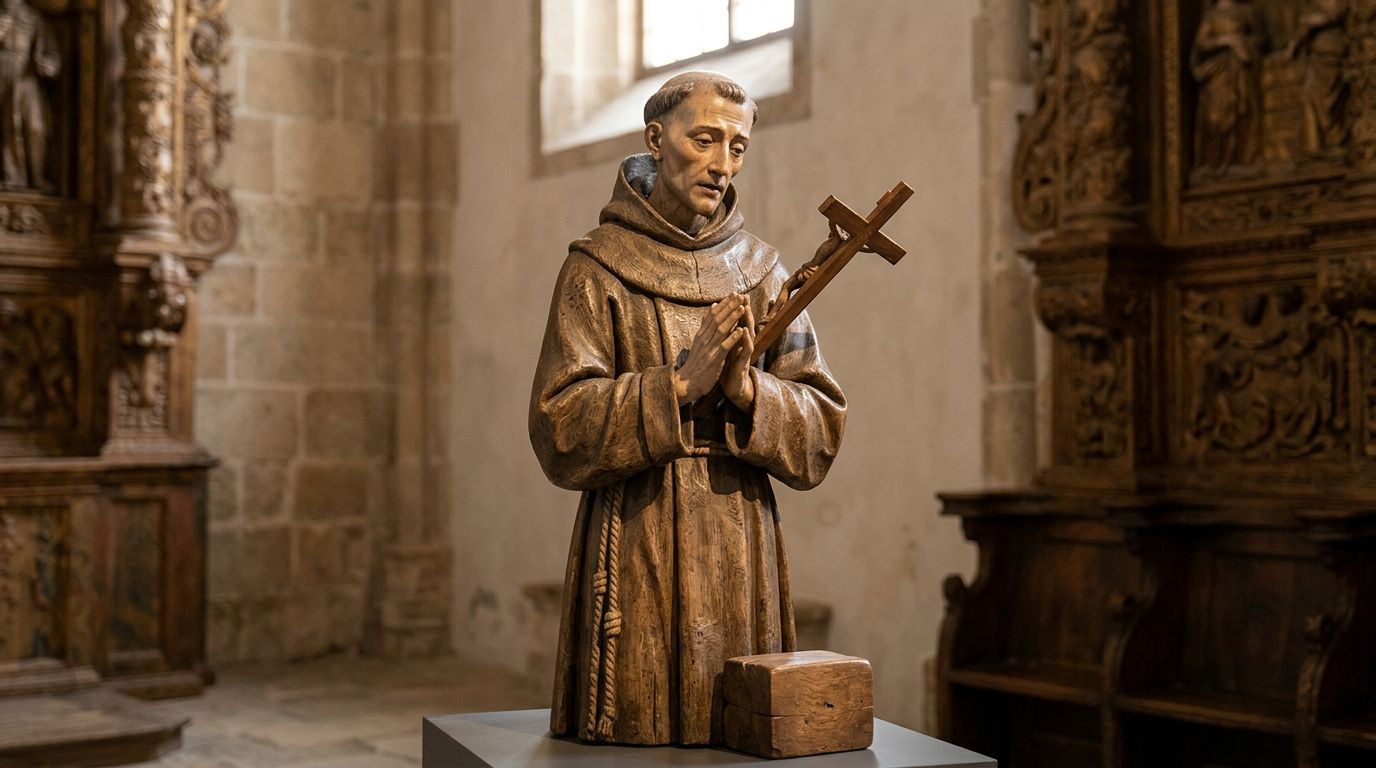
Taught the Church to Pray with Total Devotion
The Church remembers Saint Peter of Alcantara on October 19. Indeed, the Franciscans in most of the world keep this memorial. In the United States, however, they observe it on October 22, to make room for the Jesuit martyrs. Moreover, the Roman Martyrology now lists him on October 18, the day he died. Therefore, this article looks at the life of a friar whose austerity amazed his age.
Saint Peter of Alcantara was born in 1499 in Alcántara, in the Extremadura region of Spain. His family belonged to the nobility, and his father served as governor of the town. As a boy, Peter showed a serious and prayerful nature. Afterwards, he studied law at the University of Salamanca. However, he soon felt a stronger call. Consequently, he left his studies and joined the Franciscan Order at the age of 16.
Peter entered the Observant Franciscans in 1515, at the small friary of Manjarés. Soon after, he began to practise severe penance. He received ordination as a priest in 1524. Then his superiors asked him to preach and he travelled widely. His sermons moved large crowds. In addition, he served as guardian of several friaries. Thus, he gained wide experience in both preaching and leadership.
Peter dreamed of a stricter form of Franciscan life. In 1538, he became provincial of the Franciscan province of Saint Gabriel in Extremadura. However, his plans for severe rules met opposition from other friars. As a result, he resigned and withdrew to a quiet place to pray. Later, he founded a tiny friary at El Palancar in 1557 and its cells were barely large enough to lie down. Eventually, his movement became known as the Alcantarines, or Discalced Franciscans.
His personal discipline was extraordinary. According to Saint Teresa of Avila, he often ate only once every three days. Sometimes he went a week without food. In addition, he slept very little and often slept sitting up. His cell had a block of wood for a pillow. Because he stayed awake while others slept, the Church later named him patron of night watchmen. Even so, he remained humble and gentle.
Peter’s influence reached far beyond his own order. Emperor Charles V wished to have him as confessor. However, Peter begged to be excused, because he did not seek honours. Moreover, Saint Francis Borgia wrote to praise his success in preaching. Peter also wrote the Treatise on Prayer and Meditation, which people have translated into many languages. Pope Gregory XV later declared that the Holy Spirit had inspired the little book.
His friendship with Saint Teresa of Avila stands out as his greatest legacy. Teresa wanted to reform the Carmelite Order, but many people doubted her plans. Peter listened to her carefully and recognised God’s hand in her work. Therefore, he encouraged her and defended her. In April 1562, he wrote a letter that urged her to found her first reformed monastery in Avila. Consequently, Teresa opened Saint Joseph’s convent that August.
Peter died on October 18, 1562, in the friary at Arenas de San Pedro, at the age of about 63. According to Teresa, she saw his soul rise to heaven. Later, he appeared to her and spoke of the glory that his penance had won. Pope Gregory XV beatified him in 1622, and Pope Clement IX canonised him on April 28, 1669. In 1670, the Church set his feast on October 19 because Saint Luke’s feast fell on October 18.
Today, the Church invokes him as patron of nocturnal adoration of the Blessed Sacrament. He is also patron of Brazil and of Extremadura. The Alcantarines later joined the wider Order of Friars Minor at the end of the 19th century. To learn more, read the Catholic Encyclopedia entry at New Advent or the Franciscan Tradition.
In conclusion, Saint Peter of Alcantara shows that deep prayer can renew the Church. He chose a hard path, yet he kept a gentle heart. Likewise, he helped a future Doctor of the Church to follow her vision. Therefore, let us ask for his prayers on this memorial. May we, too, give God our time and our silence.

Leave a Reply