
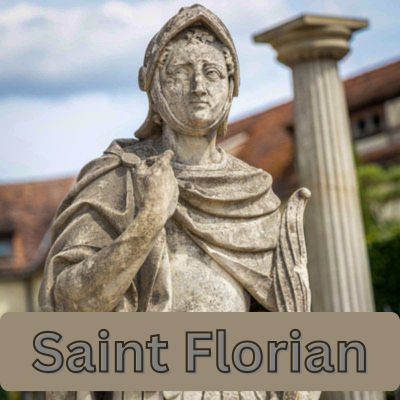
Image Credit: pamono.eu
St. Florian stands among the most revered soldier-saints of the early Church, remembered for his courage, unwavering faith, and heroic martyrdom during one of Christianity’s most violent persecutions. Celebrated annually on May 4, his life continues to inspire not only the faithful but also those who serve in dangerous professions, especially firefighters and emergency responders.
Born around 250 A.D. in the Roman city of Aelium Cetium—modern-day Sankt Pölten in present-day Austria—Florian grew up during a time when the Roman Empire was both powerful and hostile to the growing Christian faith. He joined the Roman army at a young age and quickly distinguished himself through discipline, leadership, and integrity. Rising through the ranks, he eventually became a commander in the province of Noricum, a region that corresponds to parts of modern Austria.
Beyond his military responsibilities, Florian was entrusted with organizing and leading firefighting brigades. In an era when fires could devastate entire towns, this role was of immense importance. He trained a specialized group of soldiers dedicated solely to combating fires, earning him recognition as one of the earliest known figures associated with organized firefighting. This aspect of his life later contributed to his patronage over firefighters, chimney sweeps, and those whose livelihoods involve managing fire.
Florian lived during the reign of Emperor Diocletian, whose persecution of Christians remains one of the most severe in history. As imperial edicts demanded strict enforcement against Christians, reports reached Roman authorities that Florian had failed to carry out these orders. Rather than hunting down believers, he was believed to have shown sympathy toward them, possibly even practicing the faith himself in secret.
To investigate these claims, a Roman official named Aquilinus was sent to Noricum. When confronted, Florian openly declared his Christian faith, refusing to offer sacrifice to the Roman gods as commanded. His bold confession placed him directly in defiance of imperial authority. According to tradition, Florian even presented himself voluntarily when he learned that Christians were being arrested, choosing solidarity with the persecuted over personal safety.
Initially sentenced to be burned alive, Florian displayed remarkable courage. Standing before the flames, he reportedly challenged his executioners, declaring that he was unafraid and willing to face death for Christ. His fearless demeanor unsettled the soldiers, who ultimately chose not to carry out the execution by fire. Instead, they subjected him to brutal torture—he was scourged and cruelly wounded—before being condemned to death by drowning.
Florian was taken to the River Enns, where a heavy stone was tied around his neck. He was then cast into the waters, sealing his martyrdom around the year 304 A.D. near what is now the region of Lorch, close to where the Enns meets the Danube. His death marked the ultimate testimony of faith, as he chose fidelity to Christ over allegiance to earthly power.
After his martyrdom, his body was recovered by Christians and reverently buried. A devout woman, traditionally named Valeria, is said to have played a role in ensuring his remains were properly interred. Over time, his tomb became a place of prayer and devotion. Eventually, his relics were moved to the Augustinian Abbey of St. Florian near Linz, which grew into a major center of pilgrimage. Some relics were later transferred to Rome and also to Kraków in Poland, further spreading his veneration across Europe.
By the 12th century, devotion to St. Florian had become especially strong in Poland after relics were gifted to the region by Pope Lucius III. From that time onward, he was honored as one of the nation’s patron saints. His protection was widely sought not only against fire but also against floods, lightning, and other natural dangers. Numerous miracles, particularly healings, have been attributed to his intercession.
St. Florian’s association with fire is reinforced by a popular legend in which he extinguished a massive blaze using only a single bucket of water. This story, though symbolic, highlights the spiritual truth of his life—his trust in God’s power even in the face of overwhelming danger. Because of this, he is often depicted in art holding a vessel of water, pouring it over burning buildings.
His legacy extends beyond religious devotion into cultural and everyday life. In parts of Austria and Germany, his name became widely used, especially among families seeking his protection. Fire services in these regions even adopted “Florian” as a call sign for fire engines, reflecting his enduring connection to their mission.
Despite the passage of centuries, the story of St. Florian remains deeply relevant. His life is a powerful reminder of courage under pressure, integrity in leadership, and faith in the face of persecution. As both a soldier and a servant, he exemplified how one can fulfill earthly duties while remaining faithful to a higher calling.
Today, St. Florian is honored as the patron saint of firefighters, chimney sweeps, soap makers, and brewers, as well as the regions of Upper Austria and Poland. His feast day on May 4 is celebrated with prayers, processions, and special devotions, particularly in Central Europe where his influence has been strongest.
In remembering St. Florian, the Church presents a model of steadfast faith and heroic virtue. His story is not merely one of suffering, but of triumph—a life fully given to God, crowned by martyrdom, and remembered through centuries of devotion.



Leave a Reply