
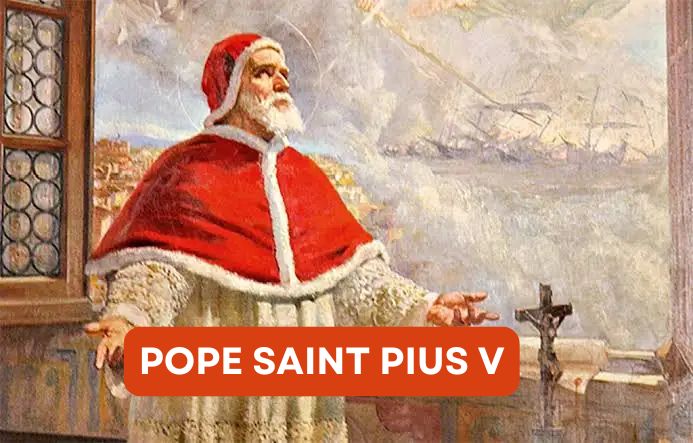
Image Credit: Heralds of the Gospel Magazine
The Pope Who Shaped the Catholic Reformation
Saint Pius V, born Antonio Ghislieri in 1504 in Bosco, Italy, stands as one of the most influential popes of the 16th century and a central figure in the Catholic Reformation. Rising from humble beginnings, his life journey—from shepherd boy to Supreme Pontiff—reflects a profound commitment to discipline, orthodoxy, and reform within the Church. His feast day is celebrated on April 30, and his legacy continues to shape Catholic liturgy and doctrine today.
Born into a poor family, Antonio spent his early years tending sheep. At the age of fourteen, he entered the Dominican Order, adopting the name Michele. His intellectual promise soon became evident as he pursued studies in Bologna and Genoa. Ordained a priest in 1528, he dedicated himself to teaching theology and philosophy for sixteen years. During this time, he also held key roles within the Dominican Order, including master of novices and prior, where he became known for his strict discipline and unwavering commitment to religious life.
Michele Ghislieri’s zeal for doctrinal purity led to his appointment as an inquisitor in regions such as Como and Bergamo. His effectiveness in combating heresy earned him recognition, and by 1551, he was appointed commissary general of the Roman Inquisition. His rise continued under Pope Paul IV, who made him Bishop of Nepi and Sutri in 1556, a cardinal in 1557, and Grand Inquisitor in 1558. Although he briefly fell out of favor under Pope Pius IV due to his stern reputation, his integrity and dedication ultimately led to his unanimous election as pope on January 7, 1566. He took the name Pius V.
As pope, Pius V focused intensely on implementing the reforms of the Council of Trent, a cornerstone of the Catholic Counter-Reformation. He worked tirelessly to restore discipline within the Church, insisting on moral integrity among clergy and eliminating corruption and excess in the papal court. Known for his personal austerity, he continued to wear his simple Dominican habit beneath papal vestments and lived a life marked by prayer, fasting, and penance.
One of his most lasting contributions was the standardization of the Roman Rite. He promulgated the Roman Missal in 1570, ensuring uniformity in the celebration of the Mass across the Latin Church. This form of the Mass, later known as the Tridentine Mass, remained largely unchanged for four centuries. He also published the Roman Catechism and revised the Roman Breviary, strengthening the Church’s doctrinal foundation.
Pius V was a strong supporter of Saint Thomas Aquinas, whom he declared a Doctor of the Church in 1567. He commissioned a new edition of Aquinas’ works, reinforcing the importance of Thomistic theology in Catholic teaching. Additionally, he established the Congregation of the Index to combat the spread of heretical writings and used the Inquisition to prevent Protestant influence, particularly in Italy.
His papacy was not only marked by internal reform but also by significant geopolitical challenges. The expansion of the Ottoman Empire posed a serious threat to Christian Europe. In response, Pius V organized the Holy League, an alliance between major Catholic powers such as Spain and Venice. This coalition achieved a decisive victory at the Battle of Lepanto in 1571. The pope attributed this triumph to the intercession of the Blessed Virgin Mary and instituted the Feast of Our Lady of Victory, later known as Our Lady of the Rosary.
Despite his many achievements, Pius V’s reign was not without controversy. His enforcement of the Inquisition was often harsh, and his policies toward the Jewish population in Rome were marked by oppression. In 1570, he issued the papal bull Regnans in Excelsis, excommunicating Queen Elizabeth I of England and declaring her deposed. This decision intensified the persecution of Catholics in England rather than alleviating it.
Personally, Pius V was deeply ascetic. He spent long hours in prayer and meditation, often walking barefoot and practicing severe penances. Yet, he also showed concern for the poor, organizing almsgiving and ensuring the supply of affordable grain during times of famine. He worked to improve public infrastructure in Rome, including water systems, demonstrating a practical side to his leadership.
Saint Pius V died on May 1, 1572, after suffering from illness exacerbated by his rigorous lifestyle. He was initially buried in the Vatican but later moved to the Basilica of Santa Maria Maggiore. His sanctity was widely recognized, leading to his beatification by Pope Clement X in 1672 and canonization by Pope Clement XI in 1712.
Today, Saint Pius V is remembered as a steadfast reformer, a defender of the faith, and a pope who guided the Church through one of its most challenging periods. His efforts in liturgical reform, doctrinal clarity, and moral discipline left a lasting imprint on Catholicism. Though his methods were often strict and uncompromising, his legacy is that of a leader wholly devoted to preserving and strengthening the Church.
Leave a Reply