
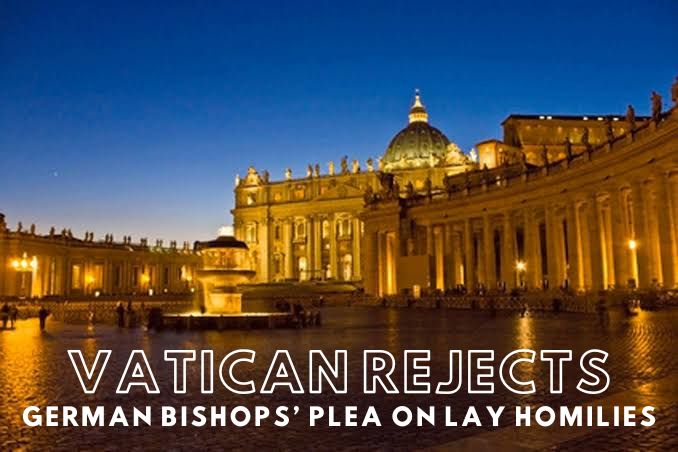
Image Credit: Catholic Gist International
By Catholic Gist International | June 24, 2026
The Vatican has formally rejected a request from the German Bishops’ Conference to allow lay Catholics to preach homilies during Mass. Consequently, this decision marks a defining moment for Pope Leo XIV’s young pontificate. Furthermore, it sends an unmistakable signal to the global Church about the limits of liturgical experimentation.
Vatican Rejects German Bishops’ Plea for Lay Homilies at Mass
The Dicastery for Divine Worship and the Discipline of the Sacraments, led by Cardinal Arthur Roche, issued the ruling earlier this month. Meanwhile, Bishop Georg Bätzing of Limburg had submitted the formal request as part of the ongoing Synodal Way reform agenda. Nevertheless, Rome responded with a firm negative, citing centuries of tradition and universal canon law.
What the German Bishops Requested
The German Bishops’ Conference sought permission for trained lay leaders—both men and women—to deliver homilies during Sunday Mass. Additionally, they argued that severe priest shortages in rural Germany made this change pastorally necessary. Moreover, they claimed that theological developments since Vatican II supported expanding the “common priesthood” of the baptized.
In contrast, the Vatican viewed this proposal as touching the very structure of the Eucharistic celebration. Specifically, the homily is not merely a reflection or sermon. Instead, it constitutes an act of the Church’s teaching office, exercised by one who stands in persona Christi.
The Vatican’s Response: Clear and Unambiguous
Cardinal Roche’s dicastery responded with directness rare in Vatican diplomacy. First, the document cited Canon 767 of the Code of Canon Law, which explicitly reserves the homily to priests and deacons. Second, it referenced Inter Oecumenici (1964), the first instruction implementing Sacrosanctum Concilium, which affirmed the same restriction. Third, it invoked Redemptionis Sacramentum (2004), which described the homily as “part of the liturgical action” itself.
Beyond these citations, the response emphasized a deeper theological point. The homily follows the Gospel reading precisely because it flows from the Church’s teaching authority. Therefore, no episcopal conference possesses the competence to alter this norm. Similarly, the document noted that lay catechists and pastoral leaders already exercise vital roles—just outside the Eucharistic liturgy itself.
Why This Decision Matters Today
This rejection carries weight far beyond Germany. To begin with, the Synodal Way has pushed for sweeping changes since 2019, including women’s ordination, married priests, and revised teachings on sexuality. However, Rome has consistently pushed back, viewing many proposals as exceeding the competence of national conferences.
Previously, the Vatican intervened against a proposed “Synodal Council” with binding authority over bishops. Likewise, tensions flared over German funding of groups advocating women’s ordination. Nevertheless, the homily decision differs in kind. It represents a direct, formal refusal of a specific liturgical request through official channels.
For Pope Leo XIV, this ruling establishes early boundaries. Although he has been Pope for just over a year, his Augustinian spirituality emphasizes the Eucharist as mystery rather than meeting. Consequently, allowing lay homilists would collapse the distinction between baptismal dignity and sacramental ordination—a line he clearly refuses to cross.
Reactions Across the Catholic World
Responses to the ruling have varied dramatically. On one hand, progressive theologians expressed disappointment. Professor Marianne Schlosser, a biblical scholar, suggested the refusal revealed “a structural inability to trust the baptized.” On the other hand, traditionalist Catholics welcomed the clarity. The Catholic Herald editorialized that “the homily is not a TED talk” but the Church teaching in her ministers’ voices.
Meanwhile, bishops from Africa and Asia offered a different perspective. One African cardinal, speaking anonymously, noted that his continent faces far greater priest shortages yet has never requested lay homilists. Instead, he urged German bishops to “send us some priests” rather than restructure the liturgy.
Within Germany itself, the conference remains divided. Cardinal Rainer Maria Woelki of Cologne reportedly supports Rome’s decision. Conversely, more progressive members may continue informal “reflections” before or after Mass, technically circumventing the homily restriction.
Theological Foundations of the Ruling
Understanding this decision requires grasping why the Church reserves preaching to ordained ministers. The homily is not simply the best sermon available. Rather, it is an exercise of the munus docendi—the teaching office entrusted to bishops, priests, and deacons.
Pope Benedict XVI, in Sacramentum Caritatis (2007), described the homily as bringing “the divine word to the present.” Similarly, Pope Francis in Evangelii Gaudium called it “the touchstone for judging a pastor’s closeness.” Pope Leo XIV, through this decision, extends this sacramental understanding. The priest preaches not because he is the most articulate person present, but because he stands in the person of Christ the Head.
Therefore, to democratize the homily would fundamentally alter the Eucharistic structure. It would treat the liturgy as a community gathering rather than Christ’s own sacrifice made present. For an Augustinian Pope deeply formed by Eucharistic theology, such a shift is unacceptable.
What Happens Next
Several scenarios now unfold. Most likely, some German bishops will accept the ruling while others seek creative workarounds. Less probably, radical wings of the Synodal Way may escalate toward formal disobedience—though actual schism remains distant. Additionally, Rome is reportedly reviewing German Church tax funding to ensure no diocesan money supports structures contradicting magisterial teaching.
For the global Church, this decision clarifies Pope Leo XIV’s trajectory. He will defend sacramental boundaries even when pastoral pressures mount. Furthermore, he will do so through institutional channels rather than personal pronouncements, letting his dicasteries speak with authority.
Conclusion: A Pontificate of Boundaries
The rejection of lay homilies is not merely a German story. Instead, it is a signal to the entire Church that Pope Leo XIV’s pontificate will safeguard the Eucharist’s sacramental structure against functional pressures. Whether from priest shortages, progressive theology, or synodal experimentation, some elements remain fixed.
As Pope Leo XIV himself reflected during his April 2026 Algeria visit, the Church is like an unfinished basilica—still being built. Yet even unfinished buildings require load-bearing walls. This decision identifies one such wall and refuses to move it.
Leave a Reply