
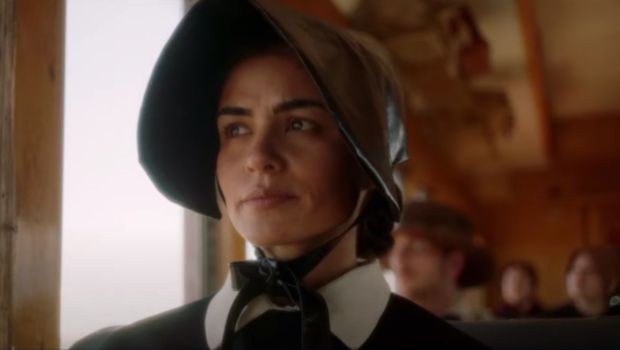
Image Credit: Aleteia
Sister Blandina Segale: The Fastest Nun in the West Moves Closer to Sainthood
Feast Day: Not yet canonized; commemorated February 23 (date of death)
Sister Blandina Segale stands as one of the most remarkable Catholic women in American frontier history. Furthermore, she confronted outlaws, founded schools and hospitals for immigrants, and defended the poor in the violent territory of 19th-century New Mexico. Consequently, her cause for sainthood has advanced, bringing her closer to becoming one of the few saints of the American Wild West.
Early Life and Journey to America
Maria Rosa Segale was born on January 23, 1850, in Cicagna, a small town near Genoa, Italy. Moreover, she was the youngest of four daughters in a middle-class family. Her father was a silk merchant, and her mother instilled in the children a deep Catholic faith. When Maria Rosa was four years old, her family emigrated to the United States, settling in Cincinnati, Ohio.
The Segale family faced hardship in America. In fact, Maria Rosa’s father died when she was eleven, leaving the family in difficult circumstances. However, this loss deepened her faith and strengthened her resolve to serve God. At sixteen, she entered the Sisters of Charity of Cincinnati, taking the religious name Sister Blandina after an early Christian martyr.
Missionary to the Southwest
In 1872, at the age of twenty-two, Sister Blandina received an assignment that would define her life. The Sisters of Charity sent her to Trinidad, Colorado, a rough mining town on the Santa Fe Trail. Afterward, she moved to Albuquerque, New Mexico, and eventually to Santa Fe, where she would spend the majority of her missionary career.
The New Mexico Territory of the 1870s and 1880s was a dangerous place. Lawlessness prevailed, outlaws roamed freely, and violence was commonplace. Additionally, the region was overwhelmingly Catholic due to Spanish and Mexican heritage, but poverty, illiteracy, and isolation left the faithful largely unserved by the Church.
Sister Blandina did not retreat from this environment. Instead, she embraced it with characteristic courage. She traveled alone by stagecoach, horseback, and wagon across hundreds of miles of desert and mountain terrain. Consequently, she earned the nickname “The Fastest Nun in the West” — not for her speed, but for her relentless energy and determination.
The Encounter with Billy the Kid
Sister Blandina’s most famous story involves her confrontation with Billy the Kid, the notorious outlaw. The encounter occurred in Trinidad, Colorado, or New Mexico (accounts vary in location, but the substance remains consistent).
According to her own writings, Sister Blandina was tending to a sick patient when she learned that Billy the Kid and his gang had entered town and were planning to kill four doctors who had refused to treat one of their wounded members. Without hesitation, Sister Blandina went directly to Billy the Kid and pleaded with him to spare their lives.
Remarkably, the outlaw listened to her. He asked her to “do what she could” for his companion, and in return, he would grant her request. Sister Blandina nursed the wounded man back to health. As a result, Billy the Kid kept his word. The doctors were spared, and Sister Blandina had turned violence into mercy through sheer moral courage.
This was not her only encounter with frontier violence. On another occasion, outlaws attempted to scalp a dying man in her care. Sister Blandina stood guard over him with a fireplace poker, refusing to leave until the danger passed. The outlaws, intimidated by her resolve, abandoned their plan.
Founder of Schools and Hospitals
Sister Blandina’s legacy extends far beyond dramatic confrontations. In fact, she was a prolific builder of Catholic institutions in the Southwest.
In Albuquerque, she founded St. Vincent’s Hospital in 1880, the first hospital in New Mexico. She also established St. Mary’s School and numerous other educational institutions for the children of immigrants, the poor, and the marginalized. Her schools served Hispanic, Anglo, and Native American children alike, making her an early pioneer of integrated Catholic education.
Furthermore, Sister Blandina was a fierce advocate for social justice. She opposed discrimination against Hispanos (Spanish-speaking New Mexicans), defended the land rights of the poor, and criticized corrupt politicians who exploited the vulnerable. Her letters to her sister, published later as “At the End of the Santa Fe Trail,” reveal a woman of sharp intelligence, deep compassion, and biting wit.
Later Life and Death
Sister Blandina continued her missionary work until advanced age. She returned to Cincinnati in 1893 to help establish the Santa Maria Institute, which served Italian immigrants in Ohio. Even in her seventies and eighties, she remained active in teaching, nursing, and spiritual direction.
She died on February 23, 1941, at the age of ninety-one. Her body was returned to New Mexico, where she is buried in Albuquerque. The Sisters of Charity of Cincinnati preserve her archives, and her cause for sainthood has gained momentum in recent years.
The Sainthood Cause
The cause for Sister Blandina’s canonization has advanced significantly. In 2014, the Archdiocese of Cincinnati officially opened her cause for sainthood, and she received the title “Servant of God.” The diocesan phase of the investigation concluded, and her cause has been submitted to the Congregation for the Causes of Saints in Rome.
If canonized, Sister Blandina would become one of the few American frontier saints and the first saint associated with the American Southwest’s Hispanic Catholic heritage. Her cause has attracted particular interest among Hispanic Catholics, Italian-Americans, and advocates for immigrants, reflecting the diverse communities she served.
The miracle required for beatification is currently under investigation. Supporters of her cause continue to pray for her intercession, particularly for healing, courage in adversity, and protection from violence.
Why Sister Blandina Matters Today
Sister Blandina Segale speaks directly to contemporary concerns. First, she demonstrates that holiness is not confined to convents and cloisters. She encountered outlaws, founded hospitals, and confronted corrupt politicians — all while maintaining her religious vocation.
Second, she embodies courageous mercy. She did not shrink from danger, but she also did not meet violence with violence. Her confrontation with Billy the Kid was not armed resistance. It was moral persuasion, rooted in the conviction that even the worst criminal retains a spark of humanity capable of responding to grace.
Third, she represents the Church’s mission to immigrants and the marginalized. In an era of anti-immigrant sentiment and border controversies, Sister Blandina’s defense of Hispanos, her schools for the poor, and her hospitals for the uninsured offer a model of Catholic social engagement.
Finally, her Italian immigrant roots and American missionary success illustrate the Catholic immigrant story that shaped the United States. She arrived as a child, poor and foreign-speaking, and became a founding mother of Catholic institutions in the Southwest.
A Prayer for Sister Blandina’s Canonization
Servant of God Sister Blandina Segale,
you who confronted outlaws with courage and founded schools with compassion,
pray for us who face our own frontiers of fear and indifference.
Obtain for us the grace to see Christ in the immigrant,
to defend the poor against exploitation,
and to transform violence into mercy through the power of love.
May your cause advance swiftly,
that the Church may recognize what the people of New Mexico already know:
that holiness walks among us, even in the desert, even in danger, even in the Wild West.
Through Christ our Lord. Amen.
Leave a Reply