
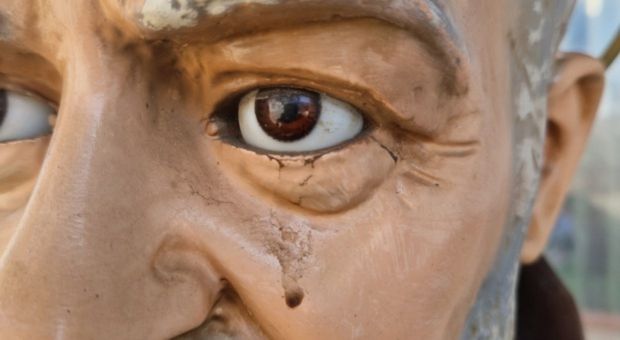
Image credit: Photo courtesy of the St. Pio Foundation, via EWTN News
Padre Pio Statue Weeps Blood, Prompting a Formal Vatican Investigation
A Padre Pio statue weeps blood inside an Italian parish, sparking international attention and a formal Church inquiry. The Catholic Church honours Saint Pio of Pietrelcina annually on September 23, and this unusual event has renewed public interest well ahead of that date. Parishioners at Santa Maria delle Grazie, within the small Campania town of Casalba, first noticed the mark in April 2026. Consequently, the local bishop has since launched an official investigation, following the Vatican’s own established procedures. Furthermore, this case has reignited wider debate concerning how the Church verifies claims that inspire devotion while demanding rigorous evidence.
According to reports, a parishioner first spotted a reddish stain trickling from the statue’s left eye, resembling a single tear of blood. Father Girolamo Capuano, the parish priest, rushed toward the Church immediately upon hearing this troubling report. Nevertheless, his repeated attempts to clean away the mark proved completely unsuccessful, regardless of the method attempted. Consequently, he ordered the fibreglass statue removed entirely, sending it away for careful scientific examination instead. Meanwhile, he also reviewed roughly a month’s worth of security footage, hoping to rule out any obvious human involvement.
This investigation yielded several genuinely striking preliminary findings, according to Father Capuano’s own public statements. Firstly, footage spanning the entire month showed no individual approaching the statue at any point, day or night. Secondly, he noted that the stain’s precise, deliberate path seemed remarkably difficult to explain through any natural or accidental process. Speaking publicly, he explained that publicising this phenomenon stemmed from pastoral responsibility, rather than any desire for personal attention. He further stressed that such signs, when handled carefully, can genuinely help people begin a meaningful journey toward faith.
Notably, the statue’s fibreglass construction complicates any straightforward, purely natural explanation for the reddish mark. Ordinary resin discolouration or environmental moisture would typically behave quite differently from what witnesses actually observed. Therefore, laboratory analysis must now determine whether the substance genuinely contains blood, or perhaps another organic or chemical compound entirely.
This particular case falls squarely under the Vatican’s Norms for Proceeding in the Discernment of Alleged Supernatural Phenomena, published in 2024. Consequently, Bishop Pietro Lagnese, leading the Diocese of Capua, must personally oversee this entire preliminary investigation process. Additionally, he must collaborate closely alongside the Italian Bishops’ Conference, while operating under direct supervision from the Dicastery for the Doctrine of the Faith. Initially, the diocesan bishop gathers relevant evidence, including scientific testing, witness testimony and independent expert evaluation. Afterwards, he submits these complete findings toward the dicastery, which then reviews both the evidence and the bishop’s overall methodology.
Crucially, these norms explicitly require the bishop to avoid any public statement regarding authenticity until the dicastery reaches its final judgement. This particular safeguard aims to prevent premature claims that could genuinely mislead the faithful or damage institutional credibility. Interestingly, Casalba has actually experienced similar claims previously, since a supposedly weeping Marian image appeared there back in 2015. However, investigators eventually attributed that earlier phenomenon toward simple rainwater seepage, rather than anything genuinely miraculous. Therefore, both local authorities and Vatican officials now approach this newer Padre Pio case with understandably heightened caution.
Padre Pio himself, the Capuchin friar from Pietrelcina who lived between 1887 and 1968, remained no stranger to extraordinary reported phenomena throughout his lifetime. He famously bore the stigmata for fifty years, alongside widely reported bilocation and an apparent ability to read hidden hearts. Nevertheless, the Church subjected these earlier claims toward decades of careful scrutiny before eventually canonising him in 2002. Consequently, his own historical case exemplifies precisely why the Vatican consistently insists upon patience, evidence and thorough procedural rigour. Father Capuano has struck a careful balance himself, admitting the footage strengthens his personal conviction, while still urging patient, faithful waiting.
For the wider global Catholic community, this unfolding case raises genuinely familiar and important questions. Do such alleged signs strengthen authentic faith, or might they risk exploiting sincere religious devotion instead? The Church’s considered answer, articulated clearly within its 2024 norms, emphasises careful discernment without outright dismissal, alongside genuine respect without uncritical credulity. Whether this reddish tear eventually proves miraculous, naturally explainable, or something else entirely, the Church’s measured response demonstrates its ongoing commitment toward balancing faith with reasoned scrutiny. For readers wishing to follow further updates, additional coverage remains available through EWTN News and Catholic World Report, alongside earlier articles published on this website concerning the life of Saint Pio of Pietrelcina.

Leave a Reply