
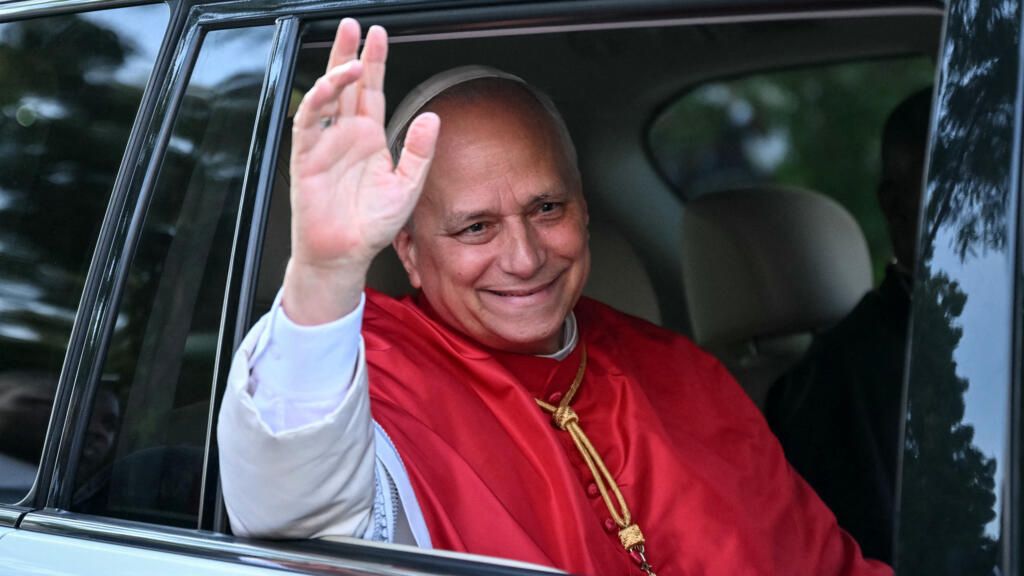
Image Credit – France 24
The “quiet Pope” roared back from an 11-day Africa tour — and nobody expected what he said about Trump, migration, and Western greed.
Pope Leo XIV just returned from his first Africa trip with explosive statements on Trump deportations, mineral colonization, and same-sex blessings. Here are the 5 quotes reshaping his papacy.
The Pope Who Left Quiet, Returned Loud
When Pope Leo XIV boarded his flight to West Africa 11 days ago, he was known as the “tempered” pope — careful, measured, sometimes to a fault.
When he landed back in Rome today, that reputation was shattered.
The Washington Post put it bluntly: “a pontiff known during his first year for being tempered and at times careful to a fault suddenly demonstrating an ability to roar”
.
His four-nation tour — Angola, São Tomé and Príncipe, Equatorial Guinea, and Cameroon — was not supposed to be controversial. It was framed as a pilgrimage to honour Pope Francis’ legacy on the first anniversary of his death.
Instead, Pope Leo XIV stepped off the Plane having delivered the most politically charged statements of his young papacy — and perhaps the most consequential words from a Pope since Francis’ “Who am I to judge?” moment in 2013.
Here are the five quotes that broke the internet.
Quote 1: “The Colonization of Oil and Mineral Deposits”
“The colonization of oil and mineral deposits without regard for international law and the sovereignty of nations is a scandal that cries out to heaven.”
Context: Speaking in Equatorial Guinea — one of Africa’s largest oil producers, where Western companies have extracted billions while the population remains impoverished — Pope Leo XIV didn’t name names. He didn’t need to. France, the U.S., China, and multinational corporations all heard themselves in his words.
.
Why it matters: This is the first time a Pope has explicitly framed resource extraction as “colonization” since the 2015 Laudato Si’ encyclical. But Leo XIV went further — he tied it to international law and national sovereignty, language that resonates with African leaders who have long accused the West of neo-colonialism.
The reaction: African media celebrated it as a long-overdue defense. European business outlets called it “naive.” American conservatives accused him of “anti-Western bias.” The debate is still raging.
Quote 2: “Extremely Disrespectful”
“The deportation of people who have built lives, raised families, and contributed to their communities is extremely disrespectful to human dignity and to the bonds that make society possible.”
Context: Asked directly about President Trump’s mass deportation policies during his in-flight press conference, Pope Leo XIV did not dodge. He didn’t use diplomatic euphemisms. He used the word “extremely” — a linguistic escalation from Francis’ more cautious “not Christian” comment in 2016
.
Why it matters: The first American pope just called out an American president by implication on one of his signature policies. This is unprecedented. John Paul II criticized Reagan on nuclear weapons. Francis criticized Trump on immigration. But Leo XIV is from the country whose policies he’s condemning — and he knows the political landscape intimately.
The reaction: Fox News ran it as a top story within hours. Catholic Twitter split instantly — Pope Leo XIV and Deportations trended simultaneously. Trump supporters called him a “Democrat Pope.” Progressive Catholics called it “prophetic.”
Quote 3: “Serve Your Own Countries”
“The future of Africa is in Africa. Young people must be given reasons to stay — opportunities, dignity, hope — so they can serve their own countries rather than being forced to seek survival elsewhere.”
Context: Addressing university students in Cameroon, Pope Leo XIV urged African youth to remain and build — while simultaneously acknowledging that migration is often driven by desperation, not choice
.
Why it matters: This quote created instant controversy because it appeared to contradict Quote 2. How can you criticize deportations while telling people not to migrate? Critics pounced. Supporters argued he was addressing root causes (why people leave) while defending dignity (how they are treated when they arrive).
The nuance: Pope Leo XIV’s argument — that migration is a symptom of failed development, not a solution — is actually consistent with Catholic social teaching. But in a polarized media environment, nuance dies fast. The “contradiction” narrative is already viral.
Quote 4: On Prisoners Without Lawyers
“A person held for years without access to legal defense is not a prisoner — they are a disappeared person. The state that permits this loses its moral legitimacy.”
Context: During his visit to Equatorial Guinea — ruled by Teodoro Obiang Nguema Mbasogo since 1979, making him the world’s longest-serving non-royal leader — Pope Leo XIV visited a Prison and met with inmates held without legal representation
.
Why it matters: He criticized a dictator to his face — in his own country — while standing in his prison. This is Francis-level boldness, but with sharper legal language. “Moral legitimacy” is a phrase with teeth.
The risk: Equatorial Guinea’s government could restrict future Catholic operations. But Pope Leo XIV calculated — correctly, by most accounts — that silence would be complicity.
Quote 5: On Same-Sex Blessings — The Clarification Everyone Missed
“Pastoral accompaniment must never become pastoral confusion. We bless persons, not lifestyles. The Church’s teaching on marriage has not changed — but the Church’s arms must remain open.”
Context: During his in-flight press conference — his longest and most wide-ranging yet — a journalist asked about same-sex blessings and the ongoing fallout from Francis’ Fiducia Supplicans document
.
Why it matters: This is the clearest statement on the issue from Leo XIV to date. He affirmed Francis’ pastoral outreach while adding a boundary: “not lifestyles.” Traditional Catholics heard a correction. Progressive Catholics heard continuity. Both sides are sharing the quote — to prove opposite points.
The Vatican’s strategy: By framing it as “clarification, not reversal,” Pope Leo XIV threads a needle that has shredded previous Popes. Whether it holds depends on what Bishops do next.
The In-Flight Press Conference: What Changed
This wasn’t supposed to happen. Pope Leo XIV had avoided extended media exposure in his first year — no in-flight pressers, no off-the-cuff interviews, no “Airplane theology” moments.
Today, that changed. Vatican News released the full audio/podcast of a press conference covering war, migration, same-sex blessings, and Vatican diplomacy — the most expansive media access of his papacy
.
Why now? Three theories:
- Confidence: Africa gave him a stage where he felt free to speak
- Strategy: The first anniversary of Francis’ death was the moment to claim his own voice
- Necessity: The issues are too urgent for silence
Probably all three.
What Happens Now
Pope Leo XIV returns to a Vatican facing:
- A polarized American Church — his home country is now his most complicated relationship
- A watching Africa — expectations raised, delivery demanded
- A global media that no longer sees him as “the quiet pope”
- A Curia that must now adjust to a pontiff who roars
The Washington Post called this his “coming out” moment
. If that’s right, the papacy that began in careful continuity has just pivoted to something more volatile — and more interesting.
The Real Story
Here’s the headline beneath the headlines:
Pope Leo XIV didn’t go to Africa to find his voice. He went to Africa because that’s where the Church’s future is — and he knew the world would listen.
Africa has the world’s fastest-growing Catholic population. By 2060, nearly 40% of all Catholics will be African. Pope Leo XIV’s words weren’t just for the countries he visited. They were for the Church he leads — and the Church that is becoming.
The “roar” wasn’t anger. It was urgency.
What’s your take? Did Pope Leo XIV cross a line, or finally find his voice? Share in the comments — and if you’re following the papacy closely..
Leave a Reply