
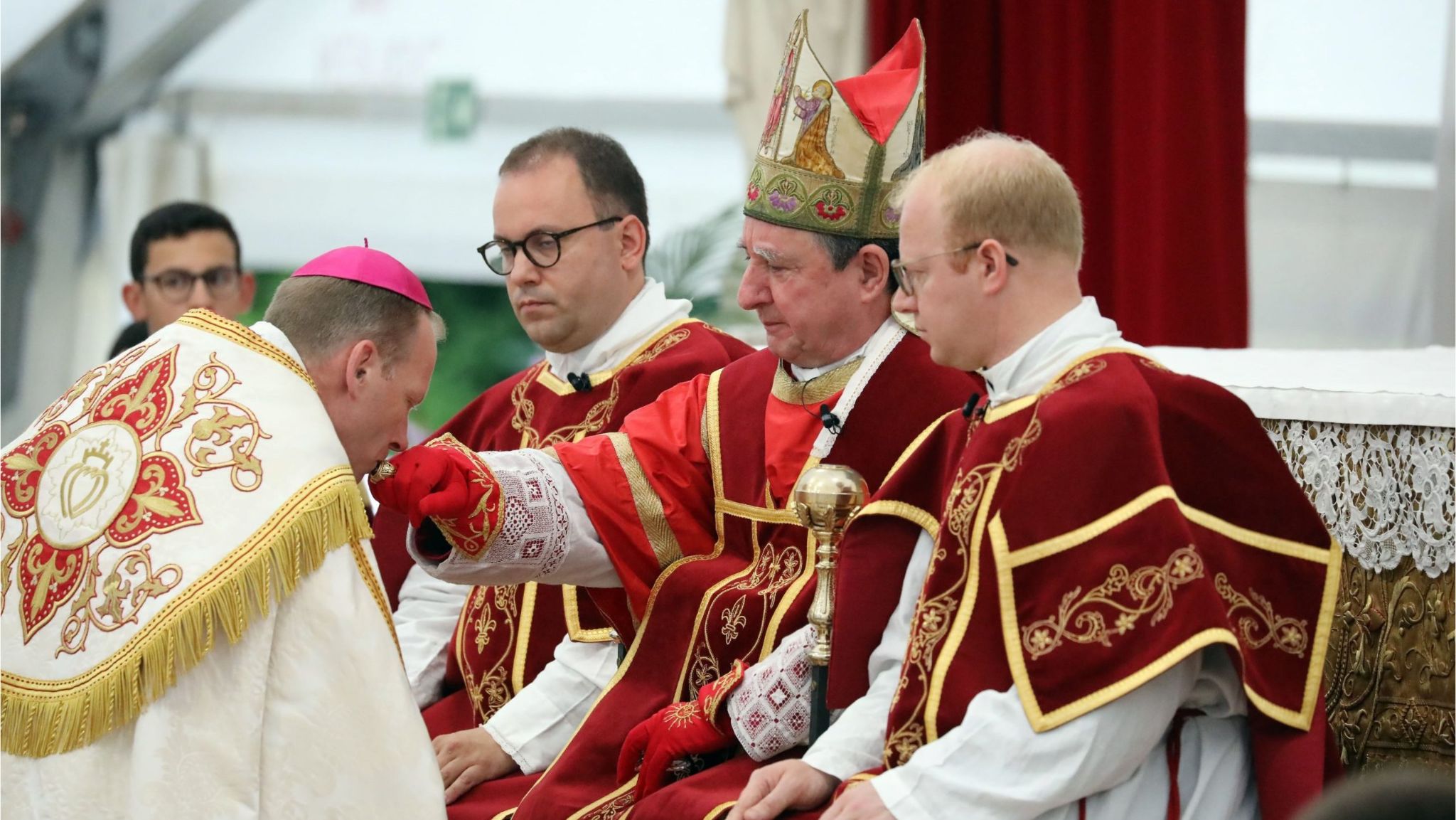
Image credit: Photo of newly consecrated SSPX bishops during the Écône consecration ceremony, courtesy of OSV News/CPP.
SSPX Appeal Vatican Schism Decree: Traditionalist Group Challenges Excommunication
The SSPX Appeal Vatican Schism Decree: What Happened
The Society of St. Pius X has formally submitted an SSPX appeal against the Vatican’s schism decree, challenging the excommunication that followed its unauthorized bishop consecrations. According to a statement from the traditionalist group, whose members are known as Lefebvrists, the appeal reached the Dicastery for the Doctrine of the Faith on July 11, just nine days after Rome declared the Society to be in schism. Notably, the SSPX argues that filing this appeal automatically suspends the excommunications under canon law while the case remains under review.
How the Crisis Began in Écône
This dispute traces back to July 1, when SSPX bishops consecrated four new bishops at the Society’s seminary in Écône, Switzerland, without papal approval. The Vatican had cautioned against this move for months. On May 13, Cardinal Víctor Manuel Fernández warned, on behalf of the Holy Office, that the planned consecrations would constitute a schismatic act carrying automatic excommunication. However, the SSPX responded the very next day, publishing a declaration of its doctrinal positions while confirming its intention to proceed regardless.
Pope Leo XIV then made a last-minute personal appeal to stop the ceremony. In a letter addressed to SSPX superior general Father Davide Pagliarani, the pope wrote that he pleaded “with all my heart” for the Society to turn back, warning that the consecrations would represent “a sin of extreme gravity” threatening Church unity. Unfortunately, the appeal went unheeded. More than 1,000 clergy and roughly 15,000 faithful gathered in a meadow near the seminary for the ceremony, and organizers declared beforehand that any resulting punishment “will have no validity.”
The Vatican’s Decree and Its Consequences
One day later, on July 2, the Dicastery for the Doctrine of the Faith issued its formal decree. It excommunicated the two consecrating bishops, Alfonso de Galarreta and Bernard Fellay, along with the four newly ordained bishops, all SSPX priests, and any lay Catholics who “formally adhere” to the Society. Significantly, this ruling went further than the Vatican’s response to a nearly identical episode in 1988, when SSPX founder Archbishop Marcel Lefebvre consecrated bishops without papal consent.
The decree specifically warned that sacraments administered by SSPX clergy are now unlawful, and that confessions heard or marriages performed by Society priests are invalid. As a result, this reverses accommodations the group had received under Pope Francis. Consequently, the ruling now affects roughly 751 SSPX priests serving worldwide, within a Society that claims around 1,500 members spread across 77 countries.
A Larger Rupture Than the 1988 Crisis
Because the current decree declares the entire Society, rather than only its bishops, to be in schism, many Church observers have called this the Catholic Church’s largest such rupture in over 150 years. Indeed, it surpasses even the 1988 Lefebvre affair, whose excommunications Pope Benedict XVI eventually lifted in 2009 after years of dialogue.
Meanwhile, some within the Society continue to dispute the Vatican’s framing altogether. Father Michel Rion, who helped organize the Écône consecrations, told reporters that parishioners in attendance remain “certain to be in the church and to be sons of the pope.” He further insisted that most believe the sacraments remain valid, despite the Vatican’s note stating otherwise. Meanwhile, several dioceses — including those of Panama and San Antonio, Texas — have already instructed the faithful not to attend Masses or seek sacraments from SSPX priests.
What the SSPX Appeal Means for the Vatican Schism Decree Going Forward
With the appeal now before the Dicastery, the coming weeks will test whether the Society’s procedural argument holds any real weight under canon law. Alternatively, Rome may simply treat the matter as settled and move forward without further negotiation. Given the pattern set in 1988 — a swift excommunication followed by two decades of gradual dialogue before eventual reconciliation — many Catholic commentators expect this standoff to stretch on far longer than a single appeal can resolve.
For readers following the broader implications of this rift, our earlier coverage of Saint Charbel Makhlouf’s enduring legacy offers a reminder of how deeply devotion and Church authority remain intertwined across Catholic life. Additionally, continuing updates from the Vatican’s Dicastery for the Doctrine of the Faith provide the clearest official record as this situation develops.
Final Thoughts
Ultimately, the SSPX appeal against the Vatican’s schism decree marks a pivotal moment in a decades-long standoff between Rome and the traditionalist Society. Whether this appeal succeeds or fails, it highlights ongoing tensions surrounding authority, tradition, and unity within the modern Catholic Church. As the Dicastery reviews the case, Catholics worldwide are watching closely to see whether reconciliation remains possible or whether this rupture will define the Church for years to come.

Leave a Reply