
Image Credit: Gaudium Press
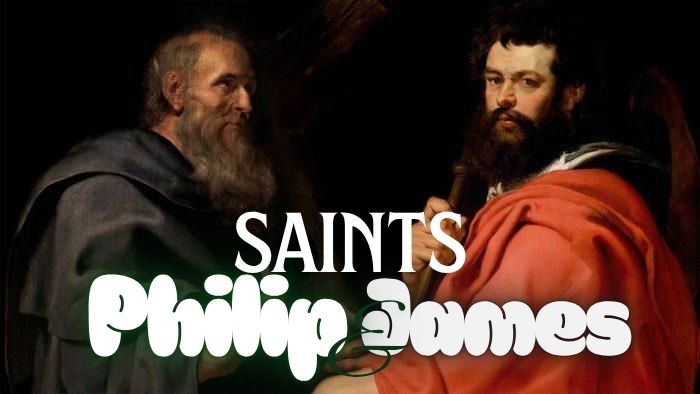
The Church commemorates on May 3 two towering pillars of early Christianity—St. Philip the Apostle and St. James the Less—whose lives, though distinct, are deeply united in mission, sacrifice, and unwavering witness to Christ. Their shared feast highlights not only their individual journeys but also their collective role in laying the foundation of the early Church.
St. Philip was born in Bethsaida, a town in Galilee also associated with Andrew and Peter. Chosen directly by Jesus, Philip’s call to discipleship is vividly recorded in the Gospel of John. Without hesitation, he responded to Christ’s invitation and quickly brought Nathanael—later identified with Bartholomew—to encounter the Messiah. This immediate evangelistic zeal became a defining mark of his apostolic ministry.
Philip appears several times in Scripture, particularly in key moments that reveal both his humanity and his growing faith. At the miracle of the loaves and fishes, Jesus tested Philip by asking how they might feed the multitude. Philip, thinking practically, saw only the impossibility of the situation. Yet this moment became an opportunity for Christ to demonstrate divine providence. Later, Philip served as a bridge between cultures when Greek seekers approached him, requesting to see Jesus. His Greek name and likely familiarity with the language made him a natural intermediary, showing how God uses personal background for divine purposes.
During the Last Supper, Philip made a heartfelt request: “Lord, show us the Father.” This prompted Jesus to reveal the profound unity between Himself and the Father, offering one of the clearest teachings on divine revelation. After Pentecost, tradition holds that Philip traveled extensively, preaching the Gospel in regions such as Greece, Syria, and Asia Minor. His missionary journeys were marked by miracles and conversions, often alongside companions like Bartholomew and his sister Mariamne.
Philip’s life culminated in martyrdom at Hierapolis during the reign of Emperor Domitian. Accounts vary—some say he was crucified upside down, others that he was beheaded—but all agree on his steadfast faith even unto death. Notably, one tradition recounts that while hanging on the cross, he continued to preach, leading to the conversion of many, including those who had initially opposed him. His relics are venerated in Rome, and his legacy endures as a model of missionary courage and fidelity.
Alongside Philip stands St. James the Less, a figure of profound authority and holiness in the early Church. Known as the son of Alphaeus, James is often identified with “James the Just” and referred to as the “brother of the Lord”—a term understood in Jewish context to mean a close relative, possibly a cousin of Jesus. His mother, Mary of Clopas, is traditionally believed to have been related to the Blessed Virgin Mary, placing James within the extended Holy Family.
James held a central leadership role in the Church of Jerusalem. Described by St. Paul as a “pillar” of the Church, he was among the first witnesses of the Resurrection and a key figure in guiding the early Christian community. As the first Bishop of Jerusalem, James presided over the Council of Jerusalem around the year 50 A.D., where critical decisions were made regarding the inclusion of Gentile converts. His wisdom and balanced judgment helped shape the Church’s universal mission.
Renowned for his holiness, James earned the title “the Just.” He was known for a life of deep prayer, ascetic discipline, and unwavering commitment to righteousness. Tradition holds that he spent so much time in prayer that his knees became hardened like those of a camel. His leadership was not merely administrative but deeply spiritual, guiding believers through both teaching and example.
James is also credited as the author of the Epistle of James, one of the New Testament’s most practical and direct writings. Addressed to the “twelve tribes in the Dispersion,” the letter speaks to Christians living outside Palestine, encouraging them to remain steadfast amid trials. Its central message emphasizes that faith must be lived out through actions—“faith without works is dead.” This teaching remains a cornerstone of Christian moral theology.
Around the year 62 A.D., James met a martyr’s death in Jerusalem. According to early historians like Eusebius and Hegesippus, he was thrown from the pinnacle of the Temple and then stoned. Despite the brutality of his death, he was widely respected even by those outside the Christian community, a testament to his integrity and holiness.
Though their missions took them to different places—Philip across distant lands and James rooted in Jerusalem—their lives intersect in purpose. Both were among the Twelve Apostles, chosen witnesses of Christ’s ministry, death, and resurrection. Both faced persecution and gave their lives for the Gospel. And both continue to inspire generations of Christians through their courage, humility, and unwavering faith.
Their joint feast day, now celebrated on May 3 in the Roman Catholic Church, reflects this unity. Historically observed on May 1, the date was later adjusted to accommodate the Feast of St. Joseph the Worker. In other Christian traditions, including the Eastern Orthodox Church, their commemorations occur on different dates, yet their significance remains universal.
St. Philip is honored as the patron saint of hatters, symbolically linked to his missionary journeys and humble service. St. James the Less, though not widely associated with a specific patronage, is revered as a model of leadership, justice, and practical holiness. Together, they represent both the outward mission of the Church and its inward spiritual strength.
As the Church continues to grow and face new challenges, the lives of these apostles remind the faithful of the enduring call to witness, service, and sacrifice. Their stories are not merely historical accounts but living testimonies that call believers to deepen their faith and live it out boldly in the world.



Leave a Reply