
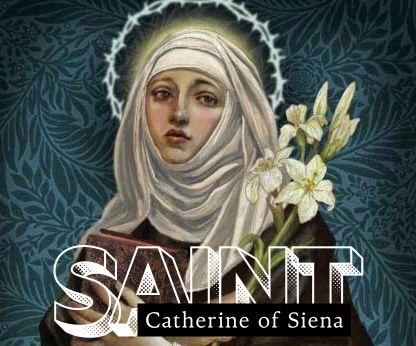
Image Credit – Dominican Sisters of Hope
Mystique, Reforemer and Doctor of the Church
Lived – March 25, 1347 – April 29, 1380
Born on March 25, 1347, in Siena, Italy, during the devastating outbreak of the Black Death, Catherine of Siena entered the world under extraordinary circumstances. She was one of many children in a large family, though several of her siblings did not survive infancy. Her father, Jacopo di Benincasa, was a cloth dyer, while her mother, Lapa Piagenti, was around forty years old at the time of her birth. From an early age, Catherine displayed an unusual spiritual sensitivity that would define her life.
As a child, she was known for her joyful nature, earning the nickname “Euphrosyne,” meaning joy. However, beneath this cheerful disposition was a deep and growing love for God. By the age of six or seven, she reportedly experienced her first vision of Christ, an event that profoundly shaped her spiritual journey. Soon after, she made a private vow to dedicate her life entirely to God—a decision that would put her at odds with her family’s expectations.
When Catherine was sixteen, her older sister Bonaventura died, leaving behind a widowed husband. Her parents proposed that Catherine marry him, a common practice at the time. Catherine firmly resisted. To discourage suitors, she cut off her hair and began a life of fasting and prayer. Her family initially opposed her, but her unwavering devotion and humble service eventually convinced them to allow her to follow her chosen path.
Rather than entering a convent, Catherine joined the Third Order of St. Dominic (the “Mantellate”), a group that allowed her to live a religious life while remaining at home. During this period, she lived in relative seclusion, dedicating herself to prayer, penance, and acts of charity. She developed a habit of giving away food and clothing to the poor, often without permission, quietly enduring criticism from her family.
At around the age of twenty-one, Catherine experienced what she described as her “mystical marriage to Christ.” This profound spiritual encounter marked a turning point in her life. She believed Christ called her out of isolation and into active service. From that moment, she began ministering publicly—caring for the sick, visiting hospitals, and assisting the poor. Her compassion and dedication quickly attracted followers who joined her in charitable works.
Catherine’s influence extended far beyond acts of charity. She became increasingly involved in the political and spiritual struggles of her time. Italy in the 14th century was marked by conflict among city-states and tension within the Church. Catherine boldly stepped into these issues, urging repentance, unity, and reform. Though she had no formal education, she dictated hundreds of letters to scribes, addressing popes, princes, and political leaders with remarkable clarity and authority.
One of her most significant contributions was her role in encouraging Pope Gregory XI to return the papacy from Avignon to Rome in 1377. At the time, the papacy had been based in France, a situation that caused division and instability within the Church. Catherine’s persistent letters and personal appeals were instrumental in influencing this historic decision, helping to restore the papacy to its traditional seat.
Her involvement did not stop there. During the turmoil that followed—particularly the Western Schism—Catherine continued to advocate for unity and obedience to the legitimate pope. She traveled extensively, often at great personal risk, working as a peacemaker among warring factions. Her courage and conviction were extraordinary, especially considering the limited role women typically held in public life during the Middle Ages.
Despite her active life, Catherine remained deeply rooted in prayer and mystical experience. She was known for intense fasting and ascetic practices, sometimes living almost entirely on the Eucharist. While this spiritual discipline strengthened her devotion, it also took a toll on her physical health. By early 1380, her condition had deteriorated significantly. She became unable to eat or walk, and on April 29, 1380, at the age of just 33, she died in Rome following a stroke.
Catherine left behind a remarkable legacy. Her writings include over 400 letters, numerous prayers, and her most famous work, The Dialogue of Divine Providence. In this spiritual masterpiece, she presents a profound conversation between God and the human soul, offering insights into divine love, repentance, and salvation. Her works are considered foundational in Christian mysticism and theology.
Recognizing her immense contribution to the Church, she was canonized in 1461 by Pope Pius II. Centuries later, in 1970, Pope Paul VI declared her a Doctor of the Church—one of the highest honors given to a saint—making her one of the first women to receive this title. She is also a patron saint of Italy, Europe, and various causes, including those who suffer illness or face ridicule for their faith.
Today, Catherine of Siena is remembered as one of the most influential figures in medieval Christianity—a woman of deep prayer, fearless action, and unwavering faith. Her life continues to inspire those who seek to serve God not only in silence and contemplation but also through bold engagement with the world.




Leave a Reply