
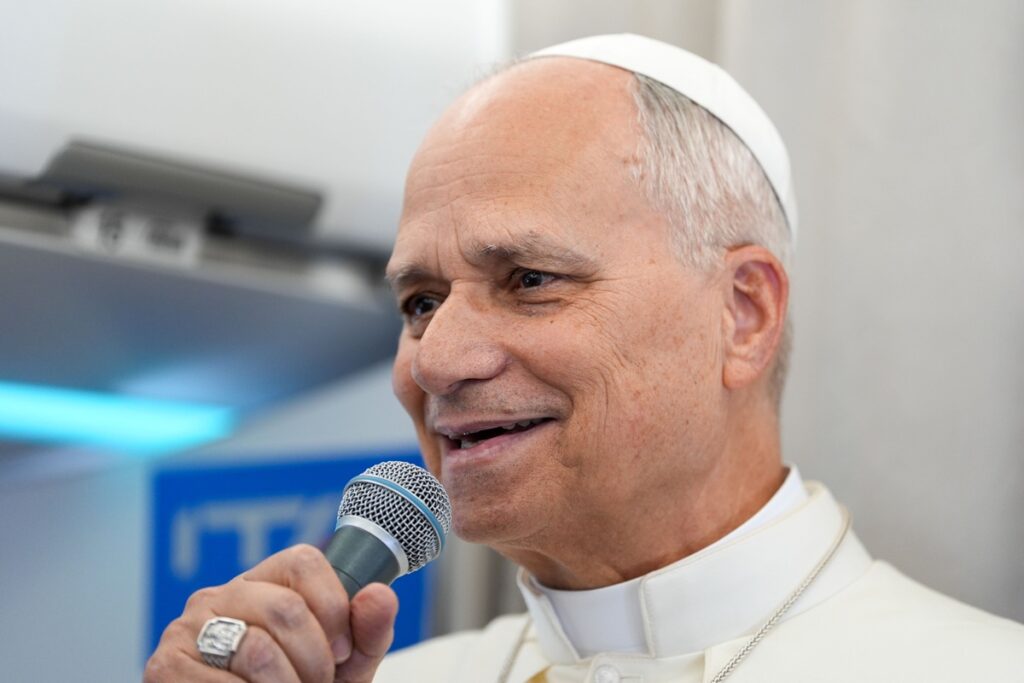
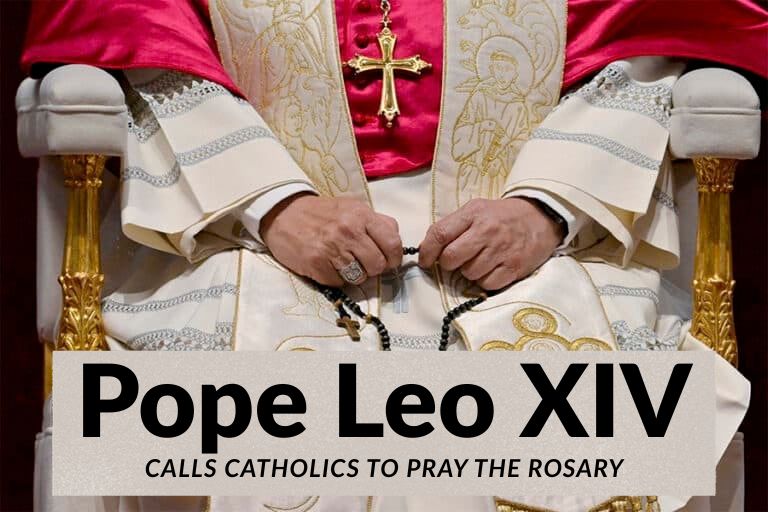
Photo Credit – Catholic News Service/Lola Gomez
The first American pope held his longest media session yet on the flight home from Africa. Here is the full context behind the quotes everyone is sharing.
Pope Leo XIV spoke for 20 minutes with journalists on his return flight from Africa. Here is the complete breakdown of what he said about war, migration, same-sex blessings, and the death penalty — with full context.
The Setting
The papal plane left Malabo, Equatorial Guinea, on April 23, 2026, carrying Pope Leo XIV and roughly 70 journalists back to Rome. It was his first extended press conference since becoming pope eleven months ago. For twenty minutes, he stood in the aisle answering questions without notes.
This was not the cautious pontiff who had carefully managed his public image during his first year. This was someone who had found his voice in Africa — and was willing to use it.
On War in the Middle East
A journalist asked about the ongoing conflict and whether the pope saw any path to peace.
What he said: “As a pastor, I cannot be in favor of war. Every war is a defeat for humanity. But I must also say this: the taking of human life through capital punishment, through targeted killing, through any means that treats a person as a problem to be eliminated rather than a brother to be embraced — this is not the way of the Gospel.”
The context: Pope Leo XIV did not name specific countries or leaders. He spoke as a pastor, not a politician. But his condemnation of “targeted killing” and treating people as “problems to be eliminated” was widely interpreted as addressing both the conflict in Gaza and the U.S. approach to Iran.
What he did not say: He did not call for a specific ceasefire. He did not condemn any nation by name. He did not offer a political solution. This was intentional. His predecessors learned that specific political statements often backfire, while principled pastoral statements endure.
On U.S.-Iran Negotiations
A reporter asked about the Trump administration’s direct negotiations with Iran.
What he said: “Dialogue is always preferable to destruction. But dialogue must be oriented toward a culture of peace, not merely a division of spoils. If the strong simply dictate terms to the weak, that is not peace. That is a truce between conquerors.”
The context: This was his most pointed geopolitical comment. The phrase “truce between conquerors” was seen as a critique of great-power politics generally, and possibly of the U.S.-Iran framework specifically. He was urging that any agreement include protections for smaller nations and minority communities in the region.
The reaction: Foreign policy analysts noted the sophistication of the comment. This was not naive pacifism. It was a specific theological critique of realpolitik — the kind of statement that only someone with deep knowledge of international relations could make.
On Migration and Deportations
A journalist from a U.S. outlet asked him to clarify his “extremely disrespectful” comment about deportation policies.
What he said: “I do not speak as an American. I speak as a pastor. And as a pastor, I must say: when a person has built a life, raised a family, contributed to a community, and is then removed as if they were refuse — this wounds human dignity. It wounds the family, which is the cell of society. It wounds the community that loses a member. I do not speak of policy. I speak of persons.”
The context: He was careful to frame this as pastoral, not political. He did not name President Trump. He did not cite specific policies. He spoke of the human cost — families separated, communities disrupted, dignity denied.
What he added: “But I must also say what I said in Cameroon: the future of Africa is in Africa. Young people must be given reasons to stay. This is not contradiction. This is complementarity. We must defend the dignity of the migrant, and we must build the conditions that make migration a choice, not a necessity.”
The nuance: This was his attempt to address the apparent contradiction in his Africa statements. He was arguing that Catholic social teaching has always held both truths simultaneously: the right to migrate, and the right to remain in one’s homeland with dignity.
On Same-Sex Blessings
A reporter asked about the ongoing implementation of Fiducia Supplicans and whether he planned any changes.
What he said: *”The Church blesses persons, not lifestyles. This was true before *Fiducia Supplicans, and it remains true. But I must also say this: to go beyond that today, I think that the topic can cause more disunity than unity. My priority as pope is to build unity in Jesus Christ. Where a pastoral practice becomes a source of division rather than encounter, we must ask: is this the moment? Is this the way?”
The context: This was the most parsed statement of the press conference. Progressive Catholics heard a warning that the topic was being overemphasized. Traditional Catholics heard a possible opening to restrict the practice. Both sides shared the quote to prove opposite points.
What he likely meant: Pope Leo XIV was signaling that he would not make same-sex blessings a defining issue of his papacy. He was not reversing Francis. He was not advancing beyond Francis. He was trying to lower the temperature — to move the Church from controversy to mission.
The key phrase: “Is this the moment? Is this the way?” — This was classic Leo XIV. He asks questions rather than issuing decrees. He invites reflection rather than demanding obedience. It is a style that frustrates those who want clarity, but it may be the only style that holds the Church together in this moment.
On the Death Penalty
A journalist asked about his statement on capital punishment and whether he was changing Church teaching.
What he said: “I condemn capital punishment. Human life is to be respected from conception to natural death. This is not new teaching. This is the consistent teaching of the Church, articulated by Saint John Paul II, confirmed by Pope Francis, and held by the Church from her earliest days. What is new is not the teaching. What is new is the urgency with which we must proclaim it in a world that has grown comfortable with eliminating the inconvenient.”
The context: He was pushing back against critics who accused him of innovation. He was anchoring his position in the magisterium of John Paul II — a conservative touchstone — while also aligning with Francis. It was a deliberate rhetorical strategy: make the teaching traditional, not progressive.
The phrase driving shares: “A world that has grown comfortable with eliminating the inconvenient” — This was interpreted as applying to abortion, euthanasia, war, and migration policy simultaneously. It was a unifying frame that allowed different audiences to hear their own concerns addressed.
On His Africa Trip Overall
Asked what he would take away from the journey, he grew quiet for a moment.
What he said: “I came to Africa as a pilgrim. I leave as a disciple. The faith I found there — tested by poverty, refined by suffering, expressed in joy — this is the faith of the apostles. The Church in Africa is not the future of the Church. It is the present. And it has much to teach those of us who have grown accustomed to thinking we are the teachers.”
The context: This was his most personal moment. He was acknowledging that his American background had shaped assumptions he was now questioning. The first American pope was discovering that his own formation was provincial — that the universal Church looked very different from what he had known in Chicago, Peru, or Rome.
What This Press Conference Reveals
Three things became clear in those twenty minutes:
First, Pope Leo XIV has found his voice. The cautious, measured pope of his first year has been replaced by someone willing to speak plainly — even controversially — on issues he cares about.
Second, he is trying to hold together what often divides. On migration, he defended the migrant and the right to stay. On same-sex blessings, he affirmed the practice while questioning its timing. On war, he condemned violence without naming villains. This is not evasion. It is a deliberate strategy of Catholic balance.
Third, he is increasingly defined by what he is against. Against war. Against capital punishment. Against deportations that wound dignity. Against practices that divide rather than unite. This is the prophetic posture — and it carries risks. Prophets are rarely popular with the powerful.
The Reaction So Far
- Vatican News published the full transcript without commentary, letting the words stand
- The Washington Post called it a demonstration of his “ability to roar”
- Fox News highlighted the migration comments as “criticism of Trump”
- Catholic progressive outlets praised his death penalty stance
- Traditional Catholic blogs parsed the same-sex blessing comments for signs of restriction
The same words. Opposite interpretations. This is the papacy Pope Leo XIV has inherited — and the one he is now shaping.
What Happens Next
On Sunday, April 26, Pope Leo XIV will ordain eight priests at St. Peter’s Basilica on the World Day of Prayer for Vocations . It will be his first liturgical act since returning from Africa. The contrast could not be sharper: from the political intensity of the press conference to the pastoral simplicity of laying hands on new priests.
But that is the rhythm of the papacy he is creating. Roar when necessary. Bless when possible. And trust that the same Spirit who descended at Pentecost is still guiding the Church through this moment.
What struck you most from the press conference? Share your thoughts in the comments.

Leave a Reply