
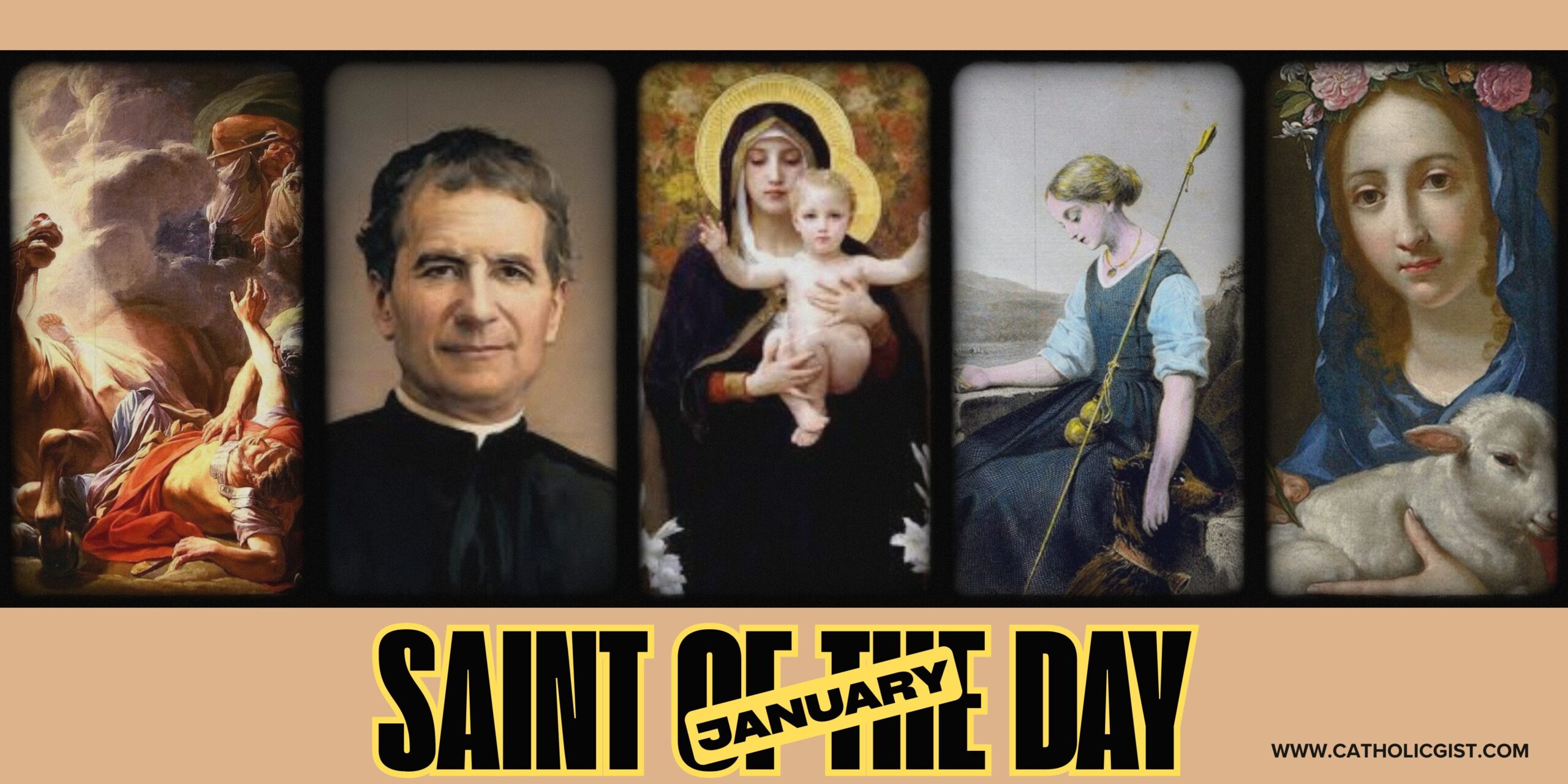
The Holy Name of Jesus and the Saints Who Bore It
January opens the Church’s calendar with one of her most ancient devotions: the Holy Name of Jesus. Since the medieval period, this month has been set aside to honor the name that the angel announced to Mary, the name before which every knee shall bow, the name that is the beginning of salvation itself. To begin the year with this focus is to begin it rightly—not with resolutions that fade, but with a gaze fixed on the One who is the same yesterday, today, and forever.
The Church gives January this character deliberately. Before the world turns its attention to goals and plans, the liturgy turns our eyes to Christ. The Solemnity of Mary, Mother of God on January 1 establishes the foundation: the God who became man had a mother, and through her, He entered human history. The Most Holy Name of Jesus, commemorated on January 3, extends this mystery into devotion. The name is not a mere label. It is a presence, a power, a prayer that the saints have invoked in every trial.
The Saints of January: Witnesses to the Name
The saints of this month are a diverse company, yet they share a common thread. Each of them lived under the banner of the Holy Name, and each, in his or her own way, made that Name known.
Saint Basil the Great (January 2) and Saint Gregory Nazianzen (January 2) were architects of Christian doctrine, defending the full divinity of Christ when the world sought to diminish it. Their writings remain foundational, not because they were clever, but because they were faithful to the Name they proclaimed.
Saint Elizabeth Ann Seton (January 4), the first native-born American saint, found in the Holy Name the strength to endure widowhood, poverty, and the founding of a religious community. Her journals are filled with simple, repeated acts of trust in Jesus.
Saint John Neumann (January 5), bishop of Philadelphia, built schools and churches across a vast immigrant Church. His secret was the same: daily prayer before the Blessed Sacrament, and constant invocation of the Name he had taken at baptism.
Saint Hilary of Poitiers (January 13) earned the title “Athanasius of the West” for his unyielding defense of Christ’s divinity. Saint Anthony of Egypt (January 17) retreated to the desert not to escape the Name, but to live more fully in its silence. Saint Agnes (January 21), barely thirteen, chose death rather than betray the purity she had consecrated to Christ. Saint Timothy (January 24) and Saint Titus (January 26) were companions of Paul, carrying the Gospel to churches that had never heard the Name spoken aloud.
The Conversion of Saint Paul (January 25) stands at the heart of the month. A persecutor of the Church became its greatest apostle, not by his own strength, but by the power of the Name he had once blasphemed. His transformation is January’s central lesson: no one is beyond the reach of grace, and no year is beyond the power of renewal.
Saint John Chrysostom (January 27), the “Golden-Mouthed,” preached the Name with eloquence that shook empires. Saint Cyril of Alexandria (January 28) defended the title Theotokos—Mother of God—ensuring that future generations would speak the Name of Jesus with precision and reverence.
These are not distant figures. They are witnesses. They show us what becomes possible when a human life is placed at the service of the Holy Name.
How to Walk With the Saints of January
The Church does not commemorate the saints merely to remember them. She commemorates them to invite us into their company. Here are simple ways to make January’s saints part of your daily life:
- Begin each morning with the invocation: “Jesus, I trust in You.” This simple prayer, rooted in the tradition of the Holy Name, aligns the day with the month’s devotion.
- Read the saint of the day before or after your evening meal. A single paragraph from their life, offered with attention, is worth more than a volume skimmed in haste.
- Choose one saint from the month as a particular patron. Ask for their intercession in a specific intention, and return to them throughout the year.
- Honor the Holy Name by speaking it with reverence. Avoid casual or irreverent use. When you hear it spoken carelessly, offer a silent act of reparation.
The Eucharist and the Name
The saints of January were sustained above all by the Holy Eucharist. Basil wrote liturgies that are still prayed. Anthony received communion from angels in the desert. Elizabeth Ann Seton founded her community around daily Mass. The Name they honored in prayer was the same Name they received in the bread and wine of the altar.
This is the pattern of Christian life: the Name is spoken in prayer, and the Name is received in sacrament. January invites us to renew both, to begin the year not with our own plans but with the presence of the One whose name is Emmanuel—God with us.
Saints Celebrated in January
| Date | Saint or Feast |
|---|---|
| January 1 | Mary, Mother of God (Solemnity) |
| January 2 | Saints Basil the Great and Gregory Nazianzen |
| January 3 | Most Holy Name of Jesus |
| January 4 | Saint Elizabeth Ann Seton |
| January 5 | Saint John Neumann |
| January 6 | Saint André Bessette |
| January 7 | Saint Raymond of Peñafort |
| January 8 | Saint Angela of Foligno |
| January 9 | Saint Adrian of Canterbury |
| January 10 | Saint Gregory of Nyssa |
| January 11 | Saint Theodosius the Cenobiarch |
| January 12 | Saint Marguerite Bourgeoys |
| January 13 | Saint Hilary of Poitiers |
| January 14 | Saint Macrina the Elder |
| January 15 | Saint Paul the Hermit |
| January 16 | Saint Berard and Companions |
| January 17 | Saint Anthony of Egypt |
| January 18 | Saint Charles of Sezze |
| January 19 | Saint Fabian |
| January 20 | Saint Sebastian |
| January 21 | Saint Agnes |
| January 22 | Saint Vincent |
| January 23 | Saint Marianne Cope |
| January 24 | Saint Francis de Sales |
| January 25 | Conversion of Saint Paul |
| January 26 | Saints Timothy and Titus |
| January 27 | Saint Angela Merici |
| January 28 | Saint Thomas Aquinas, Saint Peter Nolasco |
| January 29 | Saint Gildas the Wise |
| January 30 | Saint Bathildis |
| January 31 | Saint John Bosco |



Leave a Reply