
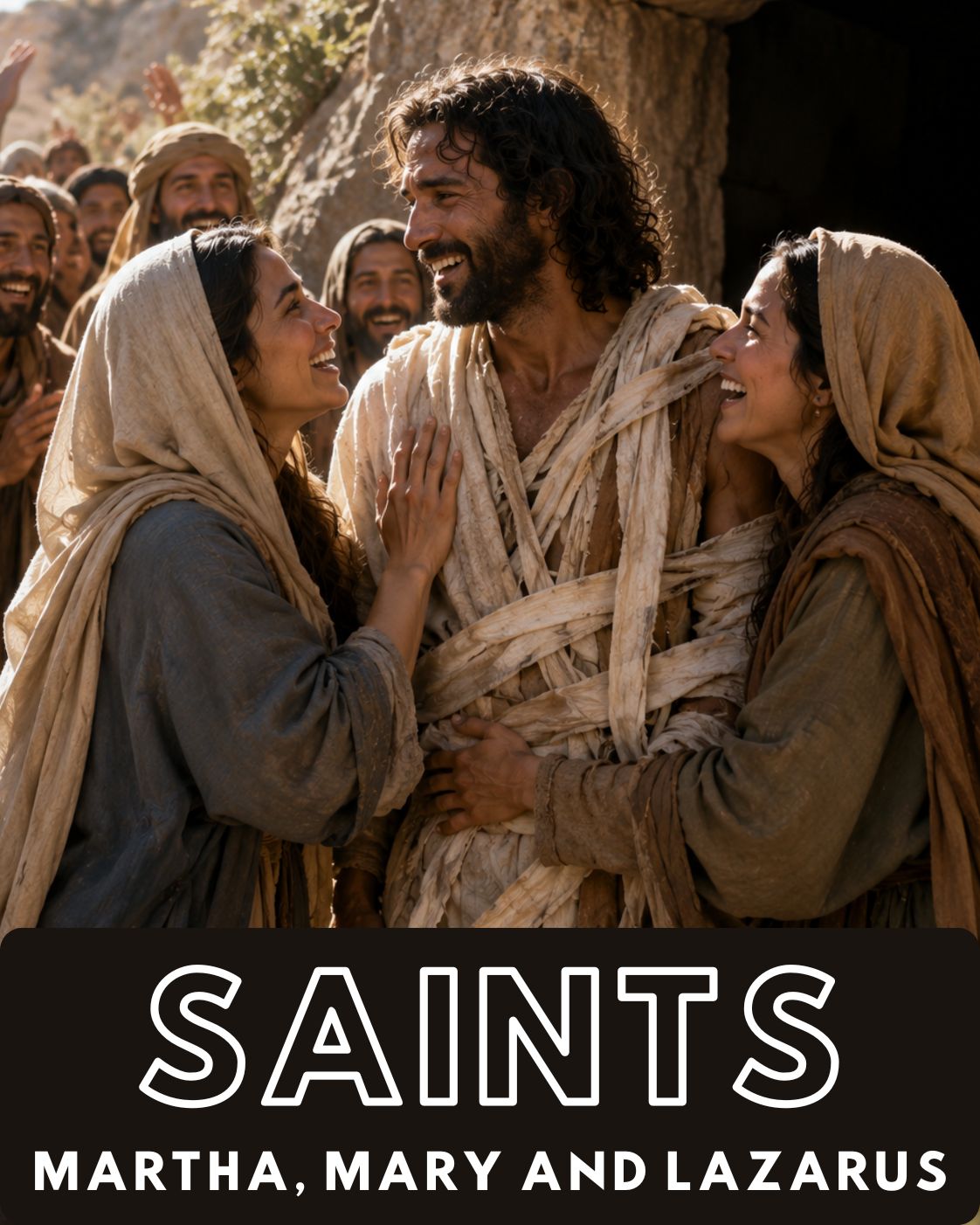
Saints Martha, Mary, and Lazarus: Feast Day July 29
Saints Martha, Mary and Lazarus form one of the most personal families found anywhere in the Gospels, since John’s Gospel states plainly that Jesus loved all three of them. That single line sets this household apart from nearly every other family mentioned in scripture. Their home in Bethany, a small village near Jerusalem, welcomed Jesus more than once and each visit reveals a different side of their shared story. Since 2021, the Church has honoured all three siblings together on one feast day, a change that finally reflects how closely their lives were woven together in scripture. Let us look at what the Gospels say about Saints Martha, Mary, and Lazarus, how later tradition expanded their story, and why the Church celebrates them jointly today.
The Catholic Church now celebrates the feast of Saints Martha, Mary and Lazarus together every year on July 29. Before 2021, the Roman calendar had commemorated Martha alone on this date, even though Benedictine communities had already honoured the whole family together for years. Pope Francis changed the universal calendar to match that older custom, explaining that the joint celebration better reflects the Gospel accounts, where the three siblings always appear as a unit. He also clarified a common point of confusion, confirming that Mary of Bethany is a separate figure from Mary Magdalene, the Apostle to the Apostles, even though the two were often blended together in medieval tradition. Beyond Catholic circles, Lutheran and Anglican calendars mark the same date for all three siblings, while Eastern Orthodox Christians commemorate Martha and Mary on June 4 and again during the Sunday of the Myrrh-bearing Women.
Martha’s Hospitality and Quiet Devotion
According to the Gospel of Luke, Jesus once entered a village and was welcomed into the home of a woman named Martha. While Martha busied herself preparing the household for her guest, her sister Mary instead sat at Jesus’ feet, listening closely to his teaching. Frustrated by the imbalance, Martha asked Jesus to send Mary back to help her. Rather than take her side, however, Jesus gently noted that Martha was anxious about many things, while only one thing truly mattered and that’s what Mary chose. Many readers recognize their own distracted busyness in this exchange, which is part of why Martha’s story has resonated across so many centuries.
Mary’s Devotion at the Feet of Jesus
Mary of Bethany appears in scripture as the sister who chose stillness over activity. In the same story from Luke’s Gospel, she sits quietly at Jesus’ feet rather than helping with household preparations and Jesus defends her choice as the better one. Later, in John’s Gospel, Mary appears again at her brother’s tomb, where she falls at Jesus’ feet in grief, prompting one of the most human moments recorded in scripture: Jesus himself weeping alongside her. At a dinner held in Jesus’ honour after Lazarus’ return to life, Mary anoints his feet with expensive perfume, an act of devotion so striking that Jesus later defends it against criticism from others at the table. Pope Francis’ 2021 clarification confirms that this Mary, though long confused with Mary Magdalene in Western art and legend, is her own distinct figure within the Gospel narrative.
Lazarus and the Miracle That Defined the Family
Lazarus enters the Gospel story through his death, an event that draws Jesus back to Bethany despite the danger involved in returning so close to Jerusalem. When Jesus arrives, he finds Lazarus already four days in the tomb and it is here that Martha makes her striking profession of faith, declaring Jesus to be the Christ, the Son of God. Jesus then calls Lazarus out of the tomb by name and he emerges alive, still wrapped in his burial cloths. This miracle stands as one of the most dramatic in all four Gospels and it becomes the very reason later Jewish leaders begin plotting against Jesus more seriously. Some later tradition holds that Lazarus eventually became a bishop, though accounts differ on exactly where he served.
A Legacy Defined by Service, Faith, and Love
John’s Gospel places the family together one final time at a dinner held in Jesus’ honour after Lazarus returns to life. Lazarus draws attention simply by being alive again and Mary causes a stir by anointing Jesus with costly perfume, yet the only detail recorded about Martha is a short, simple line: she served. Together, the three siblings capture three different expressions of devotion: active service, contemplative attention and restored life through faith. This is likely why Saints Martha, Mary, and Lazarus became linked so firmly in Christian memory, since their individual roles complement rather than compete with one another.
Legends That Grew Around the Family of Bethany
Scripture never records what became of the three siblings after these events, but later tradition filled the gap with vivid legend. According to the medieval Golden Legend, all three traveled together to Provence, in what is now France, where they are said to have helped spread the Gospel. The most famous legend involves Martha alone, who reportedly tamed a fearsome creature called the Tarasque near Arles using only holy water and a cross. Eastern tradition offers a different account, holding that the family instead traveled to Cyprus, where Lazarus became a bishop. Because these stories come from medieval and later devotional writing rather than verified history, the Church treats them as legend rather than established fact.
Devotion to the Siblings of Bethany Around the World
Interest in this family spread far beyond France and Cyprus over the centuries. In the Philippines, the town of Pateros credits Martha with taming a crocodile that once threatened local duck farms and it now holds the only shrine dedicated to her in Southeast Asia. Numerous churches across Europe, the Americas and Asia bear the names of Martha, Mary, or Lazarus today and religious communities such as the Sisters of Saint Martha, founded in Nova Scotia in 1894, continue to carry forward the family’s spirit of service.
Why Saints Martha, Mary and Lazarus Still Matter Today
Saints Martha, Mary and Lazarus offer a model of faith that feels approachable rather than distant, since their holiness grew out of ordinary family life touched by extraordinary grace. Readers interested in other women honoured during this season may also appreciate the story of Saint Mary Magdalene, whose feast falls just one week earlier, or Saints Joachim and Anne, commemorated shortly before these trio each July. For additional background on the 2021 calendar change, the Vatican’s official announcement offers further reading. Their example continues to remind believers that faithful love, whether shown through service, attention, or restored hope, still matters today.



Leave a Reply