
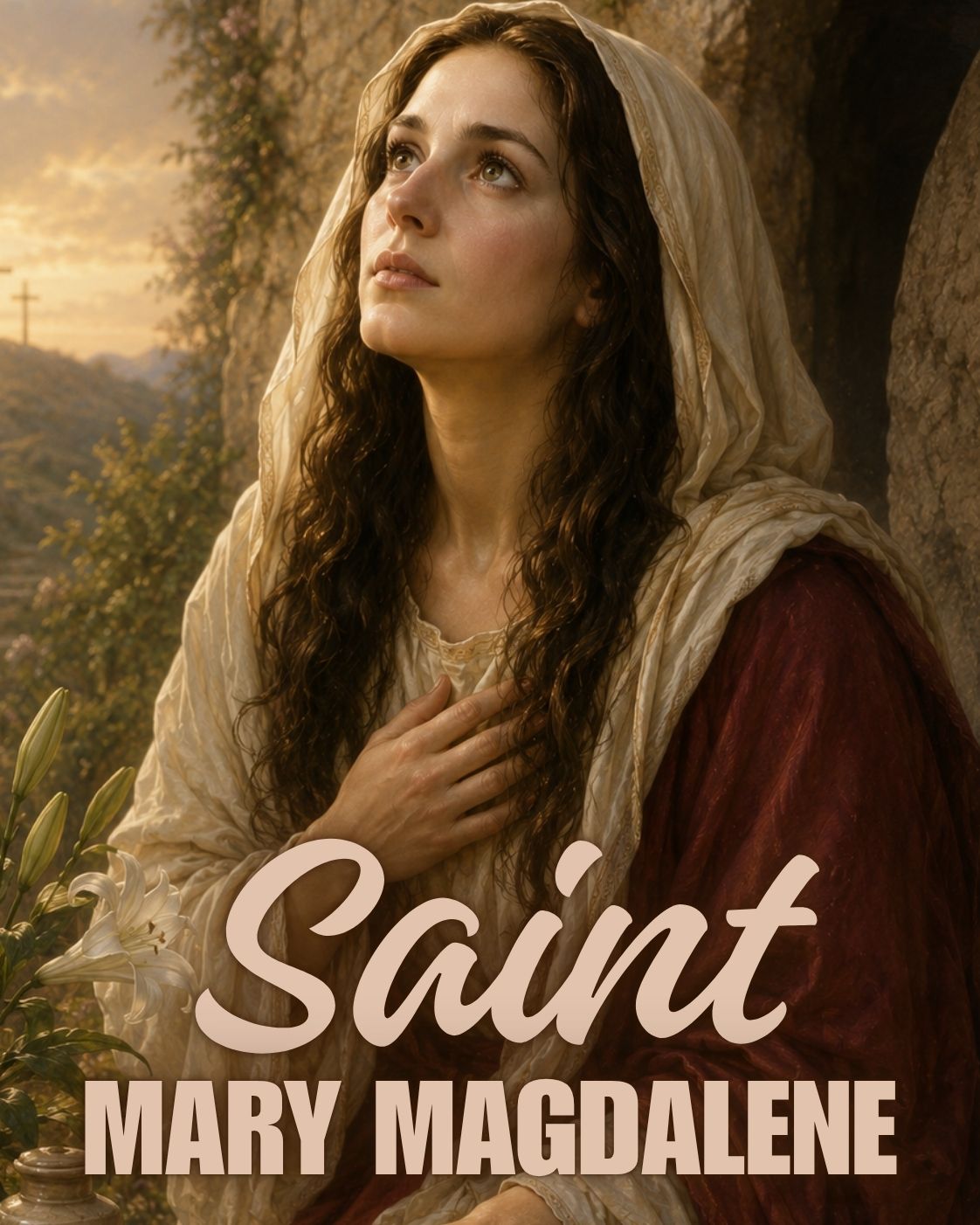
Saint Mary Magdalene: Witness to the Resurrection
Saint Mary Magdalene stands among the most significant figures in the Gospels, yet her true story has often been clouded by centuries of misunderstanding. She followed Jesus throughout his public ministry, stood by him during his crucifixion and became the very first person to witness his resurrection. Today, the Church honours Saint Mary Magdalene not as the sinner popular legend once claimed, but as a devoted disciple whose courage never wavered.
The Feast Day of Saint Mary Magdalene
The Catholic Church celebrates the feast day of Saint Mary Magdalene every July 22. Although her birth and death dates remain unknown, the Gospels mention her at least a dozen times, more than almost any other woman in the New Testament. This frequent mention alone signals how important she was to the earliest Christian communities.
Who Was Saint Mary Magdalene?
Most scholars agree that her name refers to Magdala, a fishing village on the Sea of Galilee. Because “Mary” was an extremely common name at the time, the Gospel writers needed a way to distinguish her from other women who followed Jesus. According to Luke’s Gospel, Jesus cast seven demons out of her, freeing her from what was likely severe physical or psychological suffering. Afterward, she became one of several women who traveled with Jesus and financially supported his ministry, suggesting she came from a background of relative wealth.
Contrary to a persistent myth, nothing in the Gospels ever describes St. Mary Magdalene as a prostitute. That association only developed centuries later, largely due to a homily preached by Pope Gregory I in 591, which mistakenly merged her identity with two other biblical women: Mary of Bethany and an unnamed sinner from Luke’s Gospel. This conflation shaped Western Christian art and devotion for nearly 1,400 years, even though Eastern Christianity never adopted the same interpretation. In 1969, the Vatican formally separated these identities in its revised calendar, clarifying that the feast day belongs only to Mary Magdalene, the woman who first saw the risen Christ.
Witness to the Crucifixion and Resurrection
All four Gospels agree that Saint Mary Magdalene stood among the women who watched Jesus’s crucifixion, even after most male disciples had fled in fear. She also appears among those present at his burial. Because ancient Jewish society generally viewed women as unreliable witnesses, many scholars consider her presence at these events historically credible; early Christians would have had little reason to invent a story that relied on female testimony rather than male authority.
Her most significant moment, however, came on Easter morning. According to the Gospel of John, Mary arrived at the tomb while it was still dark and discovered the stone rolled away. After running to alert Peter and another disciple, she returned to the garden alone, where the risen Jesus appeared to her directly. At first, she mistook him for a gardener, but she instantly recognized him once he spoke her name. Jesus then sent her to share the good news with the other apostles, a moment that earned her the enduring title “Apostle to the Apostles.”
Later Legends and Devotion
Christian tradition holds that Saint Mary Magdalene remained among the early believers for roughly fourteen years following Jesus’s death. According to popular medieval legend, she was later set adrift at sea and eventually landed in southern France, where she spent her final years living quietly in a Cave in Provence. Though historians cannot verify this story, devotion to it grew immensely during the Middle Ages and shrines at Vézelay and Saint-Maximin-la-Sainte-Baume both claimed to house her relics.
The widely read medieval collection known as The Golden Legend further popularized dramatic tales of her wealth, beauty and eventual conversion, cementing her image throughout European art for centuries. Interestingly, several ancient Gnostic texts, including the Gospel of Mary and the Gospel of Philip, portray her quite differently, describing her as Jesus’ closest and most spiritually insightful follower. While mainstream Christian churches do not regard these writings as reliable historical sources, they reveal how deeply her memory resonated across many strands of the early Christian world.
A Legacy of Faith and Redemption
Today, Saint Mary Magdalene serves as the patroness of converts, repentant sinners, pharmacists and many others who seek her intercession. Her story continues to resonate because it illustrates a powerful truth central to Christian faith: no person’s past, however painful or misunderstood, places them beyond God’s mercy. Rather than remembering her primarily as a reformed sinner, the modern Church instead emphasizes her unmatched faithfulness and her singular honour as the first witness to Christ’s resurrection.
As believers reflect on her legacy each July 22, Saint Mary Magdalene remains a powerful symbol of loyalty, courage and the transformative power of encountering Christ directly.
Readers interested in similar stories of faithful devotion can explore the story of Saints Joachim and Anne, the Grandparents of Our Lord Jesus Christ.




Leave a Reply