
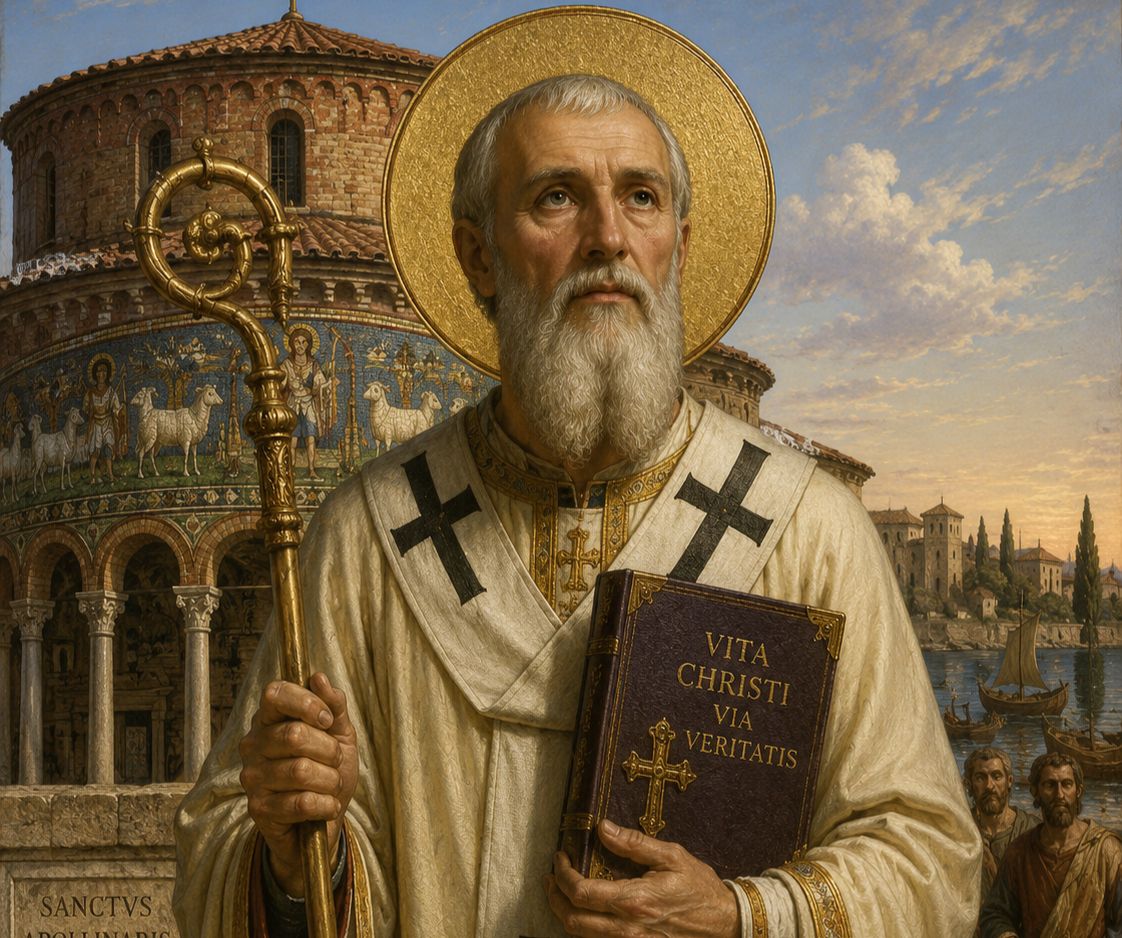
Saint Apollinaris of Ravenna: The City’s First Bishop
Saint Apollinaris of Ravenna occupies a special place in Church history as the founding shepherd of one of Italy’s most important early Christian communities. Though many details of his life remain uncertain, his legacy still shapes the city of Ravenna today, most visibly through the stunning Basilica built in his honour. His feast day continues to draw attention to a bishop whose courage under persecution helped establish Christianity in northern Italy.
The Feast Day of Saint Apollinaris of Ravenna
The Catholic Church currently celebrates the feast day of Saint Apollinaris of Ravenna on July 20. Before 1969, however, the Church observed his feast on July 23, the traditional date associated with his death. Officials moved the celebration slightly earlier because July 23 already honoured the more widely known Saint Bridget of Sweden in the Western calendar. Interestingly, the port town of Classe, near Ravenna, still keeps the older July 23 date in local celebrations.
Origins and Early Ministry
According to long-standing tradition, Saint Apollinaris of Ravenna was born in Antioch, a major city in the Roman province of Syria located in what is now modern-day Turkey. Popular legend holds that the Apostle Peter personally consecrated him and sent him to Ravenna to establish a Christian community there. While this connection to Peter cannot be verified historically, it reflects how deeply Ravenna’s early Church wanted to root it’s identity in the apostolic age.
Once he arrived in Ravenna, Apollinaris quickly became known as a gifted preacher and a worker of miracles. Through his tireless ministry, he won many converts away from pagan worship, a success that soon drew hostility from local government officials and religious traditionalists alike.
Persecution and Exile
As his influence grew, opposition to Saint Apollinaris of Ravenna intensified. Mobs reportedly beat him and forced him out of the city on more than one occasion, yet he continued returning to minister to his flock despite the danger. During one particularly brutal episode, his persecutors are said to have compelled him to walk across hot coals before expelling him from Ravenna once again.
Historical sources disagree about exactly when these events took place. Some traditions place his martyrdom under Emperor Vespasian in the first century, while other scholarly evidence suggests he may have lived a century later, possibly dying during the persecution of Emperor Septimius Severus. Regardless of the exact timeline, most accounts agree that he served as bishop of Ravenna for roughly two to three decades before his death.
Martyrdom and Lasting Devotion
Eventually, after enduring repeated beatings and exile, Saint Apollinaris of Ravenna died from the injuries inflicted upon him. Because he was not formally executed in a single dramatic event, some early writers debated whether to call him a true martyr. Nevertheless, Peter Chrysologus, a respected fifth-century bishop of Ravenna, argued that the sheer volume of suffering Apollinaris endured for his faith fully earned him that title, and the Church has honoured him as a martyr ever since.
Centuries later, devotion to him remained strong enough that Saint Romuald, founder of the Camaldolese monastic order, reported experiencing a vision of Apollinaris. This appearance further cemented his reputation as a powerful heavenly intercessor long after his earthly ministry had ended.
Shrines, Relics and Artistic Legacy
Today, the relics of Saint Apollinaris of Ravenna rest in several significant locations, including the Basilica of Sant’Apollinare Nuovo and the Benedictine Basilica of Sant’Apollinare in Classe, both in Italy, as well as Saint Lambert’s Church in Düsseldorf, Germany. The Basilica of Classe, in particular, became one of the most celebrated pilgrimage sites in the region, and it still stands today as a treasured example of Byzantine art and architecture.
Artists traditionally depict Saint Apollinaris of Ravenna in bishop’s vestments, sometimes holding a sword to symbolize his martyrdom. The faithful invoke his intercession for protection against gout, epilepsy, and other ailments, and he remains the patron of Ravenna itself, along with several other European towns, including Aachen, Düsseldorf, and Remagen.
A Legacy Rooted in Faithful Endurance
Although scholars continue to debate the precise historical details surrounding his life, Saint Apollinaris of Ravenna remains a powerful symbol of perseverance in the face of hostility. His willingness to keep returning to Ravenna, despite repeated violence, reflects the same unshakable commitment shown by so many early Christian leaders who helped establish the faith across the Roman world.







Leave a Reply