
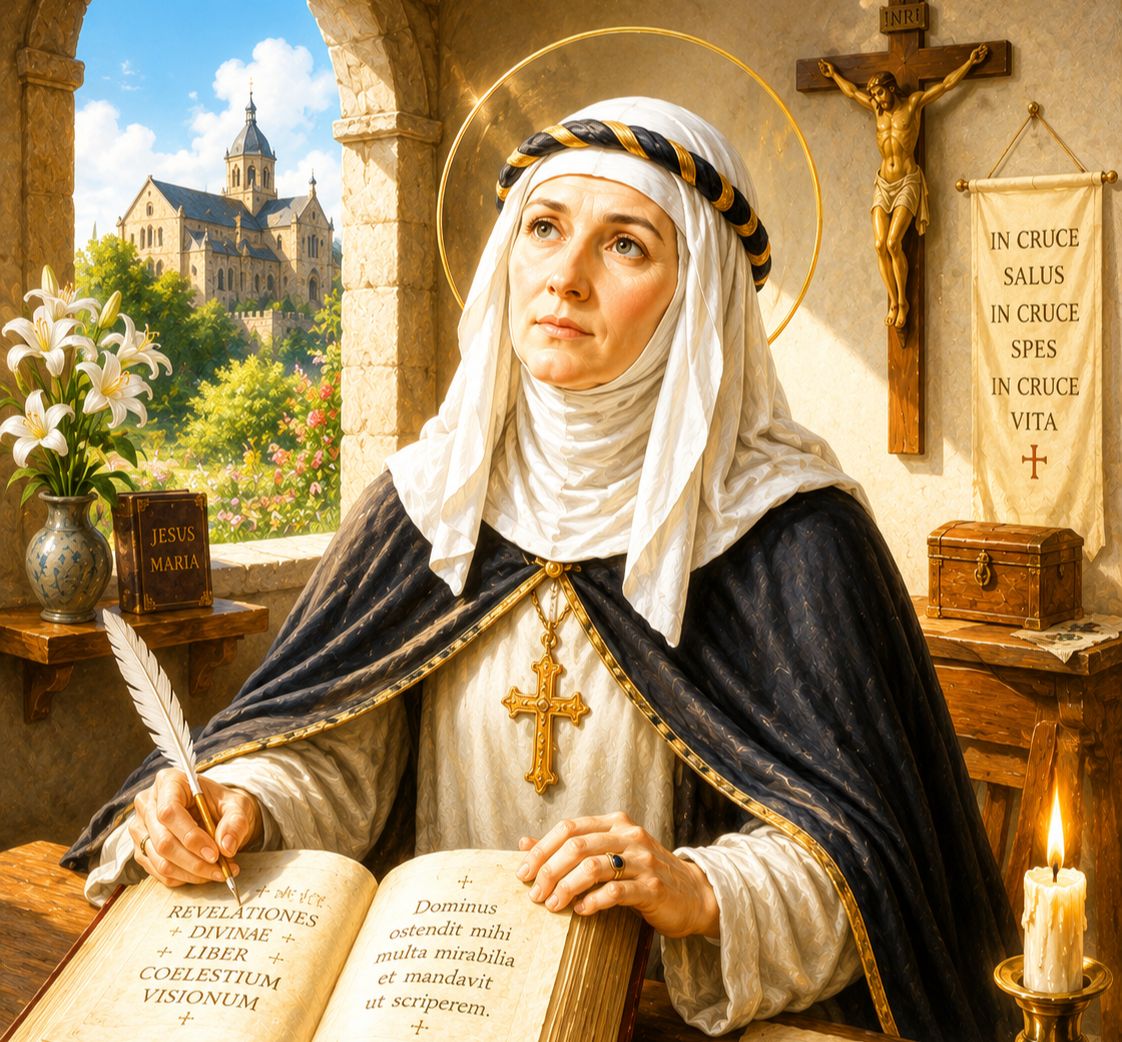
Saint Bridget of Sweden: Mystic, Mother, and Founder
Saint Bridget of Sweden lived an extraordinary life that blended noble privilege, deep motherhood, and profound mystical experience. Born into wealth, she raised eight children, buried her husband and ultimately founded a Religious Order that still exists today. Although she considered much of her life’s mission unfulfilled, the Church has long honoured Saint Bridget of Sweden as one of the most influential women in medieval Christianity.
The Feast Day of Saint Bridget of Sweden
The Church currently celebrates the feast day of Saint Bridget of Sweden on July 23, marking the anniversary of her death in 1373. Interestingly, her feast has moved several times throughout history. It was first added to the General Roman Calendar in 1623 on October 7, the date of her canonization, before later shifting to October 8. Only in the 1969 calendar revision did the Church settle on July 23, honouring her death date instead.
Childhood and a Life-Changing Vision
Born around 1304 to a wealthy and pious noble family in Uppland, Sweden, Bridget lost her mother at just ten years old. Around that same age, she experienced a vivid vision of Christ suffering on the cross. When young Bridget asked who had caused such wounds, she heard the answer, “those who despise my love.” This encounter shaped the rest of her spiritual life and never left her memory.
Following the customs of the time, Bridget married at just thirteen years old to Ulf Gudmarsson, a nobleman from Östergötland. Together, they had eight children, six of whom survived infancy, an unusually high survival rate for the era. Notably, her daughter later became venerated as Saint Catherine of Sweden. Bridget later served as lady-in-waiting to Queen Blanche of Namur and she and Ulf eventually completed a pilgrimage together to Santiago de Compostela.
Widowhood and the Call to Found a New Order
Shortly after returning from that pilgrimage, Ulf fell seriously ill and died at Alvastra Abbey in 1344. Devastated by grief, Bridget devoted herself entirely to prayer and charitable works. During this period, she reported that Christ called her to become his “bride” and instructed her to establish an entirely new Religious Order.
According to her revelations, Christ described this community as a vineyard meant to revive a Church weakened by decay in older monastic institutions. He outlined detailed plans for the convent’s construction, along with specific guidance for the sixty nuns, thirteen priests, four deacons, and eight lay brothers who would eventually make up the community. King Magnus Eriksson of Sweden donated land and a small palace to support this vision, which became known as the Bridgettines, or the Order of the Most Holy Saviour.
Pilgrimage to Rome and Final Years
Before construction could progress far, Bridget reported another vision instructing her to travel to Rome and remain there until the Pope returned from Avignon. She left Sweden at the end of 1349 and never returned home again. For the rest of her life, she delivered messages to kings, popes and other powerful figures, always insisting she merely relayed instructions from a higher authority rather than speaking her own opinions.
Remarkably, Bridget never witnessed most of her goals come to fruition. She never saw the pope permanently return to Rome, never brokered lasting peace between France and England, and never even saw a nun wearing the habit Christ had described to her. She also never returned to Sweden, dying instead in Rome in July 1373. Pope Urban V had confirmed her Order’s Rule in 1370, though full realization of her vision would only come after her death.
Sainthood, Visions and Lasting Influence
Pope Boniface IX canonized Saint Bridget of Sweden in 1391 and the Council of Constance confirmed her sainthood in 1415. Her Order eventually spread widely throughout Europe, and modern branches continue operating independently today in countries including Spain, Italy, Mexico and the United States.
Beyond her Order, Bridget’s visions left a lasting mark on Christian art. Her detailed description of the Nativity, showing the infant Jesus radiating light while Mary knelt in prayer, inspired countless painters and largely replaced older depictions of a reclining Virgin Mary throughout the following centuries. Her writings, known as the Revelationes Coelestes, were translated into Latin and widely circulated throughout medieval Europe, even inspiring devotional prayers still recited by some Catholics today.
In 1999, Pope John Paul II named Saint Bridget of Sweden a patron saint of Europe, honouring her alongside figures such as St. Benedict of Nursia. Though historians have long debated aspects of her political criticisms and personal conflicts, her spiritual legacy remains firmly rooted in Church tradition. Today, the faithful still venerate her relics at Vadstena Abbey and she remains the beloved patroness of Sweden.




Leave a Reply