
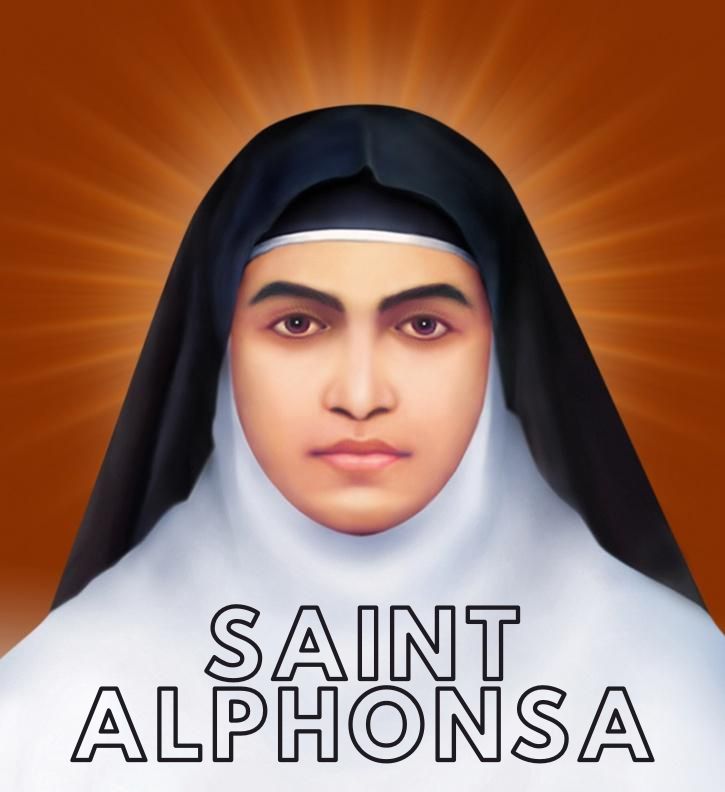
Saint Alphonsa of the Immaculate Conception: Feast Day, Life, and Legacy
Saint Alphonsa of the Immaculate Conception holds a place in Church history that no one before her had ever reached, since she became the first woman of Indian origin ever canonized by the Catholic Church. Born into hardship and marked by illness for most of her short life, she nonetheless became one of the most beloved figures in modern Indian Catholicism. Her story blends childhood suffering, quiet determination and deep spiritual devotion; and it still draws thousands of pilgrims to her tomb in Kerala every year. Today, we will talk about her early years, her path to religious life, her years of illness and the long road that eventually led to her canonization.
Saint Alphonsa’s Feast Day Falls on July 28
The Catholic Church celebrates Saint Alphonsa of the Immaculate Conception every year on July 28, the anniversary of her death in 1946. In Kerala, devotion builds for over a week beforehand, since local celebrations at her shrine in Bharananganam typically run from July 19 through July 28. Because she remains especially significant to Indian Catholics, July 28 is also observed informally as Alphonsa Day in parts of India, alongside the universal feast recognized by the wider Church.
Early Life Marked by Loss
Alphonsa was born Anna Muttathupadathu on August 19, 1910, in the village of Kudamalloor, near Kottayam, in what was then the princely state of Travancore. Her parents nicknamed her Annakutty, meaning “little Anna.” Tragically, her mother died only months after her birth, so her maternal aunt took over raising her, along with help from her devout grandmother, who filled her childhood with stories of the saints and traditional Christian songs. Despite the early loss of her mother, friends later recalled that Annakutty showed unusual devotion from a young age, telling classmates soon after her First Communion that she carried Jesus in her heart.
A Drastic Choice to Avoid Marriage
As Annakutty grew older, her aunt began arranging a traditional marriage for her, following the custom of the time. Because Annakutty felt certain that God was calling her toward religious life instead, she resisted every proposed match. At just thirteen years old, in 1923, she made a drastic decision: she deliberately placed her feet into a pit of burning chaff, reasoning that no family would want her as a bride if her body bore a visible disfigurement. The injury left her permanently disabled and caused chronic pain for the rest of her life, yet it also achieved exactly what she had hoped, since it cleared the path toward the vocation she wanted so badly.
Entering Religious Life
In 1927, Annakutty entered the convent school at Bharananganam as an intern student, and the following year, on August 2, 1928, she began her postulancy with the Franciscan Clarist Congregation. She took the religious name Alphonsa of the Immaculate Conception in honor of Saint Alphonsus Liguori, whose feast happened to fall on that very day. She received the religious habit in 1930 and went on to teach at a school in Vakakkad, though her failing health soon limited her to lighter duties such as assisting as a catechist and handling correspondence, thanks to her well-known skill with handwriting.
Years of Illness and Spiritual Depth
From 1930 onward, Saint Alphonsa of the Immaculate Conception endured a long stretch of serious illness alongside considerable inner suffering. She made her final vows in 1936, fully committing herself to religious life despite her weakening body. Rather than viewing her physical suffering as an obstacle, she came to see it as something she could offer alongside the suffering of Christ, a perspective that shaped the rest of her short life. She died on July 28, 1946, at just thirty-five years old, and was buried in the chapel connected to the cemetery of Saint Mary’s Church in Bharananganam, a site that has since become an important place of pilgrimage.
From Beatification to Canonization
Word of miraculous healings connected to Saint Alphonsa began spreading almost immediately after her death, and her official cause for canonization opened in 1953. She was declared a Servant of God in 1955 and a Venerable in 1985. Pope John Paul II beatified Saint Alphonsa in India on February 8, 1986, gaining her global recognition. Her canonization followed on October 12, 2008, when Pope Benedict XVI declared her a saint at the Vatican. During the ceremony, he described her life as one of great physical and spiritual suffering. He noted that she learned to love the cross through her love for Christ. With that declaration, Saint Alphonsa of the Immaculate Conception became India’s first canonized woman saint. She also became the first canonized saint of the Syro-Malabar Catholic Church.
Why Her Story Still Resonates
Today, believers honor Saint Alphonsa of the Immaculate Conception as a patron for those suffering illness, and her tomb in Bharananganam continues to draw pilgrims who report favors received through her intercession, many of which are documented in the magazine Passionflower. Readers interested in other modern saints whose causes progressed within living memory may also appreciate the story of Saint Titus Brandsma, canonized just fourteen years after her, or the missionary example of Saint Kateri Tekakwitha, another saint whose path to canonization spanned centuries of devotion.



Leave a Reply