
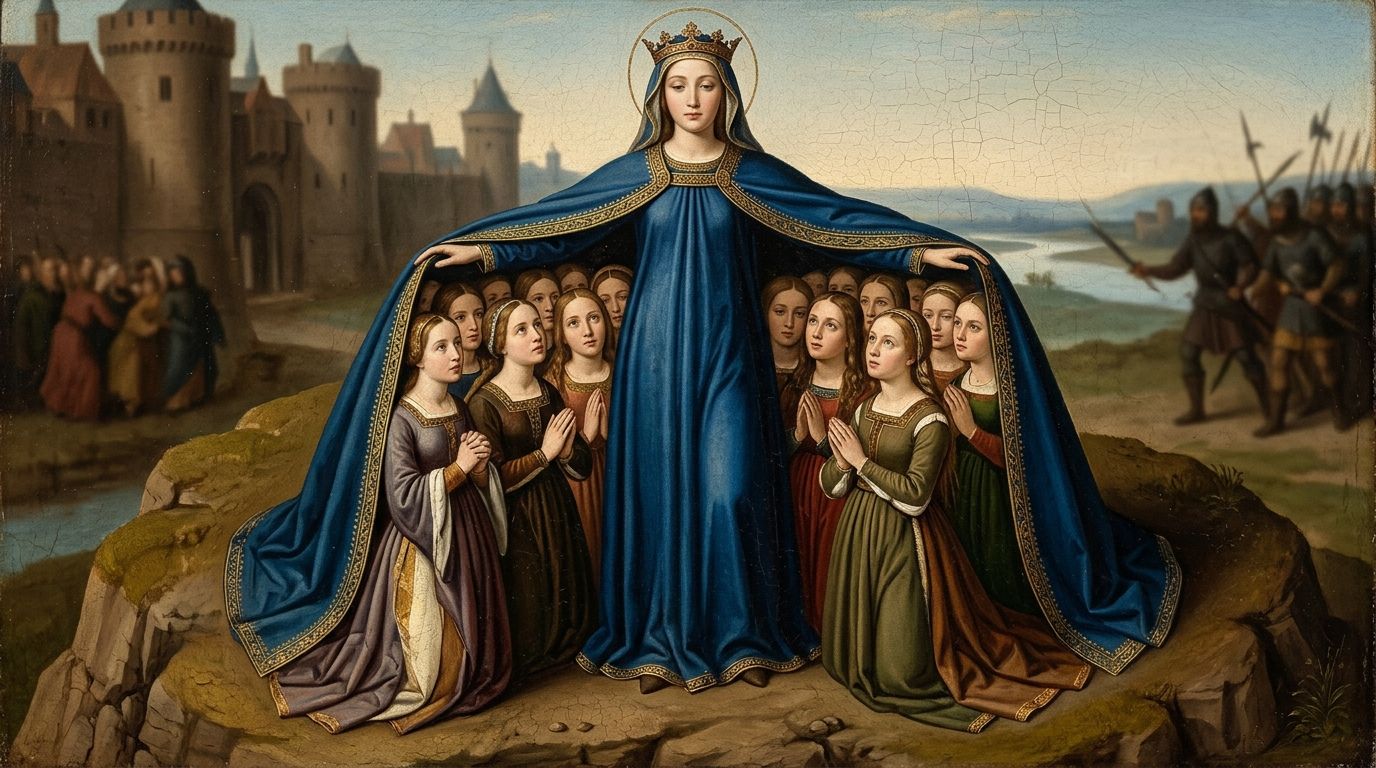
The Legend behind the 11,000 Virgins
The Church remembers Saint Ursula on October 21. Indeed, her story remains one of the most famous legends of medieval Europe. However, the Church removed her from the General Roman Calendar in 1969 because historians could not confirm the details. Nevertheless, the Roman Martyrology still lists her and many local calendars keep her feast. Therefore, this article separates the historical facts from the beautiful legend.
First, consider the legend. According to the medieval Golden Legend, Ursula was a British princess. A pagan prince asked for her hand in marriage. Instead of refusing outright, she asked for three years to prepare. During that time, she set out on a pilgrimage to Rome with a great company of young women. Later versions say that eleven thousand virgins joined her. Moreover, the story adds that a pope named Cyriacus welcomed them.
Next, the legend turns tragic. On the journey home, the pilgrims reached Cologne in Germany. At that moment, the Huns were besieging the city. The invaders attacked the travellers and killed them. According to the story, Ursula refused to marry the Hun leader, so he shot her with arrows. As a result, artists often show her holding an arrow. In addition, many paintings display her sheltering her companions under a wide cloak.
Now consider the history. The earliest evidence is a stone inscription in Cologne, which dates from the late fourth or early fifth century. It says that a man named Clematius rebuilt a basilica on the spot where holy virgins shed their blood. However, the stone does not name Ursula, and it gives no number. Furthermore, the full legend appears only centuries later. The oldest known mention of Ursula comes from a martyrology written in Cologne around the year 848.
So where did the number eleven thousand come from? Scholars offer several explanations. One theory says that a Latin abbreviation meaning “eleven martyr virgins” was misread as “eleven thousand virgins”. Another suggests that the name of a companion was confused with the Latin word for eleven thousand. Therefore, the original group may have been quite small. Even so, the Church of Cologne honoured these women for many centuries.
In Cologne, the Basilica of Saint Ursula still stands on the site. Inside, the Golden Chamber displays thousands of bones arranged in decorative patterns. Pilgrims have visited the church for centuries. Meanwhile, the Clematius inscription remains in the choir. Because of this, Cologne regards Ursula as one of its patron saints. Likewise, the city celebrates her feast with devotion each year.
Her name also travelled across the world. In 1535, Saint Angela Merici founded the Company of Saint Ursula in Italy. This community became the Ursulines, the first women’s order devoted to teaching. Consequently, Ursula became the patron of students, teachers and schoolgirls. In addition, Christopher Columbus named the Virgin Islands after Ursula and her companions in 1493. Similarly, Ferdinand Magellan named a cape in southern Argentina in the virgins’ honour in 1520.
Today, people still celebrate her feast in surprising places. For example, the town of Binangonan in the Philippines holds a river procession each October 21. Similarly, the Catalan town of Valls hosts a fair that ends with a competition of human towers. These customs show how deeply the story has touched people. Therefore, the lack of precise records has not weakened devotion. To learn more, read the Catholic Encyclopedia and the New Liturgical Movement.
In conclusion, Saint Ursula reminds us that faith can outlast uncertainty. We may not know every detail of her life. Yet we know that young women died for Christ in Cologne, and the Church honoured them. Likewise, her name still inspires teachers, students and pilgrims. Therefore, let us ask for her prayers. May we, too, remain faithful when we face danger.

Leave a Reply