
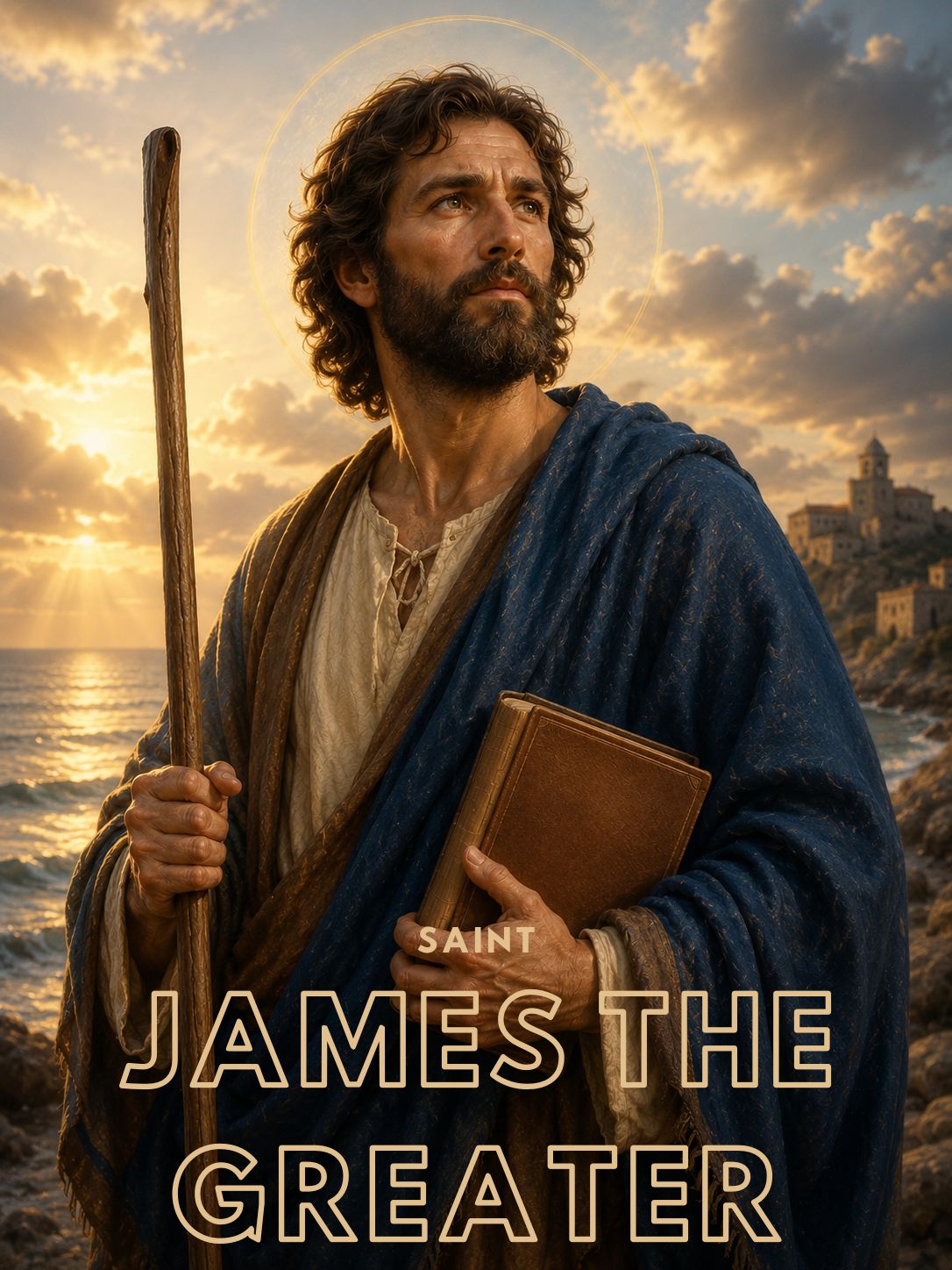
Saint James the Greater: The First Apostle to Die for Christ
Saint James the Greater holds a distinguished place among Jesus’s twelve apostles, both for his closeness to Christ during his ministry and for becoming the very first apostle martyred for the faith. Today, millions of pilgrims still walk ancient routes across Spain in his honour, following a tradition that stretches back over a thousand years. His story blends Scripture, legend, and enduring devotion in a way few other saints can match.
The Feast Day of Saint James the Greater
The Catholic Church celebrates the feast day of Saint James the Greater every July 25, a date also observed by Eastern Orthodox, Anglican, and Lutheran traditions. Although tradition holds that his martyrdom actually occurred on this date in 44 AD, some historians suggest the date may have instead been chosen to align with the feast of Saint Christopher. Eastern Orthodox Christians following the older Julian calendar additionally commemorate him on April 30.
Early Life and Calling by Jesus
Born into a family of Jewish fishermen along the Sea of Galilee, James was the son of Zebedee and Salome, and the brother of John the Apostle. According to some traditions, Salome was related to Mary, the mother of Jesus, making James a cousin of Christ himself. He earned the title “the Greater” simply to distinguish him from another apostle, James “the Less,” rather than to suggest greater importance.
James and his brother John were preparing their fishing nets alongside their father when Jesus first called them to follow him. Remarkably, after the fishermen had struggled to catch anything all day, Jesus instructed them to cast their nets again, resulting in a catch so large it nearly sank their boats.
A Trusted Witness in Jesus’s Inner Circle
Along with Peter and John, Saint James the Greater formed an especially close circle among the twelve apostles. Jesus permitted only these three men to witness several pivotal moments, including the raising of Jairus’ daughter, the Transfiguration on the mountain and his agonizing prayer in the Garden of Gethsemane. Because of their fiery temperament, James and John earned the nickname “Sons of Thunder,” a reputation reinforced when the brothers once asked Jesus to call down fire upon a Samaritan town that had rejected them. Jesus firmly rebuked this request, along with a separate appeal from the brothers seeking privileged seats beside him in glory.
Missionary Work in Spain
Following Christ’s Ascension, tradition holds that Saint James the Greater traveled extensively to spread the Gospel, eventually journeying to Hispania, the Roman province covering modern-day Spain. According to popular legend, the Virgin Mary appeared to him on January 2, AD 40, standing atop a pillar along the Ebro River near present-day Zaragoza. That same pillar remains preserved today within the Basilica of Our Lady of the Pillar, and shortly after this apparition, James returned to Judea to continue his ministry.
Martyrdom and the Journey to Compostela
Back in Jerusalem, King Herod Agrippa ordered James executed by the sword, making him the first apostle martyred for his faith, according to the Acts of the Apostles. Because Jewish authorities denied him proper burial, tradition states that his followers carried his body by sea to Galicia in northwestern Spain. According to legend, the boat arrived without any human guidance, and after various miraculous encounters involving a local queen named Lupa, his disciples successfully built his tomb near what is now Santiago de Compostela.
For centuries afterward, the location of his remains faded from memory until their rediscovery in the ninth century by a hermit named Pelayo, during the reign of King Alfonso II. This discovery quickly transformed Santiago de Compostela into one of the most important pilgrimage destinations in the Christian world, a tradition still very much alive today.
Legacy, Patronage, and Devotion Today
Saint James the Greater remains the patron saint of Spain and of pilgrims worldwide. His emblem, the scallop shell, became so closely associated with him that variations of his name appear in the words for “scallop” across several European languages. During the Middle Ages, tradition credited him with miraculously assisting Christian Armies in battle, earning him the additional title “Santiago Matamoros,” and Spanish forces once used his name as a rallying battle cry.
Today, the “Way of St. James” pilgrimage route continues to draw hundreds of thousands of travelers annually, with numbers exceeding 270,000 during recent Holy Years, special years when his feast falls on a Sunday. His relics remain enshrined within the Cathedral of Santiago de Compostela, ensuring his legacy as one of Christianity’s most enduring apostolic witnesses.

Leave a Reply