
The Apostle of Divine Mercy Who Carried a Message of Mercy to the World
The Church remembers Saint Faustina Kowalska on October 5. She is known as the Apostle of Divine Mercy. Moreover, her message also shapes the Feast of Divine Mercy, which Catholics keep on the Sunday after Easter. Therefore, her story matters to the whole year, not only to one memorial. Few saints have spread a devotion so quickly across the world.
Saint Faustina Kowalska was born Helena Kowalska on August 25, 1905, in Głogowiec, Poland. Her family was poor but devout, and she was the third of ten children. Her father worked as a carpenter and farmer. Because of this, she received very little schooling. At sixteen, she left home to work as a housekeeper and help her family. Even so, she felt a growing call to religious life.
The path to the convent was not easy. At first, her parents refused to give permission. However, Helena kept praying and kept working. Eventually, she entered the Congregation of the Sisters of Our Lady of Mercy in Warsaw in 1925. Upon taking her vows, she became Sister Maria Faustina of the Blessed Sacrament. In the convent, she cooked, gardened and served at the gate. Thus, she lived an ordinary and hidden life.
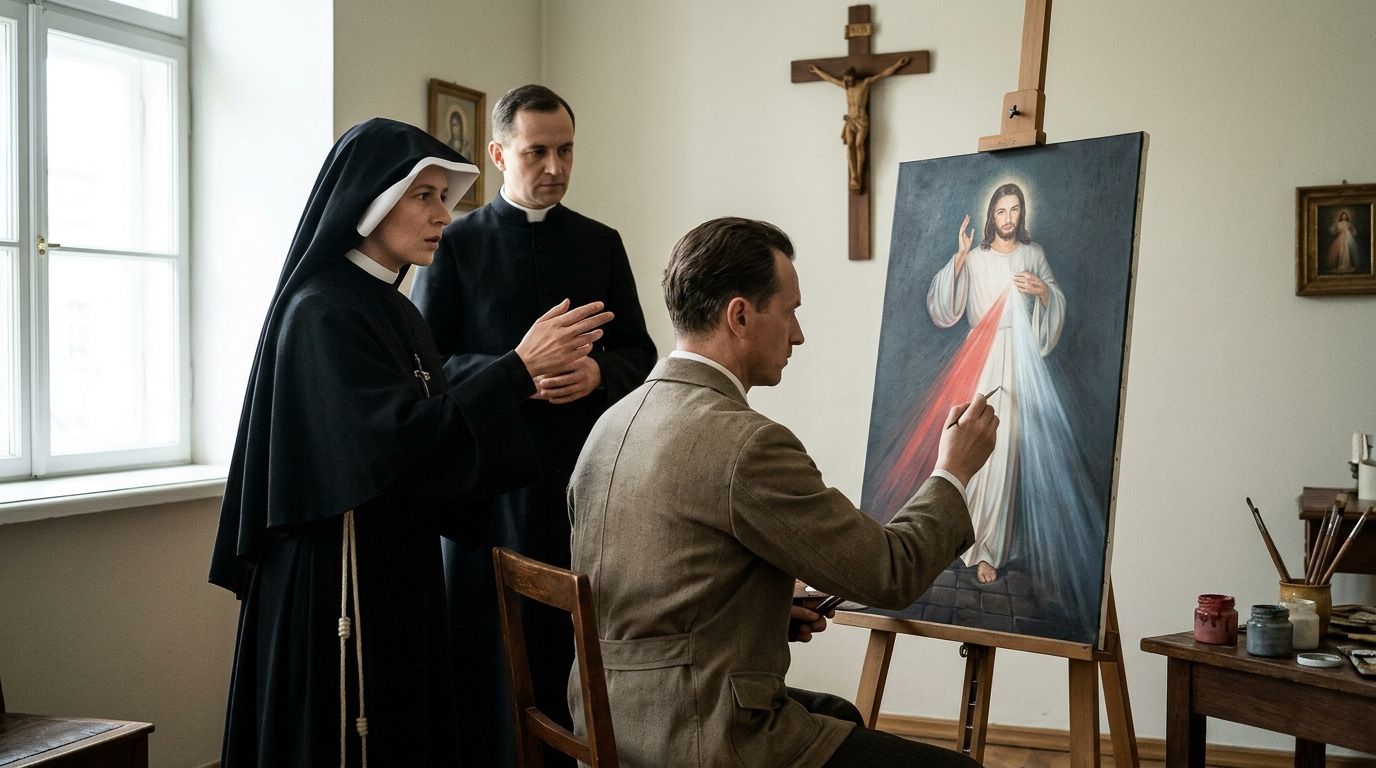
Her extraordinary mission began on February 22, 1931, in the town of Płock. According to her Diary, Jesus appeared to her in a white garment, with red and pale rays streaming from his heart. He asked her to have an image painted with the words “Jesus, I trust in You.” Later, in Vilnius, the artist Eugeniusz Kazimirowski painted the first image in 1934. Her confessor, Father Michał Sopoćko, guided the work. As a result, the Divine Mercy image soon spread across Poland.
Faustina also received other devotions. First, Jesus asked for a Feast of Mercy on the Sunday after Easter. Second, she wrote down the Chaplet of Divine Mercy, which Catholics pray on rosary beads. In addition, she recorded a novena that begins on Good Friday. Furthermore, she described the Hour of Mercy, which invites prayer at three o’clock each afternoon. Together, these devotions share a single message. They invite believers to trust in God’s mercy and to show mercy to others.
Despite her limited education, she kept a long diary at the request of her confessors. Today, it appears in print under the title Divine Mercy in My Soul. Moreover, it has become a bestseller in the Catholic world. Meanwhile, her health declined as tuberculosis spread through her body. She spent months in hospital, and she offered her suffering for sinners. By June 1938, she could no longer write.
Sister Faustina died on October 5, 1938, in Kraków, at the age of 33. After her death, the devotion continued to grow. However, in 1959, the Holy See restricted its public spread, partly because of doubts about the translated texts. Nevertheless, devotion survived among the faithful. Finally, in 1978, the Holy See lifted the restriction. At that time, the Archbishop of Kraków, Cardinal Karol Wojtyła, strongly supported the cause.
Wojtyła soon became Pope Saint John Paul II, and he promoted her message across the globe. He beatified Faustina on April 18, 1993. Then, on April 30, 2000, he canonised her in Saint Peter’s Square. She became the first saint of the new millennium. On the same day, he established Divine Mercy Sunday for the whole Church. Remarkably, he died on the eve of that feast in 2005. Today, her tomb rests in the Shrine of Divine Mercy in Łagiewniki, Kraków.
The Church invokes her as a patron of mercy and of World Youth Day. To learn more, read the Our Sunday Visitor or the National Catholic Register.
In conclusion, Saint Faustina Kowalska shows that God often chooses the humble. She had little education, yet her words reached millions. Likewise, her message tells us that no sin can outweigh God’s mercy. Therefore, let us pray, “Jesus, I trust in You.” May we, too, become instruments of his mercy.

Leave a Reply