
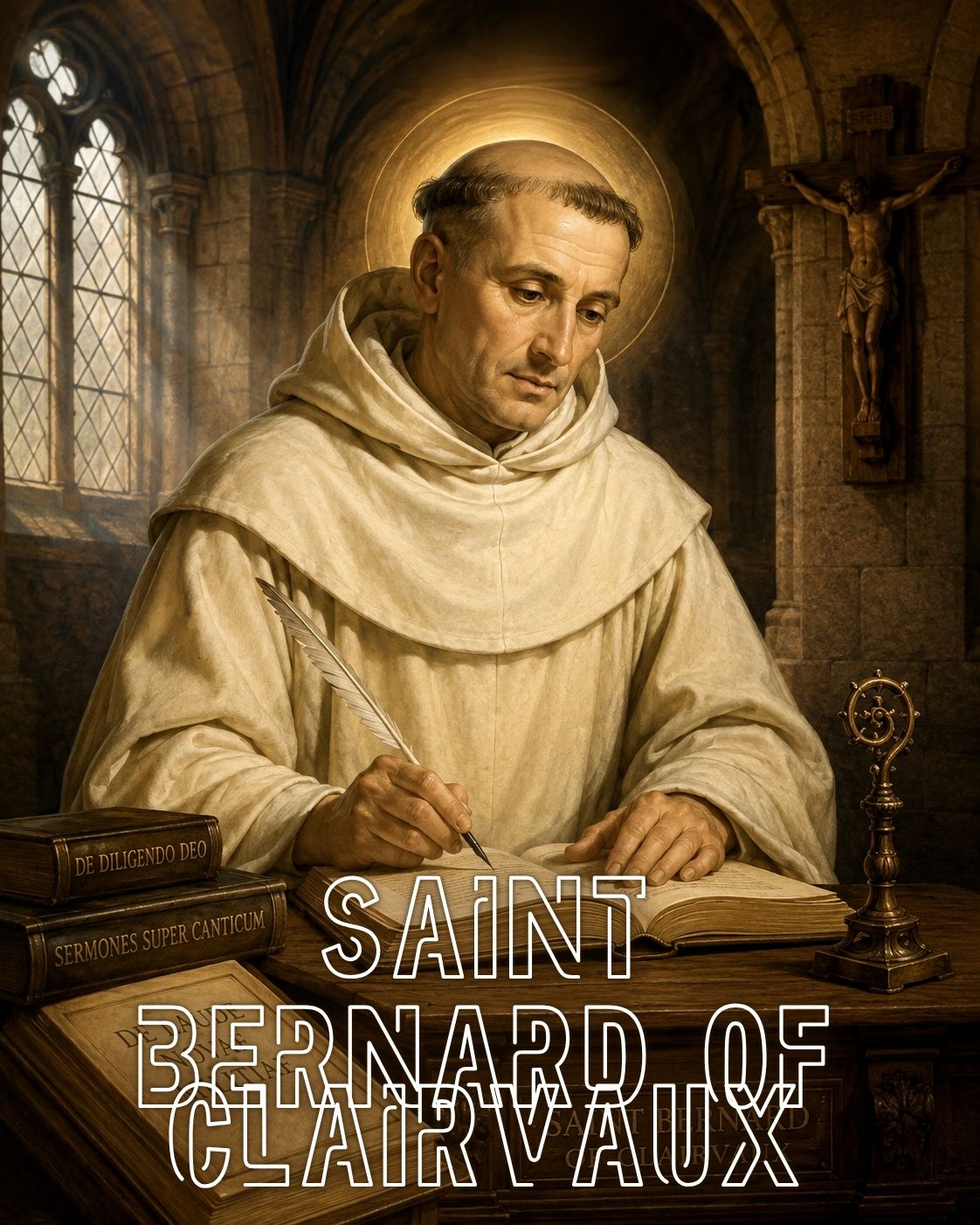
Saint Bernard of Clairvaux became arguably the single most influential churchman of the twelfth century, shaping popes, kings and monastic life alike. Born into Burgundian nobility, he abandoned worldly comfort to join a struggling new monastic reform movement. His eloquence and conviction soon carried him far beyond the cloister walls he had originally sought. This piece traces his early vocation, his monastic foundations, and the controversies that defined his extraordinary career.
Saint Bernard of Clairvaux’s Feast Day Falls on 20 August
The Catholic Church honours Saint Bernard of Clairvaux every year on 20 August, marking his death in 1153. Pope Alexander III canonised him just twenty-one years later, and Pope Pius VIII declared him a Doctor of the Church in 1830. Pope Pius XII later devoted an entire 1953 encyclical to him, describing Bernard as the last of the Church Fathers.
A Nobleman Drawn Toward Monastic Life
Bernard was born in 1090 at Fontaine-lès-Dijon, the third of seven children born to Tescelin de Fontaine and Alèthe de Montbard, both members of Burgundy’s highest nobility. Educated at Châtillon-sur-Seine, he showed early promise in literature and rhetoric. Following his mother’s death, Bernard resolved to join the newly founded and strictly austere Cistercian Order. In 1113, he arrived at Cîteaux Abbey alongside thirty young noblemen, many of them his own relatives, having personally persuaded even his own father to follow him into religious life.
Founding the Abbey of Clairvaux
Bernard’s progress within the order proved remarkably swift. Within three years of entering Cîteaux, his superiors sent him with twelve companions to establish an entirely new monastery. He named this foundation Clairvaux in June 1115, and the two names became permanently linked in history. Despite genuinely harsh living conditions and Bernard’s own fragile health, candidates flocked to join him in extraordinary numbers. Clairvaux went on to found dozens of daughter houses, and by the time of Bernard’s death, his influence had helped establish over 160 monasteries across Europe.
Saint Bernard of Clairvaux Shapes the Knights Templar
Bernard’s influence soon extended well beyond monastic administration. At the Council of Troyes in 1128, he helped draft the founding Rule for the newly established Knights Templar, an order that quickly became an ideal of Christian knighthood. This involvement placed him at the intersection of spiritual reform and the era’s military ambitions, further cementing his growing reputation across Europe.
Defending the Church During Papal Schism
When Pope Honorius II died in 1130, a bitter schism split the Church between Pope Innocent II and the rival Antipope Anacletus II. French bishops summoned Bernard to judge between the two claimants, and he decisively backed Innocent’s legitimacy. Over the following years, Bernard travelled tirelessly across Italy, France, and Germany, persuading rulers and cities to abandon Anacletus. The schism finally ended in 1138 following Anacletus’s death, closing one of the most difficult chapters of Bernard’s public life.
Confronting Heresy and Philosophical Dissent
Bernard also became the Church’s most prominent opponent of theological dissent during this period. In 1141, he confronted the philosopher Peter Abelard at the Council of Sens, successfully persuading the assembled bishops to condemn Abelard’s controversial teachings. He similarly campaigned against the Petrobrusian and Henrician heresies spreading through southern France, and later preached forcefully against Catharism as well.
Preaching the Second Crusade
In 1146, Pope Eugene III commissioned Bernard to preach the Second Crusade following the fall of Edessa to Seljuk forces. His famous sermon at Vézelay, delivered before King Louis VII, drew such overwhelming response that organisers reportedly ran out of cloth needed to make crosses for new recruits. Despite this initial enthusiasm, the campaign ended in failure, and Bernard faced considerable criticism afterwards, which he attributed to the crusaders’ own sins rather than any fault in his preaching.
A Mystic Devoted to Mary
Beyond his political and theological work, Bernard became one of medieval Christianity’s most influential voices on Marian devotion. He famously described Mary as an aqueduct of grace, channelling divine mercy toward humanity. His preaching proved so effective that Dante later chose Bernard as his final guide through Paradise in the Divine Comedy, reciting one of literature’s most celebrated Marian prayers.
Death and Lasting Influence
Saint Bernard of Clairvaux died on 20 August 1153, aged sixty-three, after four decades of monastic life. He was originally buried at Clairvaux Abbey, though his remains were later transferred to Troyes Cathedral following the abbey’s destruction during the French Revolution. For further reading on his theological contributions, New Advent’s Catholic Encyclopedia entry on Saint Bernard offers additional background. Readers exploring nearby August feasts can browse the complete August Saints calendar for more.


Leave a Reply