
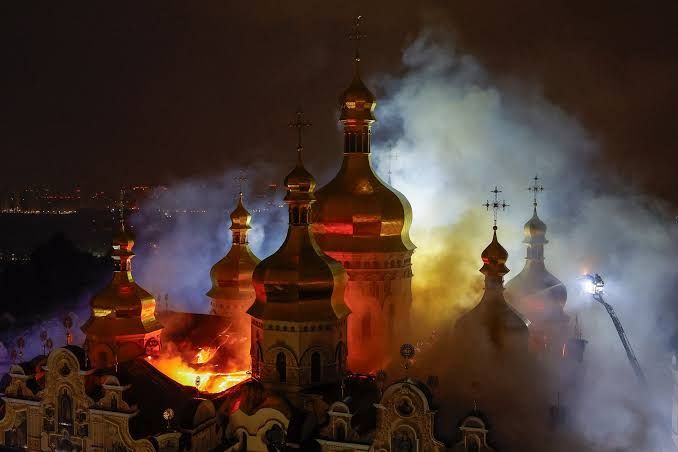
Image Credit: Damage to the Dormition Cathedral, Kyiv Pechersk Lavra, following reported missile strike, June 15, 2026. Photo via social media/Ukrainian sources, used under fair use for news reporting.
Russian Missile Strikes Kyiv’s Dormition Cathedral: Catholic and Orthodox Leaders Condemn Attack on Sacred Site
The Strike on a Sacred Site
On June 15, 2026, a Russian missile struck the Dormition Cathedral in the Kyiv Pechersk Lavra, one of the most revered religious complexes in Eastern Christianity . The attack damaged the historic cathedral, which sits at the heart of a UNESCO World Heritage site dating back to the 11th century.
The Pechersk Lavra — also known as the Monastery of the Caves — is the spiritual center of Orthodox Christianity in Ukraine and Russia. Founded in 1051 by Saint Anthony and Saint Theodosius, it has survived Mongol invasions, Soviet suppression, and Nazi occupation. Its underground caves contain the relics of dozens of saints, and its churches have drawn pilgrims for nearly a millennium.
The missile strike represents not merely an act of war but an assault on shared Christian heritage. The Dormition Cathedral itself was originally constructed in the 1070s, destroyed during World War II, and painstakingly reconstructed in the late 20th century. Its golden domes are visible across the Dnieper River, a symbol of Kyiv’s identity as the “Mother of Rus’ Cities.”
Catholic and Orthodox Response
Religious leaders across confessional lines swiftly condemned the attack . Catholic bishops in Ukraine, the Ukrainian Greek Catholic Church, and Orthodox leaders issued joint statements decrying the desecration of a place consecrated to prayer and pilgrimage.
The Vatican, through its diplomatic channels, expressed “deep concern” over the targeting of religious sites and renewed calls for an immediate ceasefire and respect for international humanitarian law, which protects places of worship during armed conflict.
This ecumenical solidarity is significant. The relationship between Catholic and Orthodox communities in Ukraine has been historically fraught, marked by centuries of division, political rivalry, and competing jurisdictional claims. The attack on the Lavra — a site claimed by both the Ukrainian Orthodox Church and the Russian Orthodox Church — has temporarily transcended these divisions in shared grief and shared protest.
The Broader Pattern: Religious Sites in War
The Kyiv strike is not isolated. Throughout the Russian invasion of Ukraine, which began in February 2022, dozens of churches, cathedrals, monasteries, and religious sites have sustained damage or destruction . The Catholic Church has documented attacks on its own properties, including churches, schools, and charitable centers. Orthodox, Protestant, and Jewish sites have also been hit.
International law distinguishes between intentional targeting of religious sites, which constitutes a war crime under the Geneva Conventions and the Rome Statute of the International Criminal Court, and collateral damage during military operations near religious complexes. Determining which category applies in specific cases requires independent investigation, which is often impossible in active war zones.
However, the pattern of strikes near or on religious sites has raised concerns among human rights organizations and religious freedom advocates. The U.S. Commission on International Religious Freedom, the Papal Nuncio in Kyiv, and the World Council of Churches have all called for protected status for religious sites and accountability for violations.
The Pechersk Lavra: History and Significance
Understanding the Lavra’s importance explains why its damage resonates far beyond Ukraine’s borders.
The Kyiv Pechersk Lavra is a sprawling complex of churches, bell towers, monastic cells, and underground caves spread across hills overlooking the Dnieper River. Its name derives from the Ukrainian word pechera, meaning “cave,” referring to the extensive underground passages where monks lived, prayed, and were buried.
The Dormition Cathedral — also called the Assumption Cathedral — was the Lavra’s principal church. It was modeled after the Hagia Sophia in Constantinople and served as the coronation church for Ukrainian princes. Its destruction in 1941 during the Nazi-Soviet war was one of the great architectural losses of the conflict. Its reconstruction, completed in 2000, was celebrated as a national and religious resurrection.
The Lavra is also a site of political contestation. Since 2022, control of the complex has been disputed between the Ukrainian Orthodox Church (UOC), historically linked to the Russian Orthodox Church, and the Orthodox Church of Ukraine (OCU), granted autocephaly (independence) by the Ecumenical Patriarchate of Constantinople in 2019. The Ukrainian government has taken steps to evict the UOC from the Lavra, citing national security concerns and alleged collaboration with Russian authorities.
This internal Orthodox conflict adds layers of complexity to the missile strike’s interpretation. For some Ukrainian commentators, the Lavra represents Russian religious imperialism as much as Christian heritage. For others, the attack on any sacred site is unconditionally condemnable, regardless of political jurisdiction.
What Catholics Should Know
For Catholic readers, particularly in the West, the Kyiv attack raises several urgent considerations.
First, it demonstrates the fragility of Christian heritage in zones of conflict. The churches, monasteries, and sacred sites that have endured for centuries can be destroyed in moments. The preservation of Christian patrimony is not merely an archaeological concern. It is a spiritual and moral imperative.
Second, it highlights the ecumenical imperative in times of persecution. Catholics and Orthodox share apostolic foundations, sacramental theology, and veneration of Mary and the saints. When Orthodox sites are attacked, Catholic hearts should grieve. The joint condemnation by Catholic and Orthodox leaders models the unity that Christ prayed for at the Last Supper.
Third, it raises questions about religious freedom in wartime. The right to worship, to preserve sacred sites, and to practice faith without fear of violence is not suspended by martial law. Catholics should advocate for international enforcement of protections for religious sites and accountability for violations.
A Prayer for Ukraine and Peace
Lord God, whose Son wept over Jerusalem and cleansed the Temple,
look with mercy on the people of Ukraine and the sacred sites desecrated by war.
Protect the monks of the Pechersk Lavra,
the faithful of the Dormition Cathedral,
and all who seek You in places consecrated to Your name.
Convert the hearts of those who make war,
comfort those who mourn,and hasten the day when swords become plowshares
and nations learn war no more.
Through Christ, the Prince of Peace,
who lives and reigns with You and the Holy Spirit,
one God, forever and ever.Amen.

Leave a Reply