
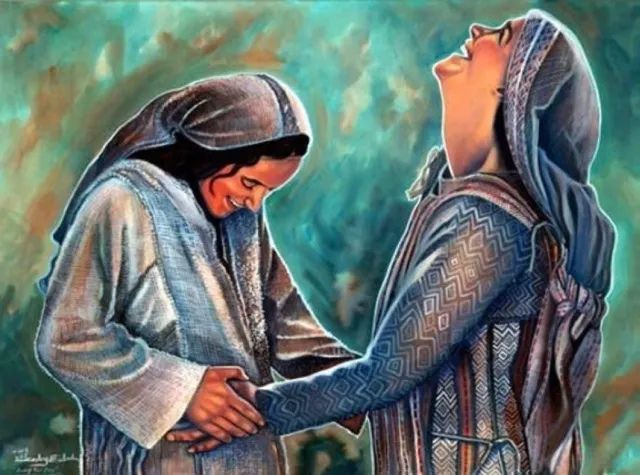
Image Credit: Photo of Artwork by Corby Eisbacher, “Jump for Joy”
Why We still Celebrate the Visitation of Mary on May 31
Visitation of Mary – A Young Girl on a Long Road
Picture this: a teenage girl just found out she’s pregnant—not by any man, but by the Holy Spirit. The Angel who told her also mentioned something wild: her much older cousin Elizabeth, who everyone thought was too old to have kids, is six months pregnant too.
Most of us would probably sit down and process that for a while. Not Mary. Scripture says she went “in haste” to the hill country of Judea. That’s roughly 80-100 miles from Nazareth, by the way. On foot or maybe with a donkey. Through terrain that was not exactly friendly.
She was not going for a vacation. Elizabeth needed help. Pregnancy at an advanced age was dangerous back then, just like it is now. Mary came to serve—to cook, clean, support, and just be there for the woman who had been there for her family. It’s one of those moments where you see Mary’s character before you see her glory.
The Greeting That Changed Everything
When Mary walked into Zechariah’s house and called out a greeting, something happened that no one could have staged.
Elizabeth’s baby—John the Baptist, though nobody knew his name yet—leaped in her womb. Not a kick. Not normal movement. The original Greek word practically jumps off the page with energy. This unborn child recognized the unborn Saviour. Even in the darkness of the womb, John knew who had arrived.
Then Elizabeth, filled with the Holy Spirit, spoke words that the Church has treasured ever since:
“Blessed are you among women, and blessed is the fruit of your womb! And why is this granted to me, that the mother of my Lord should come to me?”
Think about what Elizabeth just did. She looked at a young, unmarried pregnant girl from a nowhere town and called her the mother of her Lord. No hesitation. No judgment about the circumstances. Just pure, Spirit-led recognition of who Mary was carrying and what it meant.
It’s actually the first time anyone in the New Testament calls Jesus “Lord.” And it comes from an old woman speaking under divine inspiration about her teenage cousin. God has a sense of timing like that.
Mary’s Song: The Magnificat
Elizabeth’s words opened something in Mary. What came out was the Magnificat—her soul’s spontaneous overflow of praise, and one of the most subversive prayers ever prayed.
She starts personal: “My soul magnifies the Lord, and my spirit rejoices in God my Savior.” But she doesn’t stay there. Mary zooms out to see the bigger picture of what God is doing in history.
“He has shown strength with his arm; he has scattered the proud in the thoughts of their hearts. He has brought down the powerful from their thrones, and lifted up the lowly. He has filled the hungry with good things, and sent the rich away empty.”
This is not gentle, sweet Mary from the Christmas cards. This is a young Jewish woman who knows her people’s history, who has read the prophets, who understands that God’s coming means upheaval. The proud get scattered. The powerful lose their thrones. The hungry eat. The rich leave empty-handed.
Mary was not just singing about spiritual feelings. She was announcing a revolution—one that would eventually get her Son killed by the very powers she named.
What This Means for Us Today
The Visitation is not just a nice Bible story to remember in May. It shows us three things we desperately need:
First, presence matters. Mary could have sent a message. She could have prayed for Elizabeth from a distance. Instead, she showed up. She walked all that way because her cousin needed her, not her good intentions. In our screen-saturated world, the Visitation is a kick in the pants to actually go be with people who are suffering.
Second, Jesus changes the room. Mary didn’t preach a sermon. She didn’t perform a miracle for Elizabeth. She just arrived, carrying Jesus inside her, and that presence alone made John leap and Elizabeth prophesy. When we carry Christ into a room—through our baptism, through our love—things shift. People notice, even if they can’t explain why.
Third, the lowly have a voice. Mary was nobody by worldly standards. Young, female, poor, from a backwater town. Yet her words have been prayed daily by billions of Christians for two thousand years. The Magnificat is part of the Church’s evening prayer every single day. God does not need impressive people. He needs available ones.
A Feast Day Worth Keeping
The Church has celebrated the Visitation of Mary since at least the 13th century, though Pope Benedict XIV made it universal in 1751. It falls on May 31—right after the feast of the Annunciation (March 25) and before the Nativity of John the Baptist (June 24), which makes perfect sense chronologically.
In the Rosary, it’s the second Joyful Mystery. When you pray it, you are not just remembering history. You are entering into that moment of recognition, that leap of joy, that song of revolutionary hope.
Some of the most beautiful art in the Church depicts this scene. Fra Angelico painted it with almost tender simplicity. Ghirlandaio gave it Italian Renaissance grandeur. Modern artists have reimagined it across cultures because the story transcends time and place. Two women, two miraculous pregnancies, one moment of pure, Spirit-filled recognition.
The Bottom Line
The Visitation of Mary is where the hiddenness of the Incarnation starts to crack open. For nine months, Jesus was silently growing in Mary’s womb. But at the Visitation, that hidden presence did something. It sanctified John, moved Elizabeth to prophecy and drew forth Mary’s Magnificat.
We are invited into that same dynamic. Carry Christ into your conversations, your work, your family, your neighbourhood. Don’t worry about having the right words. Mary’s presence was enough. Let yours be too.
And when you feel small, overlooked, or powerless? Remember that the most important prayer in Christian history after the Our Father came from a teenage girl who said yes to God and then walked a hundred miles to help her cousin. God does not waste small beginnings.

Leave a Reply