
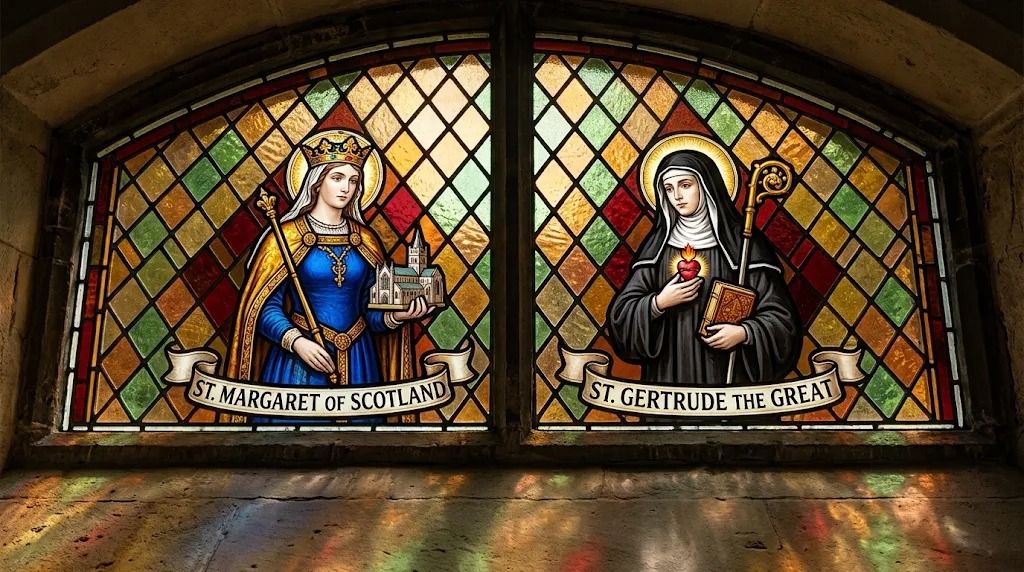
Saint Margaret of Scotland and Saint Gertrude Share One Feast and One Love for Christ
The Church honours Saint Margaret of Scotland and Saint Gertrude the Great on November 16. Both celebrations are optional memorials. Moreover, the two women lived in very different worlds. One was a queen who served the poor and the other was a nun who studied and prayed. Therefore, together they show that holiness can grow in palaces and in cloisters alike.
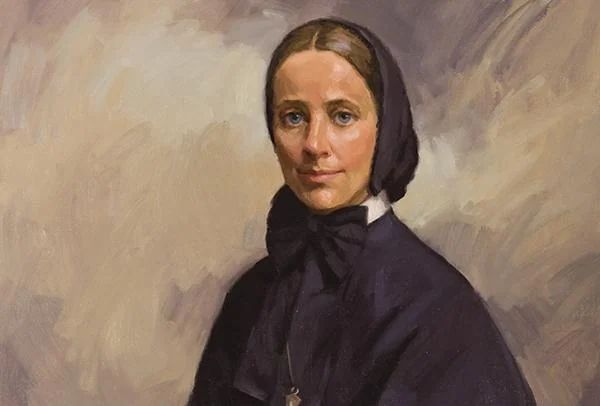
First, consider Margaret. She was born around 1045 in Hungary, where her father, the English prince Edward the Exile, lived in exile. Her mother, Agatha, came from a noble family. In 1057, the family returned to England. However, the Norman Conquest of 1066 forced Margaret to flee north. Her ship reached Scotland, where King Malcolm III welcomed her. Thus, a refugee became a queen.
Margaret married Malcolm by 1070 at Dunfermline. Although he was rough and unlettered, he deeply loved her. In turn, she softened his manner and encouraged him in the faith. They had eight children, and three of their sons became kings of Scotland. Moreover, their daughter Matilda became queen of England. Margaret raised them with great care and taught them to pray. As a result, her family became known for piety.
She also served the poor with great tenderness. According to her biographer, she fed orphans and washed the feet of the poor. She also welcomed English captives and often paid their ransom. In addition, she used her influence to reform the Church in Scotland. She encouraged the clergy to follow Roman customs, to observe Lent faithfully and to celebrate Mass with reverence. Furthermore, she founded and supported churches, including Dunfermline Abbey.
Margaret died in Edinburgh Castle on November 16, 1093, at about the age of 47. Only days earlier, her husband and her eldest son had died in battle at Alnwick. Pope Innocent IV canonised her in 1250 and the Church moved her remains to a new shrine at Dunfermline. Later, the Reformation scattered her relics. Today, the Church honours her as a patron of Scotland and of queens. Before 1969, her feast fell on June 10.
Next, consider Gertrude. She was born on January 6, 1256, in the region of Saxony in Germany. When she was 5, her family placed her in the monastery of Helfta. There she studied Latin, literature and the arts and she excelled in all of them. However, she later felt that she had built a tower of pride and curiosity. Consequently, she turned her heart toward God. Around the age of 25, she received a powerful vision of Christ.
After this experience, Gertrude devoted herself to prayer and writing. She had a special love for the heart of Jesus and for the Eucharist. In one vision, she rested her head against Christ’s side and heard his heartbeat. Thus, she became a forerunner of devotion to the Sacred Heart. She also lived beside saintly companions, including Mechtilde of Hackeborn, who taught her in her youth. In addition, the community at Helfta became a centre of learning and mysticism.
Gertrude wrote several works, but only some survive. Her best-known book is the Herald of Divine Love, which has five parts. The second part is entirely her own work. Moreover, she composed Spiritual Exercises, a collection of prayers for the stages of the spiritual life. In these writings, she stresses that God’s mercy is greater than human weakness. As a result, many Catholics have found comfort in her words.
Gertrude died on November 17, though sources disagree about the year, 1301 or 1302. The Church celebrates her on November 16. The title “the Great” distinguishes her from other nuns named Gertrude, and she is the only woman saint who bears it. Wikipedia lists her canonisation as an equipollent act under Pope Innocent XI in 1677. She is the patron of the West Indies and people often invoke her for the souls in purgatory.
What do these two women teach us? First, power can serve love. Margaret used her throne to help the poor. Second, study can lead to prayer. Gertrude used her mind to deepen her faith. In addition, both women show that God can work in times of grief and uncertainty. To learn more, read the Catholic Encyclopedia article on Margaret of Scotland and the EWTN News article on Gertrude.
In conclusion, Saint Margaret of Scotland and Saint Gertrude remind us that holiness has many forms. One served the poor from a throne, and the other served God from a cloister. Likewise, both loved Christ above all things. Therefore, let us ask for their prayers on this memorial. May we, too, serve the Lord with open hands and an undivided heart.

Leave a Reply