
Saint Elizabeth of Portugal: The Queen Who Became a Peacemaker
Saint Elizabeth of Portugal transformed a difficult royal marriage into a life defined by patience, charity and remarkable diplomatic skill. Born a princess of Aragon, she became Queen of Portugal at a young age and despite facing personal betrayal and hardship, she eventually earned admiration across two kingdoms. Today, the Church remembers Saint Elizabeth of Portugal not only as a devoted wife and mother, but also as one of history’s most effective royal peacemakers.
The Feast Day of Saint Elizabeth of Portugal
The Catholic Church currently celebrates the feast day of Saint Elizabeth of Portugal on July 4, the anniversary of her death in 1336. Her feast has shifted several times over the centuries; in 1694, officials moved it to July 8 to avoid conflicting with another celebration, before the 1969 calendar revision eventually restored it to its original July 4 date. Interestingly, because July 4 marks Independence Day in the United States, American parishes now observe her memorial on July 5 instead.
Royal Birth and an Arranged Marriage
Born in 1271 into the royal house of Aragon, Elizabeth was the daughter of Infante Peter, later King Peter III of Aragón, and Queen Constance of Sicily. She was also the great-niece of Elizabeth of Hungary, another sainted royal known for similar acts of charity. From childhood, Elizabeth embraced rigorous religious devotion, praying the full Divine Office daily and observing frequent fasting.
At just eleven years old, Elizabeth was betrothed to King Denis of Portugal, though the couple did not marry until 1288, when she turned seventeen. Denis, often called the “Farmer King” for planting extensive pine forests to protect the region’s soil, proved to be a capable ruler. Unfortunately, he also lived a life of infidelity that caused considerable public scandal and personal suffering for his young queen.
A Legendary Test of Faith and Innocence
According to popular tradition, one of the most dramatic episodes of Saint Elizabeth of Portugal’s life involved a Page falsely accused of impropriety with the queen. Believing a jealous rival’s lie, King Denis ordered the accused Page sent to a lime-burner, secretly instructing the furnace operator to kill the first page who arrived. However, the innocent Page stopped for daily Mass along the way and lingered for a second service. Meanwhile, the king sent the actual liar to confirm the lime-burner had killed the other page, and the lime-burner threw that page into the furnace instead.. When Denis learned the truth, he recognized both his wife’s innocence and the protective power of faithful devotion and the incident reportedly inspired him to live more virtuously afterward.
A Devoted Mother and Skilled Diplomat
Beyond her personal trials, Saint Elizabeth of Portugal proved herself a shrewd and capable political figure. She played a key role negotiating the Treaty of Alcañices in 1297, which established the modern border between Portugal and Castile. She and Denis had two children, a daughter named Constance and a son named Afonso, who later became King Afonso IV.
During a bitter civil war between 1322 and 1324, Elizabeth intervened decisively to prevent bloodshed between her husband and their son. In 1323, she famously rode a Mule directly onto the battlefield at Alvalade, positioning herself between the opposing Armies until peace was restored. This act of courage cemented her growing reputation as a genuine peacemaker.
Widowhood and a Life of Charity
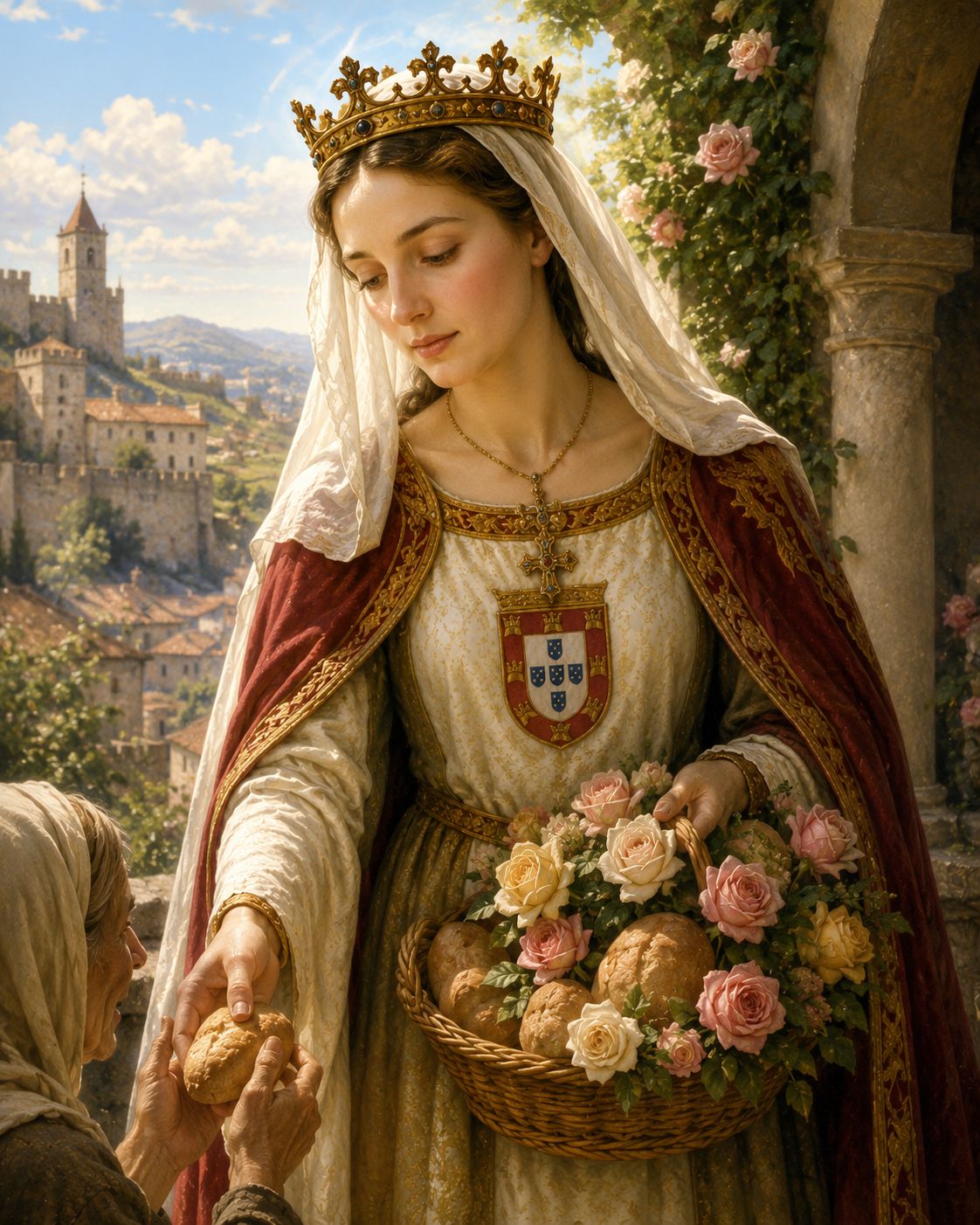
After King Denis died in 1325, Elizabeth retired to the Poor Clare Monastery she had founded in Coimbra, joining the Third Order of Saint Francis and dedicating her remaining years to serving the poor and sick. During the severe famine of 1293, she had already distributed flour from her own stores to starving residents of Coimbra, and her later years continued this same spirit of generosity, funding hospitals, dowries for poor girls and lodging for pilgrims.
Even in old age, Saint Elizabeth of Portugal answered one final call to peacemaking in 1336, traveling to Estremoz to stop her son Afonso IV from marching against King Alfonso XI of Castile. Though she successfully negotiated peace once again, the exhausting journey brought on a fatal illness and she died shortly afterward on July 4, earning her lasting title as “the Peacemaker.”
Canonization and Lasting Legacy
Pope Urban VIII canonized Saint Elizabeth of Portugal in 1626, following her earlier beatification in 1516. She remains closely associated with the popular “miracle of the roses” legend often depicted in art, showing her carrying roses in her skirt or scapular. Her legacy also extended beyond religious devotion. An island in the Galapagos was originally named in her honour and her story has since inspired films, novels and churches dedicated to her memory across the world.






Leave a Reply