
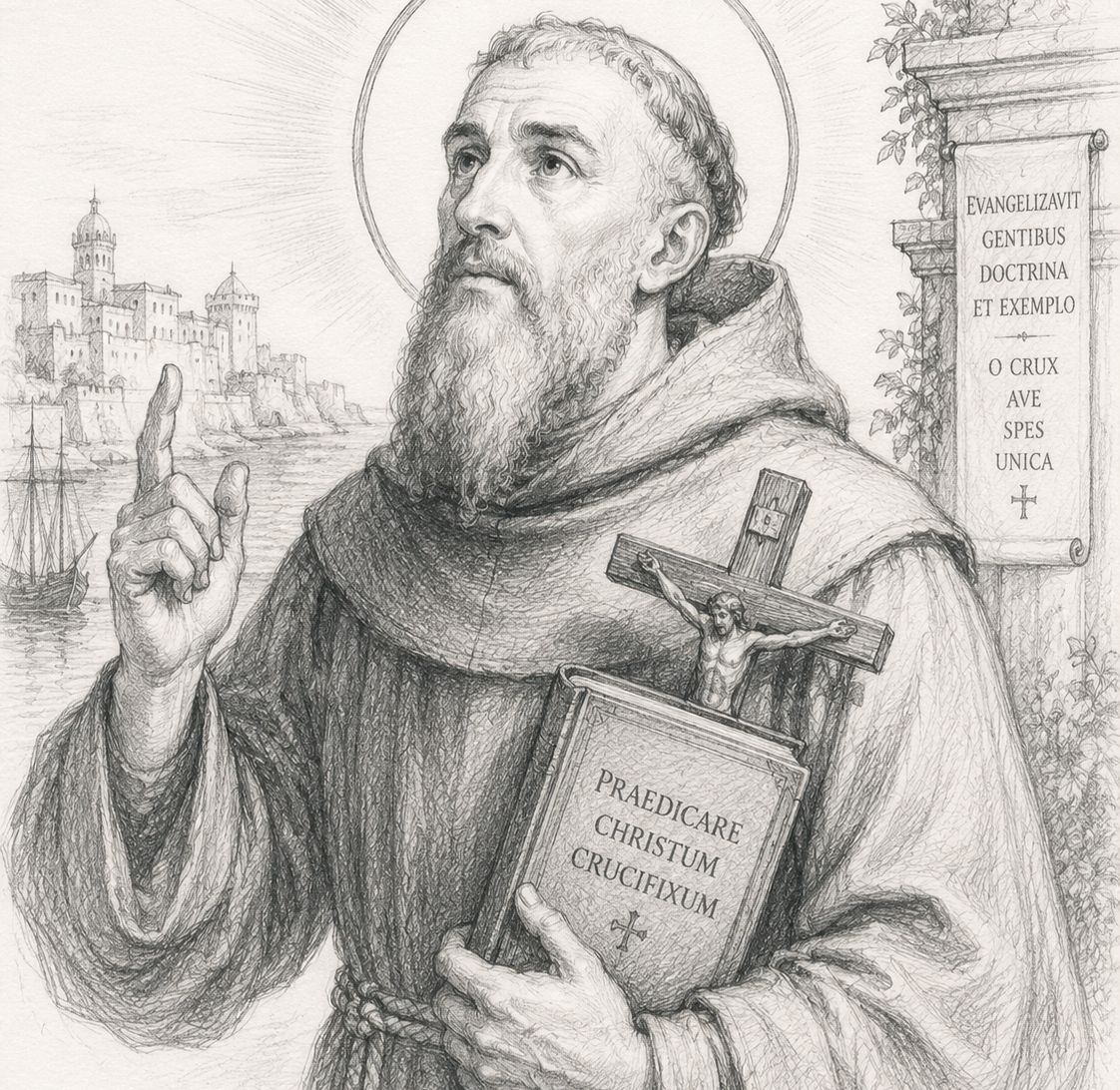
Saint Lawrence of Brindisi: Scholar, Preacher, and Peacemaker
Saint Lawrence of Brindisi lived a life that few saints can match in sheer variety. He mastered nearly a dozen languages, preached to converts across Europe, led an army into battle armed only with a crucifix, and later negotiated peace between kings. Despite these remarkable achievements, he remained a humble Capuchin friar at heart. Today, the Church honours Saint Lawrence of Brindisi as a Doctor of the Church, recognizing both his holiness and his extraordinary intellectual gifts.
The Feast Day of Saint Lawrence of Brindisi
The Catholic Church celebrates the feast day of Saint Lawrence of Brindisi every July 21. Remarkably, he was born on July 22, 1559 and died on that exact same date sixty years later in 1619, making his death anniversary fall just one day after his annual feast.
Early Life and Education
Born Giulio Cesare Russo in Brindisi, then part of the Kingdom of Naples, Lawrence came from a family of Venetian merchants. From a young age, he displayed a natural gift for oratory, and his community regularly chose him to deliver Christmas sermons to fellow townspeople. However, his childhood was not without hardship, since his father died when Lawrence was only twelve years old. Afterward, he continued his education at Saint Mark’s College in Venice under the guidance of his uncle.
At sixteen, Lawrence joined the Capuchin Franciscans in Verona, taking the religious name Lawrence upon entering the Order. He then pursued advanced studies at the University of Padua, where he built an impressive command of languages, eventually reading and speaking Latin, Hebrew, Greek, German, Czech, Spanish, and French with fluency, alongside his native Italian. He was ordained a priest at just twenty-three years old and quickly earned a reputation as a powerful preacher throughout Northern Italy.
Rising Leadership Within the Capuchin Order
By the age of thirty-one, Saint Lawrence of Brindisi had risen to become superior of the Capuchin province of Tuscany. In 1596, he was appointed definitor general in Rome, a leadership position he would hold five separate times throughout his life. Around this same period, Pope Clement VIII assigned him the delicate task of preaching to the Jewish community in Rome, a mission that benefited greatly from his fluency in Hebrew.
Beginning in 1599, Lawrence traveled to Germany and Austria, where he worked to counter the spread of Lutheranism during the Counter-Reformation. Alongside Blessed Benedict of Urbino, he established Capuchin friaries in Prague, Vienna, and Gorizia, communities that eventually grew into full religious provinces spanning Bohemia, Austria, and Styria.
A Friar on the Battlefield
In 1601, Emperor Rudolf II asked Lawrence to help raise an Army among German rulers to defend Hungary against invading Ottoman forces. Lawrence agreed, serving as chaplain and helping recruit the Duke of Mercœur to lead the campaign. During the siege of Székesfehérvár, Lawrence reportedly rode into battle carrying nothing but a crucifix, and many observers credited the resulting Christian victory directly to his presence and leadership.
The following year, in 1602, his fellow Friars elected him Vicar General of the entire Capuchin Order, it’s highest possible office. Though he was elected again in 1605, he declined a second term, choosing instead to remain a trusted advisor to his successors.
Diplomacy in the Service of Popes and Kings
Saint Lawrence of Brindisi’s talents soon extended well beyond religious life. The Emperor sent him to Spain to persuade King Philip III to join the Catholic League and while there, Lawrence founded a Capuchin house in Madrid. Afterward, he served as papal nuncio to the Bavarian court of Maximilian, where he helped mediate several disputes among European royalty. He later served as nuncio to Spain as well, before finally retiring to a Friary in Caserta in 1618.
Retirement, however, proved short-lived. In 1619, the rulers of Naples recalled him for one final diplomatic mission, asking him to travel to Spain and intervene with King Philip III against the Duke of Osuna, the Spanish viceroy of Naples. Lawrence successfully convinced the king to recall the duke, averting a potential uprising. Sadly, the grueling summer journey exhausted him, and he died in Lisbon on July 22, 1619, his sixtieth birthday. He was later entombed at the Poor Clares’ Convent of the Annunciation in Villafranca del Bierzo, Spain.
Writings, Canonization and Recognition as Doctor of the Church
Beyond his preaching and diplomacy, Saint Lawrence of Brindisi left behind a substantial body of written work, including a commentary on Genesis, several treatises countering Martin Luther’s teachings, and nine full volumes of sermons. Pope Pius VI beatified him in 1783 and Pope Leo XIII canonized him in 1881.
Nearly eighty years later, in 1959, Pope John XXIII declared Saint Lawrence of Brindisi a Doctor of the Church, granting him the title “Apostolic Doctor” in recognition of his theological depth and missionary impact. Today, he remains the patron saint of Brindisi and his life continues to inspire those who see faith and intellect as complementary rather than competing pursuits.




Leave a Reply