
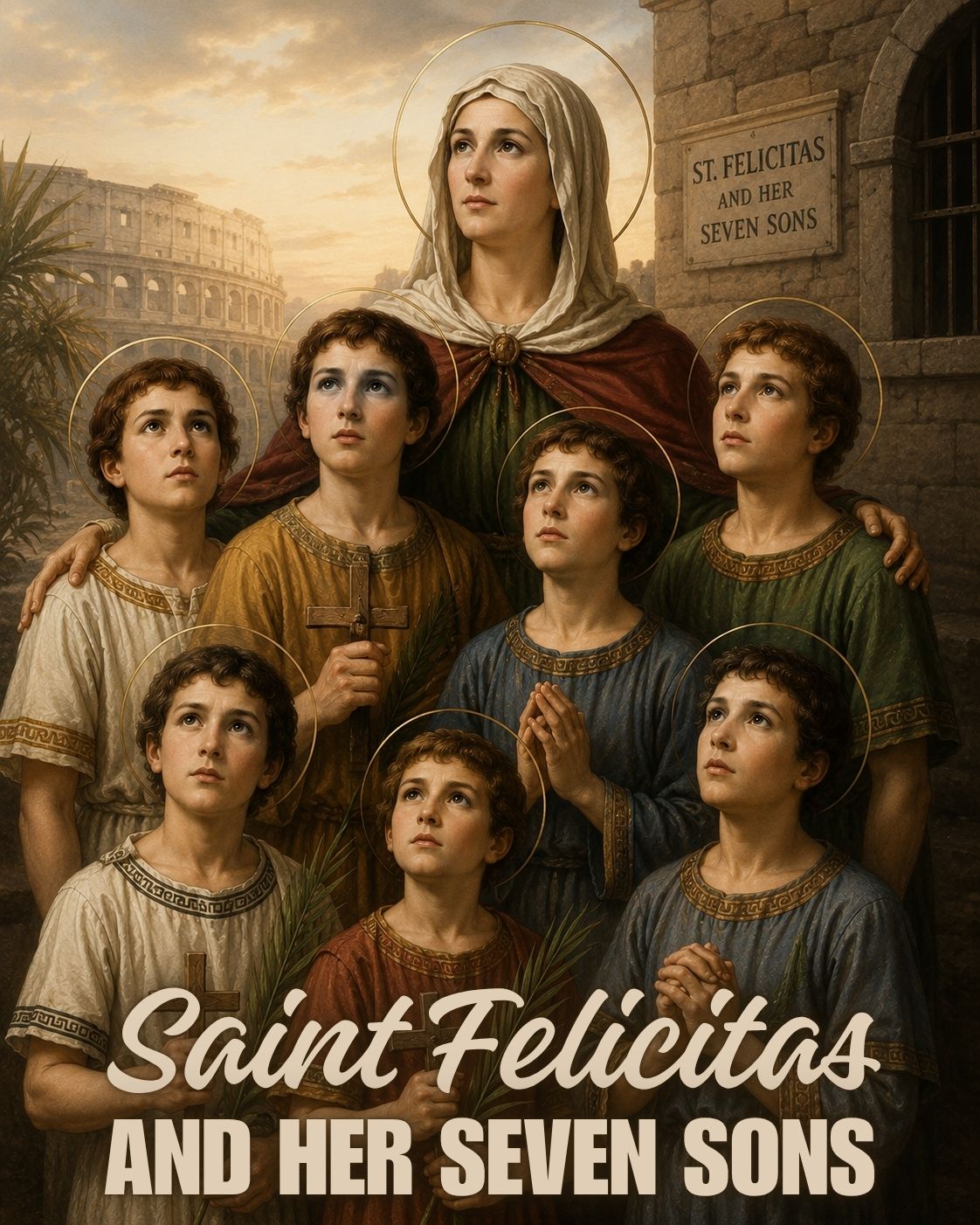
Saint Felicitas and Her Seven Sons: A Mother’s Ultimate Sacrifice
Saint Felicitas and her seven sons stand among the most moving martyr stories from the early Church. A wealthy Roman widow, Felicitas raised her seven boys in the Christian faith during a time when following Christ could mean death. Ultimately, both she and her sons paid that price together and their shared witness has inspired Christians for nearly two thousand years.
The Feast Day of Saint Felicitas and Her Seven Sons
The Church celebrates the joint feast of Saint Felicitas and her seven sons on July 10. Interestingly, Felicitas also holds a separate feast day of her own on November 23, since ancient records first listed her individually before later tradition linked her story to that of the seven martyrs honoured on July 10. Regardless of the date, both feasts commemorate the same remarkable family.
Who Was Saint Felicitas?
Felicitas was born around the year 101 into a wealthy and respected Roman family. After her husband’s death left her a widow, she devoted herself fully to raising her seven sons and to serving God through works of charity. Rather than withdrawing quietly into private life, she used her example to influence others, and many people reportedly abandoned pagan worship because of her public devotion to Christianity.
This growing influence, however, did not go unnoticed. Pagan priests grew alarmed at how effectively Felicitas was drawing people away from the traditional Roman gods. Consequently, they filed a formal complaint against her with imperial authorities, accusing her of insulting the gods through her Christian teaching.
Arrest and Martyrdom of Saint Felicitas and Her Seven Sons
Roman officials eventually handed Felicitas and her seven sons over to Publius, the city prefect, for examination and punishment. Each son bore a distinct name: Januarius, Felix, Philip, Silvanus, Alexander, Vitalis, and Martial. When none of them agreed to renounce their faith or offer sacrifice to pagan idols, authorities condemned them all to death.
According to tradition, Felicitas endured the anguish of watching each of her sons suffer martyrdom before her own execution. Remarkably, rather than despairing, she prayed that her sons would remain steadfast and enter their heavenly reward ahead of her. Pope Gregory the Great later reflected on this in a famous homily, observing that a mother who witnessed her children’s martyrdom experienced a kind of martyrdom herself, multiplied seven times over. Around the year 165, after her sons had all died, Felicitas herself was put to death, completing the family’s shared sacrifice.
Burial Sites and Early Veneration
Following their deaths, the bodies of Saint Felicitas and her seven sons were buried across four separate Roman cemeteries. Alexander, Vitalis, and Martial were laid to rest in the Cemetery of the Jordani; Januarius was buried in the Cemetery of Praetextatus; Felix and Philip were placed in the Cemetery of Priscilla; and Silvanus was buried in the Cemetery of Maximus. This widespread burial pattern suggests how quickly and broadly their story spread throughout the early Roman Christian community.
Devotion to the family grew steadily in the centuries that followed. By the sixth century, Pope Gregory the Great preached about them in a homily delivered at the very church built over Felicitas’ tomb. Today, her major shrine remains the Church of Santa Susanna in Rome, and some historical accounts of the seven brothers’ cult have survived since at least that same era.
Questions Raised by Historians
Modern historians have occasionally questioned certain details within the traditional “Acts” that describe the martyrdom of Saint Felicitas and her seven sons. For instance, her name does not appear in a well-known fourth-century Roman calendar, which has led some scholars to wonder whether her story became linked to the seven martyrs simply because her tomb stood near that of Saint Silvanus, one of the seven. Even so, the Catholic Church has long held it as historically certain that Felicitas and the seven martyrs associated with her name truly died for the Christian faith, regardless of how their individual stories became intertwined over time.
A Lasting Model of Faith and Sacrifice
Today, the faithful invoke Saint Felicitas and her seven sons for many needs, including comfort for parents who have lost a child, support during infertility, and strength for widows facing hardship alone. Her story continues to resonate because it reflects something universal: a parent’s love for their children, paired with an unshakable trust in God even amid unimaginable loss.
As believers reflect on her witness each July 10, Saint Felicitas and her seven sons remain a powerful reminder that faith, once deeply rooted, can withstand even the greatest trials a family might face.


Leave a Reply