
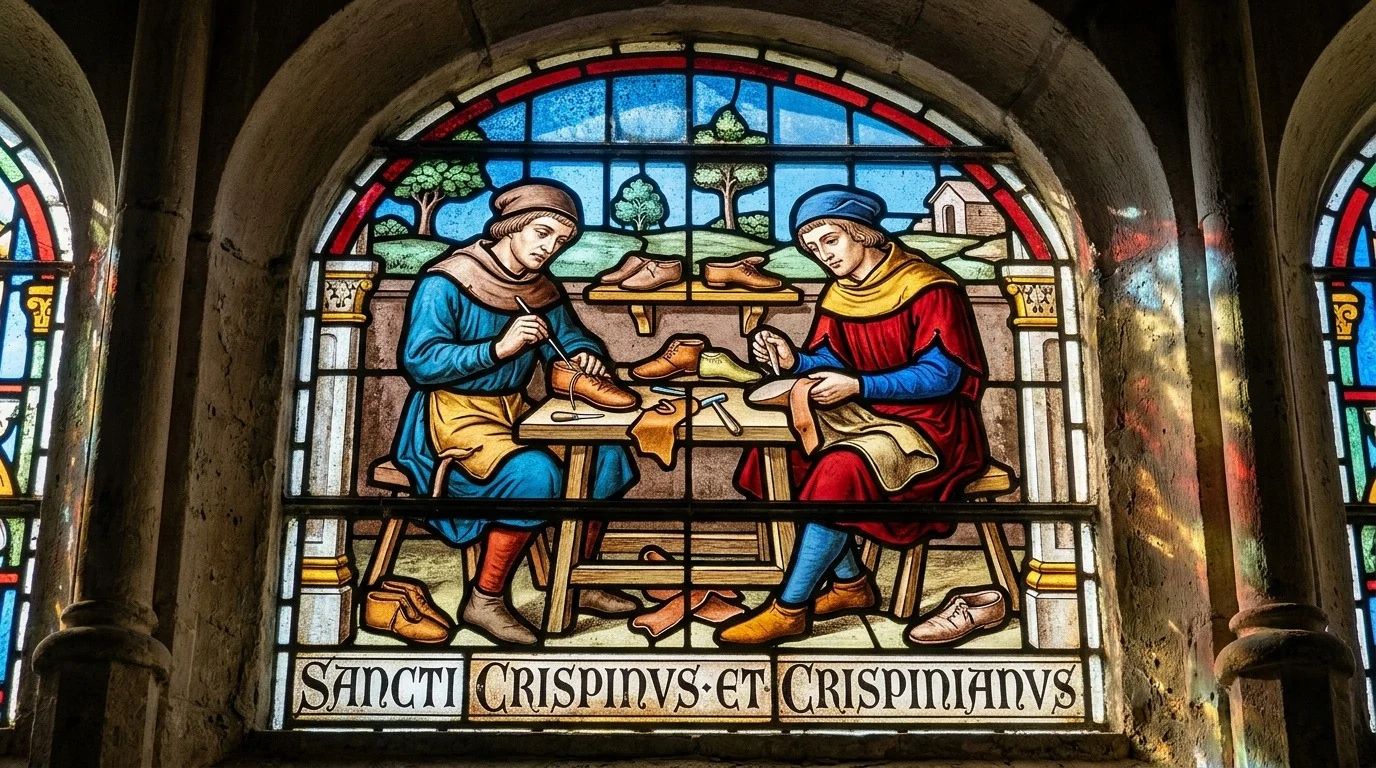
Patrons of Cobblers and Agincourt, Who Made Shoes and Won the Martyr’s Crown
The Church remembers Saints Crispin and Crispinian on October 25. Their names live on in one of the most famous speeches in English literature. Therefore, their story deserves a fresh look.
First, consider who they were. According to tradition, Crispin and Crispinian were brothers from a noble Roman family. Some accounts call them twins. In the third century, they fled the persecution of Christians and travelled to Gaul, which is now France. They settled in Soissons, a city in the north. However, historians note that the earliest written account of their lives dates only from the 8th century. Therefore, much of the story belongs to legend.
Next, look at their work. The brothers wished to preach the Gospel, but they did not want to burden the local people. As a result, they supported themselves as shoemakers. During the day, they spoke about Christ in the streets. At night, they made and mended shoes and they gave many pairs to the poor. Thus, they combined preaching with practical charity. Many citizens of Soissons listened and converted.
Their success soon attracted attention. The governor, Rictius Varus, served under Emperor Maximian and hated Christians. When he heard of the brothers, he ordered their arrest. According to the traditional account, he had them tortured. Executioners drove sharp awls under their fingernails and cut strips from their flesh. Meanwhile, the brothers continued to pray. Their courage astonished the crowd and many more people believed.
Then the legend grows more dramatic. The governor ordered that millstones be tied to their necks and that they be thrown into a river. However, the stones did not drag them down, and the brothers floated safely to the bank. Furious, the governor ordered other tortures, including boiling liquid. Finally, he sentenced them to beheading. They died on October 25, around the year 285 or 286, during the reign of Diocletian. Thus, they won the martyr’s crown.
After their deaths, the faithful honoured them. A church rose in their honour at Soissons in the sixth century. Over time, other places claimed their relics. Rome keeps some in a church dedicated to Saint Lawrence, and Emperor Charlemagne gave others to a cathedral he founded at Osnabrück in Germany. In addition, an English tradition claims that their bodies washed ashore near Faversham in Kent. Historians cannot confirm this. Nevertheless, the story shows how widely people loved them.
The brothers also became patron saints. Cobblers, shoemakers, saddlers, tanners and leatherworkers all invoke them. In medieval times, guilds of shoemakers held processions and feasts on October 25. Artists often show them with shoes, awls or an axe. Although the Church removed their feast from the universal calendar in 1969, many local calendars kept it. Likewise, the Church has never declared them to be anything other than saints.
Finally, consider their place in English history. On October 25, 1415, King Henry V led his small army to victory at the Battle of Agincourt. Many English soldiers were archers and the French outnumbered them greatly. Later, around 1599, William Shakespeare wrote a speech for Henry V in which the king names Crispin and Crispian. The speech promises that those who fight will be remembered as a band of brothers. Thus, two humble saints entered a royal drama.
What can we learn from them? First, honest work can become a form of prayer. The brothers made shoes, and they served the poor. Second, faith can give courage under pressure. They stood firm when others would have fled. In addition, their story reminds us that ordinary people can carry great witness. To learn more, read the Catholic Encyclopedia and the Shakespeare’s Globe.
In conclusion, Saints Crispin and Crispinian show that holiness can grow at a workbench. They preached with their words and served with their hands. Likewise, they remind us that faith can survive fear. Therefore, let us ask for their prayers. May we, too, serve Christ in our daily work.
Leave a Reply