
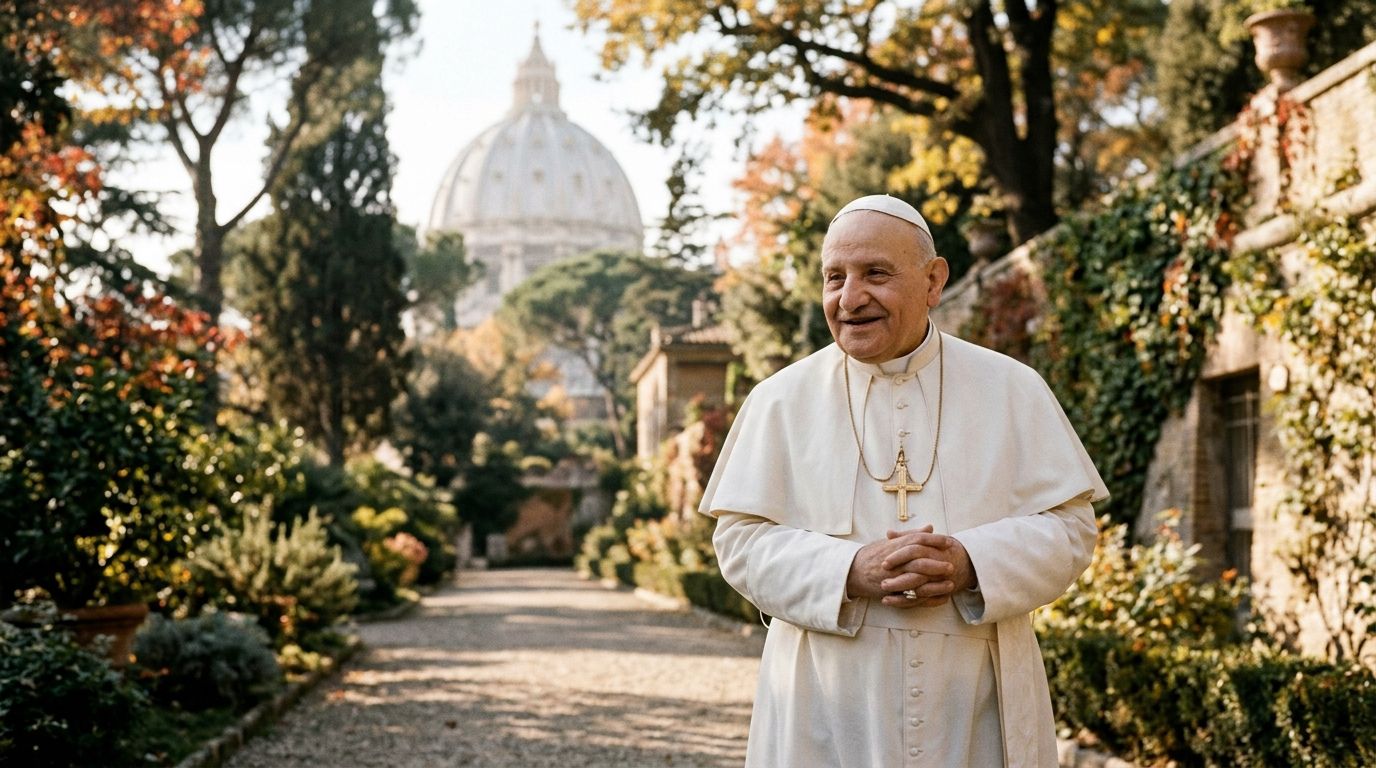
The Good Pope Who Opened Vatican II
The Church honours Saint John XXIII on October 11, the day he opened the Second Vatican Council in 1962. That date has just passed in 2026. However, another milestone comes next week, because the cardinals elected him Pope on October 28, 1958. Therefore, this is a fitting moment to look again at his life. Moreover, few popes have won as much affection from ordinary people.
Saint John XXIII was born Angelo Giuseppe Roncalli on November 25, 1881. His family lived in Sotto il Monte, a village near Bergamo in northern Italy. They were poor sharecroppers, and Angelo was one of thirteen children. Even so, his parents filled the home with prayer and kindness. As a boy, he showed unusual piety and intelligence. Consequently, a local priest helped him enter the seminary in Bergamo.
He received ordination as a priest on August 10, 1904. Afterwards, he served as secretary to his bishop, Giacomo Radini-Tedeschi, who taught him a great deal about pastoral care. Then the First World War broke out. During that conflict, Roncalli served as a medic and later as a military chaplain. Thus, he saw suffering at first hand. These experiences shaped his lifelong love of peace.
Later, the Holy See sent him abroad as a diplomat. For example, he served in Bulgaria, Turkey and Greece, and later in France. In every post, he made friends easily and listened with respect. Likewise, he built bridges with Orthodox Christians and people of other faiths. In 1953, Pope Pius XII made him a cardinal and patriarch of Venice. Meanwhile, he kept the simple manners of a country priest.
Then came the great surprise. Pope Pius XII died on October 9, 1958. After eleven ballots, the cardinals elected Roncalli on October 28, at the age of seventy-six. Many expected a short and quiet reign. However, he chose the name John XXIII and soon changed that expectation. On January 25, 1959, he announced his plan for an ecumenical council. In addition, he called a diocesan synod for Rome and began a revision of canon law.
The Second Vatican Council opened on October 11, 1962. In his own words, the Pope wanted to “throw open the windows of the church”. He hoped the Church would speak to the modern world with mercy rather than condemnation. Furthermore, he invited observers from other Christian communities. He also enlarged the College of Cardinals and made it more international. Consequently, the Council became a global event, and it continued until 1965.
His concern for peace also reached world leaders. In October 1962, the Cuban missile crisis pushed the world close to nuclear war. On October 25, he broadcast an appeal on Vatican Radio for peace. Many believe that his words influenced John Kennedy and Nikita Khrushchev. Later, on April 11, 1963, he issued the encyclical Pacem in Terris. In it, he addressed all people of goodwill and defended human dignity and human rights.
Sadly, his health failed soon afterwards. He died of stomach cancer on June 3, 1963, before the Council ended. Pope Paul VI continued the work. Pope John Paul II beatified him on September 3, 2000. Workers then found his body incorrupt, and the Church moved it to the altar of Saint Jerome in Saint Peter’s Basilica. Finally, Pope Francis canonised him on April 27, 2014, together with Saint John Paul II. In fact, Francis waived the usual second miracle.
Today, many call him “the Good Pope” because of his warmth and humour. In 2014, Pope Francis added his optional memorial to the General Roman Calendar. To read more, visit the Southern Cross profile.
In conclusion, Saint John XXIII shows that humility can change history. He began as a poor farmer’s son, yet he opened the Church to a new age. Likewise, he reminds us that kindness is a strong form of leadership. Therefore, let us ask for his prayers. May we, too, work for peace with open hearts.
Leave a Reply